
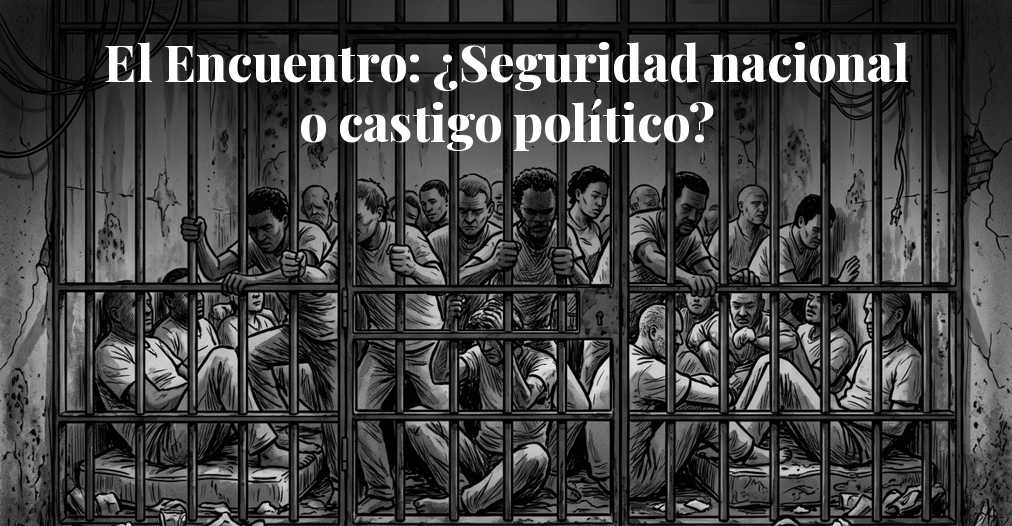
The following article written by Daria and entitled "El Encuentro: National Security or Political Punishment?", was published in the September 2026 issue of El Pueblo, the organ of the Communist Party of Ecuador.
Communist Party of Ecuador on new prisons
When Daniel Noboa’s government inaugurated the so-called “Encounter Prison” in Santa Elena, the official narrative was unequivocal: it was a maximum-security facility designed, at least according to the government’s discourse, to neutralise the influence of the leaders of Organised Crime Groups (GDOs). This was the central promise of the security model that had been implemented since early 2024, following the declaration of an internal armed conflict.
However, less than two years after its controversial launch, reality presents a radically different picture. Within a few months of its inauguration—which appeared more like a publicity strategy than a genuine response to the country’s security crisis—the complex was transformed into a disturbing instrument of extreme isolation, systematic violations of human rights and constitutional guarantees, as well as a tool for persecuting political dissent against the regime.
One of the most visible faces of this troubling development is Omar Campoverde, a social leader, president of the “Nelson Mandela” Committee of Persons Deprived of Liberty and member of the Guevarist Movement Tierra y Libertad. His case exposes the workings of a system that appears to confuse the fight against crime with the suppression of critical political thought and the legitimate demands of the most vulnerable groups.
On 17 December 2025, Campoverde was transferred to the Encounter Prison abruptly, without a final and enforceable conviction against him and without prior notification. In light of the background to the case, it is clear that this move was not based on technical assessments of dangerousness, but rather constituted open state retaliation for his activist work demanding dignified conditions in prisons.
Campoverde, together with Gabriela Gallardo and Carlos Carguachi, has remained in the limbo of pre-trial detention since May 2022. The accusations of “organised crime” and “human trafficking” against them were, paradoxically, based on extraordinary evidence: political theory books, flags and popular-education materials seized during violent raids.
What is happening inside El Encuentro borders on horror and appears to take us back to the days of the old dictatorships. During an appeal hearing several months ago, Omar Campoverde managed to turn on his microphone and describe a “regime of terror”: absolute isolation, the denial of communication with his lawyers and severe deprivation of food.
But the most serious allegations concern physical torture and sexual violence. According to a subsequent testimony given during a habeas corpus action, after identifying himself as a “political prisoner” and refusing, under threats, to accept claims that he had links to criminal mafias, Omar was taken to a hidden area inside the same facility. There, state agents allegedly subjected him to systematic beatings, electric shocks, controlled drowning and sexual violence in order to force him to make a false confession that he belonged to organised-crime groups.
The Campoverde case is not an isolated incident or an anomaly within the system. Rather, it is the starkest expression of a pattern of political use of El Encuentro that has already been documented by human-rights organisations.
Other social leaders and opponents who had become inconvenient to the regime have been transferred to the same prison under the same justification of “high dangerousness,” without technical reports to support such decisions. In all these cases, the same script is repeated: disproportionate charges of organised crime; nighttime transfers without notification to family members; prolonged incommunicado detention; and the imposition of the orange uniform as a public mark intended to morally discredit the adversary and equate social protest with organised crime.
El Encuentro is therefore ceasing to be a prison for criminal bosses and revealing itself as a centre of exemplary punishment, where those whom the authorities wish to make invisible are sent.
Ecuador now faces an ethical and legal crossroads. When the prison system is used as a laboratory of repressive control to silence protest, security ceases to be a public good and becomes tyranny.
The case of Omar Campoverde is the ultimate test: if the state does not investigate transparently and punish those responsible for torture, the Encounter Prison will not be remembered as the end of the mafias, but as the mausoleum of the so proudly named Constitutional State of Rights.