
The following article written by Manuel Sutherland and entitled "Venezuela has world’s highest inflation yet the government persists in its failure" was published on 13 September in Tribuna Popular, organ of the Central Committee of the Communist Party of Venezuela.
Communist Party of Venezuela on Venezuelan economy
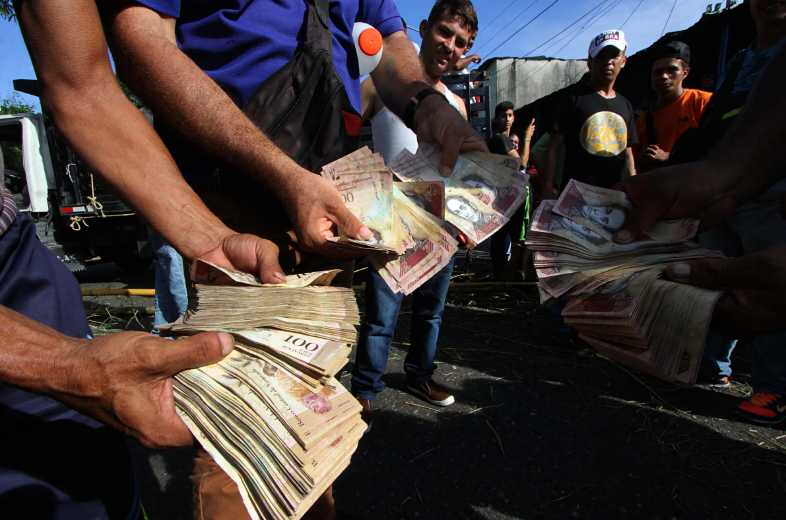
Venezuela’s year-over-year inflation, measured between July 2025 and July 2026, reached a staggering figure of 576%, which is substantially higher than the International Monetary Fund’s estimate of 387%. With this result, the country solidifies its position as having the highest inflation on the planet. The other nations in the top 10 range from 19% to 75%. For nearly a decade, Venezuela has held the dismal record of having the highest inflation in the world, including a four-year period of hyperinflation that stands as the third-longest in contemporary economic history.
Following the military conquest of January 3, 2026, there was a possibility of a substantial economic turnaround that has emerged. Dozens of U.S. analysts who exercise de facto neocolonial control over Venezuela’s economy and politics—promoted stabilization as a priority within a three-phase program as the first stage of the democratic transition process they sought to impose on the Bolivarian regime by force. In theory, the plan aimed to restore the institutional functioning of politics and the economy and granting the latter an absolute priority. However, in these first seven months under U.S. tutelage, monetary, economic, and exchange rate policies inherited from Nicolás Maduro have remained intact, although all the proceeds from oil sales are administered by the State Department and transferred to the country solely through a monthly budget for expenditures and foreign currency settlements at the interbank exchange desks.
This iron-fisted U.S. domination, backed by an interim government whose collaborationism —evoking Admiral Pétain in Vichy—has run up against a formidable barrier: the inertia of Chavista economic policy over the past 13 years. As if nothing had happened, the flagrant violations of economic, social, cultural, and environmental rights persist. The erosion of real wages and elimination of pensions continues. Monetary issuance without any backing in the real economy persists. The private appropriation of oil revenues through an overvalued exchange rate deepens. The financial and tax stranglehold against any honest attempt at productive entrepreneurship is perpetuated. Added to this is the deliberate policy of censoring and suppressing official economic and financial statistics, which makes administrative opacity the most efficient tool for corruption. Clearly, if these practices continue, the most likely outcome is the continuation of the chronic crisis and long-standing poverty that are plunging the nation into underdevelopment.
Inflation in 2026 has proven exorbitant, higher than in recent years
The year-over-year inflation rate of 576% is the highest recorded by Venezuela in the last five years, nearly 12 times higher than in 2024, a year in which stricter sanctions were in place. This figure underscores the failure of price control despite the extremely restrictive wage freeze imposed in May 2022, the last month a minimum wage increase was enacted.
The fact that Venezuela’s inflation is 24 times higher than Haiti’s underscores the severity of the monetary disaster. The monthly inflation rate of 19.9% in July 2026 is approximately equivalent to Bolivia’s total annual inflation rate, the ninth highest on the planet. In light of this situation, it is imperative to investigate the root causes of this phenomenon and find solutions to overcome a scourge that is impoverishing an already impoverished working class.
The cause of inflation is endogenous
Despite the strict surveillance and rigid controls that the U.S. exercises over the export of oil and minerals, the government continues down the path of the most grotesque monetary disaster with renewed vigor. Domestic economic management is essentially the same as in previous years but with greater recklessness in issuing unbacked currency. Some of the current problems can be attributed to the financial inertia of the previous fiscal year. However, examining the cumulative inflation between January and July of 2026, which stands at 175.5%, reveals that it is once again the highest in the world, at 10 times the rate of Argentina and 12 times the rate of Cuba, the latter of which has faced considerable tightening of U.S. sanctions over the past year.
Cumulative Trends (December 2025 – July 2026)
According to available data:
- The National Consumer Price Index (INPC) increased by about 175% between December 2025 and July 2026.
- The monetary base (MB) expanded by about 125% over the same period.
Cumulative inflation exceeded the growth of the monetary base. This behavior is consistent with an elasticity greater than one and an increased velocity of money. In other words, the stock of bolivars increased, and each monetary unit circulated more rapidly as economic agents sought to dispose of it at an accelerated pace by exchanging it for foreign currency or goods and services. Gresham’s law, which states that «bad money drives out good money,» operates to the fullest extent when two means of payment coexist with an identical nominal legal value but different real intrinsic value. Consequently, the public prefers to hoard foreign currency and quickly dispose of «bad» money. This pattern is characteristic of periods in which confidence in the currency deteriorates or remains at critical levels. Economic agents do not react only to the amount of money already issued, but also to the expectation that unbacked issuance will continue indefinitely.
When observing the monthly variations in the CPI and the M1 money supply, an evident positive relationship emerges, though it is not perfectly synchronous from month to month, which is a normal phenomenon attributable to lags and seasonal or supply factors:
- In the months of greatest relative monetary expansion (January, March, and May), significant variations in the CPI are also recorded.
- July shows a sharp acceleration in the M1 money supply (+19.9%) despite a more moderate expansion of the MB (+4.3%). This behavior can be attributed to lags from previous money supply expansions that materialize with a delay.
- Supply-side factors, such as food prices, the parallel exchange rate, and utility rates.
- A possible further deterioration in expectations during that specific month.
However, the medium-term relationship remains extremely strong, as evidenced by the coefficient of determination (R²) of 0.93. Figure 1 plots the logarithms of both variables, their linear correlation, and the trend line illustrating their joint evolution.
The results reinforce several conclusions relevant to analyzing the Venezuelan economic situation.
1. The monetary base continues to be the main driver of the price level during the period analyzed. Any stabilization effort that does not credibly and sustainably control the expansion of the monetary base will have limited effects.
2. The margin for «financing» public spending through currency issuance is extremely narrow. Given that prices react almost one-to-one (and even with slight amplification), the real seigniorage that can be obtained is low and erodes rapidly.
3. Expectations are poorly anchored. Elasticity close to unity and the high R² suggests that economic agents interpret changes in liquidity as the dominant signal for setting prices.
4. The problem lies not only in quantity, but also in the monetary regime. As long as the perception persists that the monetary authority will accommodate fiscal policy or liquidity needs of the system, the relationship between the monetary base and inflation will remain in effect.