
Gandhi Sheikho from the Syrian Communist Party assessed the recent protests in Syria, as "Not Merely a Fuel Crisis."
Syrian Communist Party on recent protests
The late Dr. Ammar Bakdash, Secretary-General of our Syrian Communist Party, once said:
“The country may witness major social upheavals. The popular mood will quickly shift and change under the impact of the misery of daily life. Empty refrigerators will have more impact than what television broadcasts in the form of speeches saturated with calls to the unseen, which neither feed the hungry nor ever lead to an improvement in the living conditions of the popular masses.”
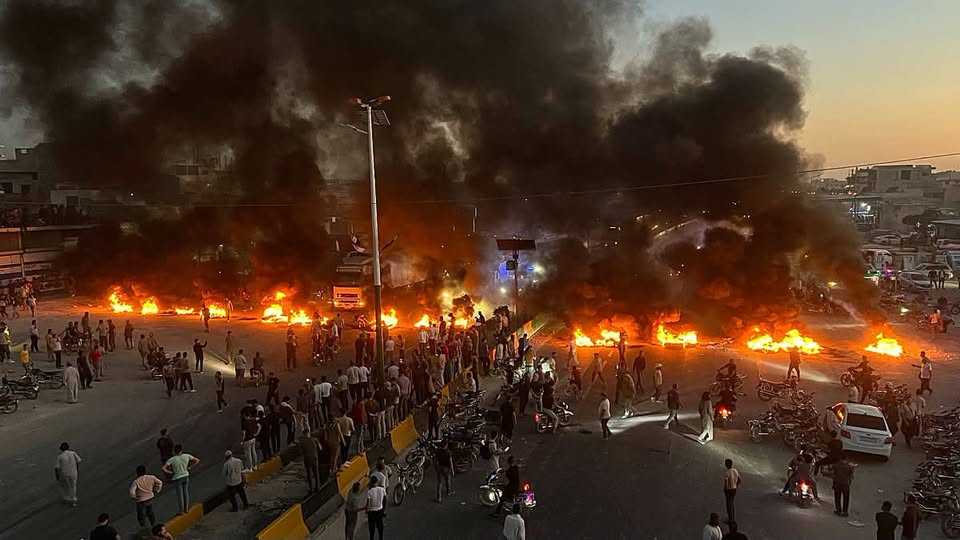
On the highways in Aleppo, protesters stopped oil tankers by throwing stones at them. In Idlib, a young man poured gasoline over his body and attempted to set himself on fire in protest against the collapse of livelihoods. These are not scenes of a returning war; rather, they are the real picture of a wave of protests sweeping through more than ten Syrian governorates following the sharp rise in fuel prices.
If national and political concessions are served up cold and presented as victories, the rising cost of living has reached directly into the kitchens of ordinary Syrian families, setting the streets ablaze…
When the authorities announced a 40% increase in the price of diesel and a rise in the price of gasoline by more than a quarter, the burden placed on citizens could no longer be eased by grandiose speeches about forthcoming investments and promises of “reconstruction.” Instead, it has made itself felt in the cost of a gas cylinder and a litre of diesel—in the cost of daily survival in its simplest form.
The immediate trigger for these protests is clear and specific. The Syrian Ministry of Energy announced the increases: the price of diesel rose from 125 Syrian pounds per litre to 175 pounds, an increase of 40%; 95-octane gasoline rose from 152 pounds to 195 pounds, an increase of approximately 28%; and even the domestic gas cylinder, the most basic of household necessities, did not escape the increase, with its price rising by around 9%.
The authorities justify this by describing the measures as “temporary,” attributing them to fluctuations in the global energy market and Syria’s heavy dependence on imports. Ministry of Energy officials say the reasons include the blockade of the Strait of Hormuz, the Russia-Ukraine war and tensions in global supply chains. They also point to limited domestic refining capacity, with the Baniyas refinery undergoing comprehensive maintenance for three months, forcing the government to balance costs against the selling price. What they deliberately overlook here is that Syria is an oil-producing country and that the people cannot be made to pay as though all their needs were priced on global stock exchanges.
But in any case, this technical explanation has failed to calm the anger in the streets.
The key to understanding these protests lies in seeing the human reality behind the figures.
Estimates by the United Nations Development Programme indicate that around 90% of Syrians live below the poverty line, whereas the figure was only around one-third before the outbreak of the events in 2011. Against a backdrop of almost completely stagnant incomes, any increase in the prices of basic goods means catastrophic pressure.
A taxi driver says passengers have begun complaining about higher fares, while what he cannot explain to them is that the cost of fuel is eating into his already meagre income. He added: “Tomorrow the prices of vegetables will rise, and everything will go up. We have no solution. Should we steal? We cannot do that.”
These words reveal a reality concealed by abstract economic data: in the current Syrian context, the price of fuel is not merely the price of fuel. It is the baseline cost of transportation, a hidden tax on food prices, and the only hope for heating in winter. When the price of diesel rises, the cost of transporting flour to bakeries rises; hospital generators are disrupted; pumps stop lifting water to upper floors. The entire fragile chain of life is hanging from the same rope that is now fraying and breaking.
Faced with the pressure of survival, the effectiveness of metaphysical narratives and televised speeches becomes extremely limited. When the household refrigerator is empty, all the “lofty speeches” appear pale and meaningless.
At a protest site in Aleppo, one demonstrator said: “The border crossings generate millions of dollars every day. We do not want a roundabout or a shopping centre; we just want to live.”
The statement is shocking in its frankness. It expresses a simple logic that allows no argument: the ultimate criterion for the legitimacy of authority does not lie in the eloquence of its rhetoric, but in the ability of the ordinary family table to endure.
The power of “refrigerator politics” lies in the fact that it is non-negotiable. You may be able to wrap concessions in the realm of geopolitics in claims of victories at international meetings, and debate the articles of a constitution. But when a mother discovers that she cannot afford to buy gas to cook a dish of lentils for her children, all those discussions lose their meaning. She takes to the streets, not because someone has incited her, but because the biological drive to survive is what moves her.
International media have described these protests as “the broadest since the fall of the previous regime.” From the Aleppo and Idlib countryside in the north, to Deir ez-Zor and Hasakah in the east, and all the way to Sweida in the south, the demonstrations have covered almost all of Syria’s major geographic regions.