
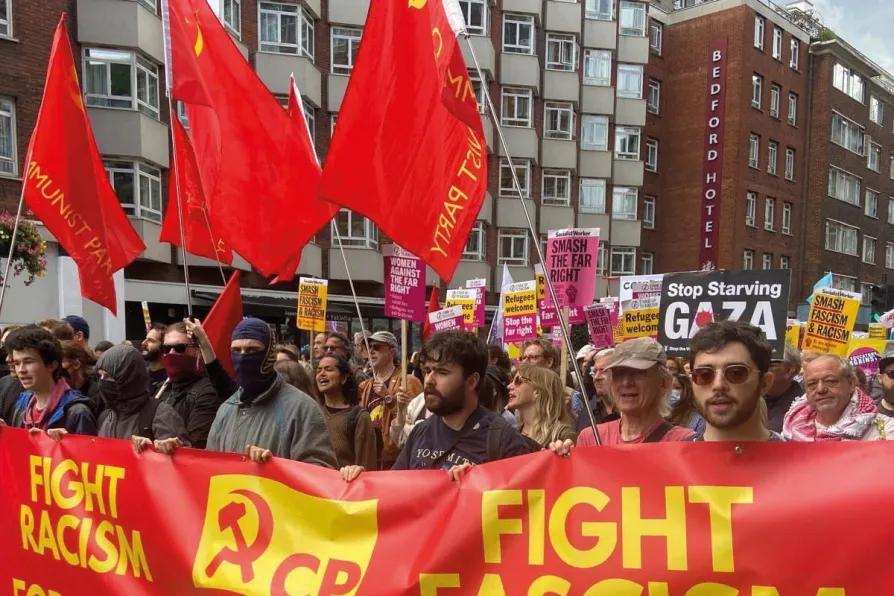

The Communist Party of Britain (CPB) took part in the 90th anniversary mobilisation marking the Battle of Cable Street in London on Sunday, 4 October, presenting the commemoration as both a tribute to the anti-fascist resistance of 1936 and a call for renewed working-class organisation against racism and fascism.
Communist Party of Britain mobilises for anniversary of Cable Street
The anniversary march, in which thousands of people participated, assembled at Tower Hamlets Town Hall before proceeding to Cable Street, followed by speeches, music and poetry at St George's Gardens. Trade unions, community organisations and anti-racist groups participated in the event, including Unite and the RMT. The RMT reported that one of its representatives addressed the rally.
For the CPB, however, the significance of the anniversary goes beyond historical commemoration. In its appeal for the 4 October mobilisation, the party described Cable Street as “one of the most important moments in our movement's history” and argued that the anniversary should serve as a “call to action for the present day.” It urged every CPB member to become actively involved in building the mobilisation and promoted the slogan “They did not pass — They shall not pass.”
The party's Anti-Racism and Anti-Fascism Commission and Party History Group organised the CPB's campaign around the anniversary. Members were instructed to publicise the march through trade-union branches, community organisations and their own networks, while the party also promoted the official Cable Street 90 social-media campaign.
The CPB places particular emphasis on the role of the communist movement in the original 1936 mobilisation. The party's historical narrative centres on the participation of the Communist Party of Great Britain and the Young Communist League in organising resistance to Oswald Mosley's British Union of Fascists. Communist organiser Phil Piratin, who was active in Stepney, is particularly associated with this history. Contemporary accounts also document the role of communist loudspeaker vans and Young Communist League activists in mobilising people along the proposed route of the fascist march.
The CPB therefore presents the 1936 experience as an example of working-class unity across different communities. The original mobilisation brought together Jewish and Irish workers, trade unionists, communists and other East End residents against Mosley's attempted march. Unite's account of the anniversary similarly stresses the participation of the Jewish community and organised labour, while contemporary historical accounts identify communist organisers among those who helped build the resistance.
The CPB's message is that this history retains contemporary relevance. Its appeal argues that the slogan “They shall not pass” remains applicable and that the spirit of Cable Street should be reflected in an organised response to racism and fascism today. The party consequently encouraged its members not simply to attend the anniversary but to use it to strengthen links with trade unions, community organisations and wider anti-racist activity.
The anniversary mobilisation took place within a broader programme of events. The TUC held a conference on 2 October examining the historical lessons of Cable Street, while trade unions including RMT and Unite organised their own participation in the anniversary weekend. The TUC described the 2026 commemoration as a commitment to action rather than simply a heritage event.