
The member of the Political Bureau of the Communist Party of Cuba and Prime Minister, Manuel Marrero Cruz, informed the National Assembly of People's Power about the progress of the implementation of the Economic and Social Transformations, on the first month of their implementation.
Image
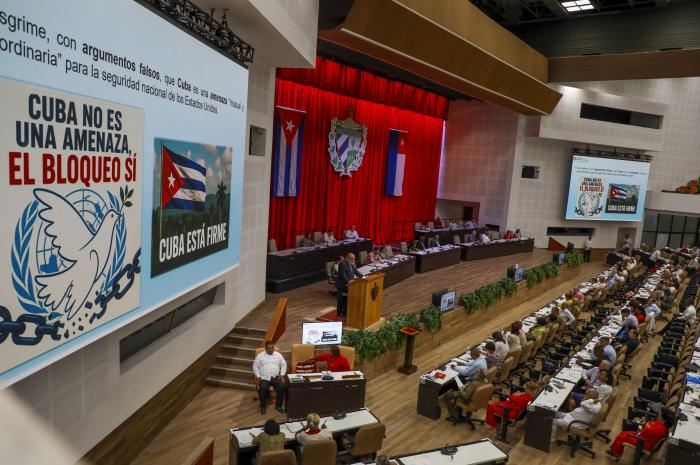
Prime Minister updates Cuban Parliament on implementation of economic and social transformations
Cuban Prime Minister on implementation of transformations
Cuban Prime Minister Manuel Marrero Cruz presented a report to the National Assembly of People's Power on the first month of implementing the government's Economic and Social Transformations, describing them as the most comprehensive modernization of Cuba's economic and social model to date. According to Granma, he argued that the reforms are being implemented under exceptionally difficult conditions due to the intensification of U.S. sanctions, but maintained that they are essential to strengthening Cuba's socialist system, stimulating production, improving public services, and protecting vulnerable groups.
Impact of U.S. Sanctions
Marrero opened his report by emphasizing that the country's economic difficulties have been aggravated by the tightening of U.S. policy toward Cuba. He highlighted the implementation of Executive Order 14404, effective since May 1, which introduced secondary sanctions against foreign companies and individuals conducting business with Cuba. According to the Prime Minister, these measures have disrupted trade and affected key sectors including energy, agriculture, tourism, finance, healthcare, and foreign trade. He noted that several major shipping companies had suspended cargo operations to Cuba, leaving shipments of food, medicines, solar panels, and other essential goods stranded in nearby ports. He rejected the U.S. justification for the sanctions, describing it as based on false claims that Cuba constitutes a threat to U.S. national security.
Progress in Implementing the Reform Program
The Prime Minister explained that the reform package approved by the National Assembly in June was subsequently revised to incorporate recommendations from Party leaders, economists, academics, and members of parliament. Of 171 proposals submitted by deputies, 165 were incorporated into the implementation process.
Implementation has been supported by detailed planning, specialized working groups, legal reforms, and nationwide training for Party and government officials. A legislative timetable covering 138 legal norms has been established to support the reforms.
According to Marrero, of the 121 transformations scheduled for June and July, 110 had already been approved (90.9%), with another five partially approved. Most of the remaining reforms are expected to be completed by September, while a small number are scheduled for November.
Reform of State Enterprises
A central element of the reform program is the modernization of Cuba's state enterprise system. New legislation grants state enterprises significantly greater managerial autonomy, allowing them to:
- establish their own wage structures;
- determine prices and tariffs;
- make financial investments;
- distribute profits more flexibly;
- decide on employment termination; and
- cooperate more closely through business groups.
Restrictions on performance-based wage systems have also been removed, with salary increases now linked only to each enterprise's financial capacity. However, enterprises operating at a loss will not be permitted to exercise these new powers. The reforms are intended to increase efficiency while maintaining socialist state ownership.
Expansion of the Non-State Sector
Marrero reported substantial liberalization affecting Cuba's non-state economy.
All pending applications for micro, small and medium-sized enterprises (MSMEs) and non-agricultural cooperatives meeting legal requirements have been approved, bringing the total number of such entities to over 15,000.
New legislation simplifies the creation and operation of private businesses by reducing bureaucratic procedures. In addition, a new decree removed prohibitions on 46 economic activities and partially relaxed restrictions on another 36, significantly expanding opportunities for private economic activity.
The government argues that these measures will increase production and improve the supply of goods and services while remaining within Cuba's socialist framework.
Government Administration and Decentralization
The report outlined reforms intended to streamline the state administration.
More than 92,000 unfilled positions within several ministries—including Health, Education, Culture, and Sports—have been eliminated as part of an effort to reduce bureaucracy and separate governmental from business functions.
The government has also expanded the powers of municipalities, allowing greater local control over development funds and strengthening territorial decentralization. Updated regulations also seek to improve community services and territorial development planning.
Energy Policy
Addressing Cuba's continuing electricity shortages and blackouts, Marrero acknowledged the seriousness of the situation while highlighting measures intended to diversify energy sources.
He reported:
- installation of 1,464 MW of renewable energy capacity;
- deployment of over 4,000 photovoltaic systems in public institutions and isolated communities;
- distribution of more than 11,000 solar systems to vulnerable households and selected professionals;
- tax incentives for renewable-energy investments;
- authorization for private businesses and foreign companies to import and market fuels.
The government hopes these measures will gradually reduce dependence on conventional electricity generation and improve energy security.
Agricultural Reform
Four of the five planned agricultural reforms have already been approved.
These include:
- more flexible land-use regulations;
- updated cooperative policies;
- new incentives for agricultural producers; and
- legislative reforms governing agricultural and forestry land.
The objective is to increase food production and improve agricultural efficiency.
Social Protection
Marrero emphasized that protecting vulnerable groups remains central to the reform process.
Authorities have identified approximately 876,500 people living in the most vulnerable conditions.
Among the new measures:
- an online social assistance application system has been created;
- tax incentives encourage employment of persons with disabilities;
- community services are being strengthened through greater participation of different economic actors.
The Prime Minister stressed that every economic reform must be evaluated according to its social impact.
Wage Reform
Beginning in August, Cuba will implement wage increases costing approximately 42.5 billion pesos annually.
The minimum wage will rise to 3,210 pesos, applying across all sectors whenever workers currently earn less than that amount.
Marrero acknowledged that the increase remains insufficient but argued it represents a necessary step to improve the incomes of workers providing essential public services.
Financial and Monetary Reforms
The government introduced several measures affecting finance and foreign currency management.
These include:
- simplified procedures for opening foreign-currency accounts;
- permission for non-state actors to deposit and withdraw foreign currency;
- authorization for international payments from these accounts;
- removal of certain Central Bank approval requirements;
- expansion of digital payment systems;
- approval of private foreign-exchange houses under Central Bank licenses.
The government also approved reforms to taxation, including replacing the sales tax with a value-added tax (VAT), introducing accelerated depreciation for productive investment, and decentralizing price-setting authority while strengthening inspection mechanisms.
Foreign Investment
Marrero reported significant changes aimed at attracting foreign investment.
Among the reforms:
- amendments to the Foreign Investment Law;
- authorization for foreign companies to hire Cuban workers directly;
- greater flexibility for partnerships between foreign investors and non-state Cuban entities;
- approval of foreign investment in commerce, real estate, healthcare, and tourism.
He also announced the country's first Economic Development Zone dedicated to a wholly foreign-owned health tourism company.
Tourism
The Prime Minister acknowledged that tourism has been severely affected by fuel shortages and sanctions.
He reported that:
- 73% of tourism facilities have been closed;
- seven international hotel chains have withdrawn from Cuba.
To revive the sector, the government has approved new business models, tax incentives for ecotourism, expanded private participation in transportation and travel services, and certification systems for tour guides and travel agents.
Transport, Commerce, Insurance and Digital Economy
Additional reforms include:
- liberalization of vehicle imports and transfers;
- encouragement of electric mobility;
- modernization of domestic trade;
- easing commercial licensing;
- creation of neighborhood markets;
- reforms to public procurement;
- expansion of insurance products;
- mandatory civil liability insurance for vehicle owners;
- authorization for private companies to operate data centers.
The government also announced the creation of a digital monitoring platform that will track implementation of all reforms and evaluate their impact in real time using artificial intelligence.
Marrero concluded that the legal and organizational preparation phase had largely been completed and that the principal challenge now lies in effective implementation. He emphasized the need for continuous monitoring, evaluation, and adjustment of the reforms while expressing appreciation for the resilience of the Cuban people during a period of severe economic hardship.
Rejecting suggestions that the reforms represent a departure from socialism, he argued instead that they are intended to strengthen and consolidate Cuba's socialist model by increasing efficiency, expanding productive capacity, improving public services, and preserving social protection despite the impact of external sanctions.
(Photo: José Manuel Correa)