
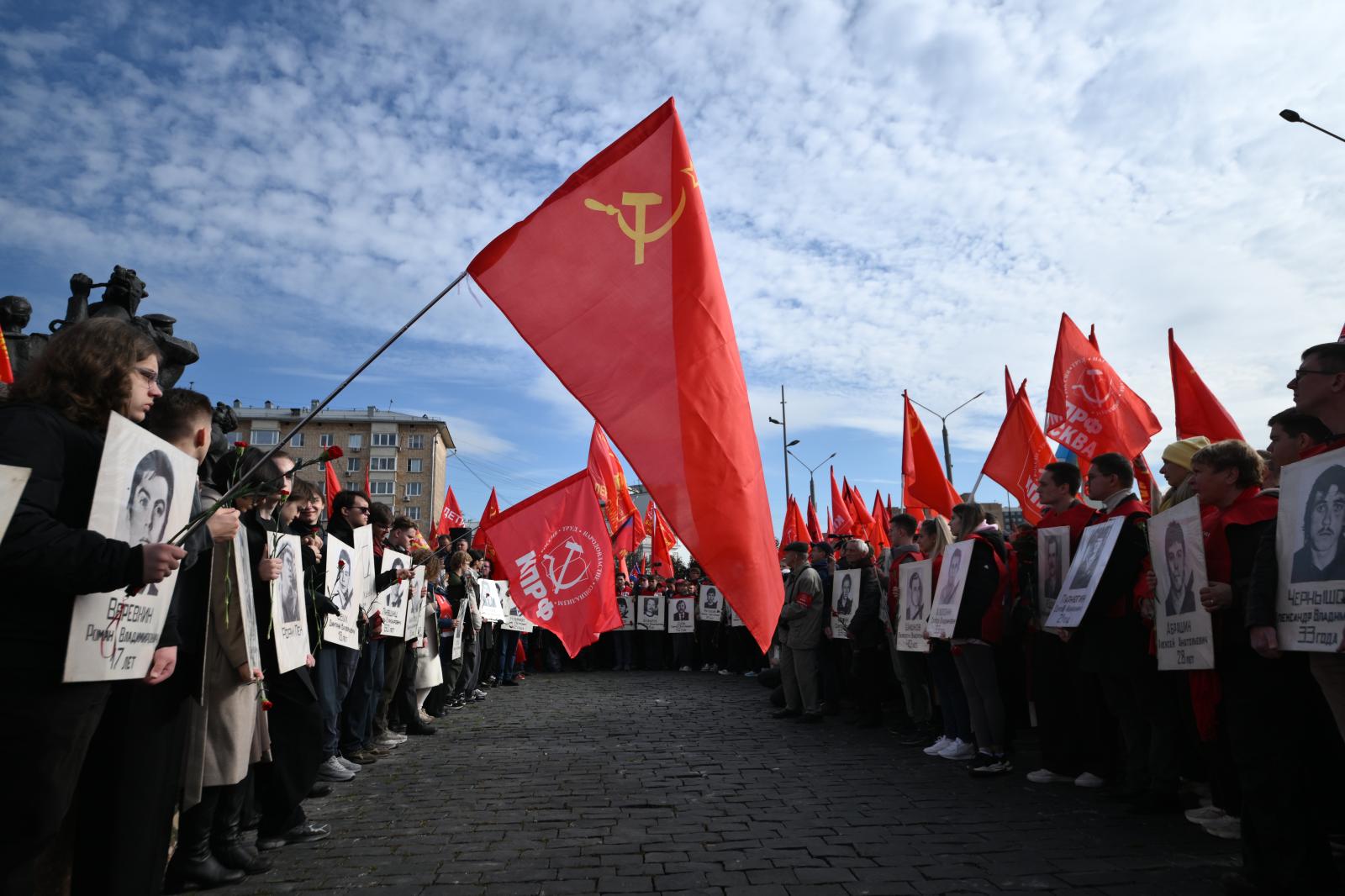
The Communist Party of the Russian Federation (KPRF) devoted much of its activity on 3–4 October to commemorating the 33rd anniversary of the violent confrontation in Moscow in October 1993, when the conflict between President Boris Yeltsin and the Russian parliament culminated in the shelling of the Supreme Soviet building. Demonstrations were held across Russia and there were detentions at the end of the demonstration in Moscow.
KPRF marks 33rd anniversary of October 1993 across Russia
The party organised memorial events, information pickets, flower-laying ceremonies and public discussions in Moscow and a number of Russian regions. KPRF's central website announced a major demonstration, street procession and wreath-laying ceremony in Moscow for 4 October at the memorial known as the “Poklonny Cross,” dedicated to those who died defending the House of Soviets.
In Moscow, KPRF's Moscow City Committee and allied organisations held a memorial ceremony on 3 October near the Ostankino television centre, where people were killed during the clashes of 3 October 1993. The event included a religious memorial service and the laying of flowers. KPRF Moscow City Duma faction leader Nikolai Zubrillin addressed participants and linked the events of 1993 to the subsequent political and economic development of Russia.
During the concluding part of the action, police began making arrests. The KPRF reported that approximately 60 people, predominantly young participants, were placed in police vans and taken to several police stations. Some were subsequently released. The party said that its representatives were working to secure the release of the remaining detainees and that the Moscow City KPRF organisation, with support from the Central Committee, would provide them with assistance. During the march, the protesters began chanting political slogans, shouting "Down with Roskomnadzor!", "No to political repression!", and "Freedom for political prisoners!" According to former Moscow City Duma deputy from the Communist Party of the Russian Federation, Yevgeny Stupin, the slogan "Down with the Tsar!" was the pretext for the mass arrests.
In Samara, KPRF activists conducted individual street pickets on 3 October commemorating those who defended the Supreme Soviet. Party activists spoke with passers-by about the events and distributed information. The Samara organisation described 3–4 October 1993 as a period of acute political confrontation that ended with the use of armed force against the parliament.
In Tambov, communists organised an information picket on 3 October under the slogan “October 1993: memory to the dead, shame to the executioners!” The event was opened by Andrei Zhidkov, first secretary of the Tambov regional KPRF committee. Participants observed a minute of silence and held placards commemorating those who died defending the Supreme Soviet. The party also reported that similar memorial events had taken place in towns and district centres across the Tambov region.
The commemorations extended beyond these three locations. In Novosibirsk, flowers were laid at the Heroes of the Revolution Square in memory of those who defended the Supreme Soviet, with regional KPRF leader Anatoly Lokot speaking about the significance of the events. In Kursk, the regional organisation held a round-table discussion on the October 1993 confrontation, while in Cherkessk local communists held their 33rd annual commemoration.
Other activities were reported in Lipetsk, Penza and Saratov. In Lipetsk, activists held individual pickets on 3–4 October. In Penza, KPRF members, Young Communist League activists and other left-patriotic forces held a memorial event and laid flowers. In Saratov, a 4 October memorial ceremony was held under the slogan “We will not forget! We will not forgive!”
Across these events, KPRF speakers presented the October 1993 confrontation as a decisive political turning point. The party characterises Yeltsin's dissolution of the parliament and the subsequent military assault on the House of Soviets as an unconstitutional coup and associates the events with the political and economic course that followed the collapse of the Soviet Union.
The commemorations therefore combined remembrance of those killed in 1993 with broader criticism of the post-Soviet political order. In several of its regional statements, KPRF argued that the consequences of the 1993 confrontation included the subsequent privatisation programme, social inequality and the dismantling of Soviet-era institutions.