
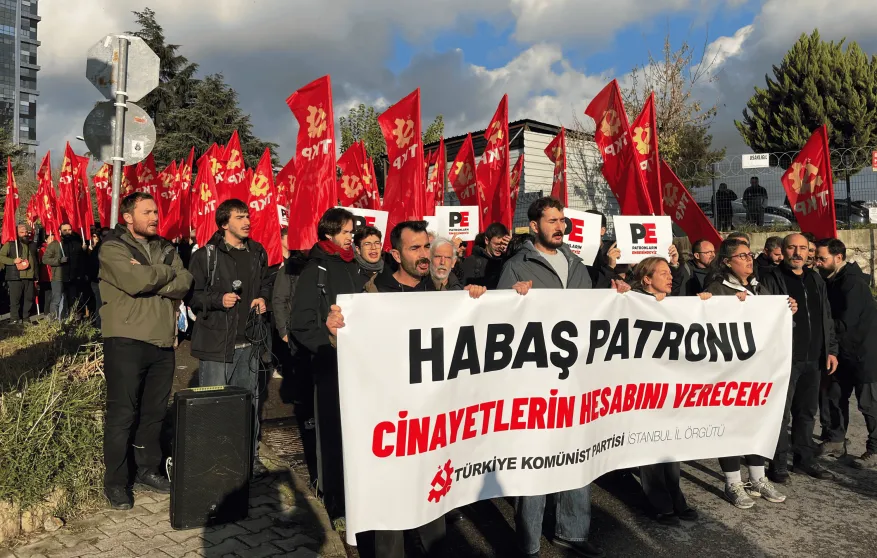

The Communist Party of Turkey (TKP) staged a protest outside the headquarters of the HABAŞ conglomerate in Istanbul on 10 November, demanding that the company’s owners be held accountable for the deaths of workers in the devastating explosion at its iron and steel plant in Aliağa, İzmir. The party also issued a statement calling for the immediate and uncompensated nationalisation of all enterprises belonging to HABAŞ.
NEW: TKP protests outside HABAŞ headquarters and demands nationalisation following factory disaster
The protest was organised by TKP’s Istanbul Provincial Organisation outside the company’s headquarters in Kartal. Demonstrators chanted slogans including “The HABAŞ bosses who kill workers will be held accountable” and “We will hold the owners accountable for the workers’ deaths.”
Addressing the protest, TKP Istanbul Provincial Chair Ahmet Dincel accused the company’s owners of escaping responsibility for a disaster caused by inadequate safety measures and the pursuit of profit.
“Here we are, standing in front of your headquarters! Where are the bosses? We have come to your door to remind you: you cannot escape without answering for this workplace crime. We will demand justice for our fellow workers who lost their lives,” Dincel declared.
He rejected the suggestion that the explosion was an unfortunate accident, describing it as the foreseeable consequence of inadequate oversight and the drive to maximise profits. Dincel placed the disaster within a wider pattern of workplace deaths in Turkey, stating that 1,509 workers had lost their lives in the first eight months of the year.
Calling on workers to organise against employers who exploit their labour and disregard their safety, he said the party would continue its campaign against HABAŞ and other major corporations through workplace and neighbourhood organising. Following the speech, demonstrators threw red paint at the company's headquarters building, chanting that the bosses would not be allowed to escape responsibility.
TKP demands nationalisation of HABAŞ
In a separate statement published on 10 November under the title “This Cruelty Must End”, TKP argued that the disaster was not simply the result of technical failures but a consequence of an economic system that places corporate wealth and profit above workers’ lives.
The statement recalled that another worker had died at the same factory in October and that the latest explosion, on 9 November, had claimed the lives of 18 workers according to the figures available when the statement was issued. It also criticised the factory management and state authorities for failing to provide timely and reliable information to workers’ families about the dead and injured.
TKP pointed out that HABAŞ operates not only in steel production but also in industrial gases and other sectors, employing thousands of workers and generating revenues worth billions. It said that workers at the Aliağa facility faced heavy working conditions and wages below the poverty line, while the company’s owner, Mehmet Rüştü Başaran, controlled enormous personal wealth.
The party warned that technical investigations and official reports risked concentrating responsibility on workers and selected managers while overlooking the underlying causes of the disaster: the pursuit of profit, inadequate safety conditions and the exploitation of labour. It also criticised the environmental impact of HABAŞ’s operations on the Bakırçay basin, arguing that the company was polluting the region’s air and water.
As its central demand, TKP called for all HABAŞ enterprises to be nationalised immediately and without compensation. Steel production, it argued, should serve the country’s development and public interests, with workers’ health and safety guaranteed and their labour properly remunerated.
The party concluded that no more workers should lose their lives to increase the wealth of corporate owners.
Continuing the campaign
The Istanbul protest followed an action by TKP’s İzmir Provincial Organisation in Aliağa on 9 November, immediately after the explosion. The party delegation had visited the factory and hospital to seek information and express solidarity with workers’ families. Speaking at a gathering in Aliağa, provincial chair Tuğçe Sezen Gedik described HABAŞ as “a factory that grinds people up” and pledged that the party would continue demanding accountability for every worker killed.
What happened
A major explosion and fire struck the HABAŞ iron and steel plant in Aliağa, İzmir, on 9 November 2026, killing at least 18 workers and injuring several others, according to reports published the following day. There are still workers missing. The disaster occurred during industrial operations involving the plant’s electric arc furnace. Initial accounts from the authorities and preliminary findings pointed to equipment failure and damage to gas and oxygen lines, but the precise sequence of events and the causes of the explosion remained under investigation.
The disaster took place against a background of serious concerns about working conditions and occupational safety at the factory. Workers have reportedly faced demanding shifts, inadequate safety precautions and repeated workplace accidents. Two other workers had died in separate incidents at the same facility in the preceding weeks: Hakan Doğan, who fell from a height on 21 October, and Eyüp Eğinli, who died on 5 November when a heavy-machinery tyre exploded during inflation. These incidents have intensified questions about safety standards, maintenance and the responsibility of the company’s management.
The explosion also highlights the wider problem of workplace deaths in Turkey, where inadequate inspections, unsafe working conditions and the prioritisation of production and profit continue to put workers’ lives at risk. The scale of the HABAŞ disaster has prompted demands for accountability from the company’s owners and for a thorough investigation into the circumstances surrounding the deaths. TKP has described the incident as a workers’ massacre, arguing that it was not an isolated accident but the consequence of a system that places corporate profits above workers’ health and safety.