
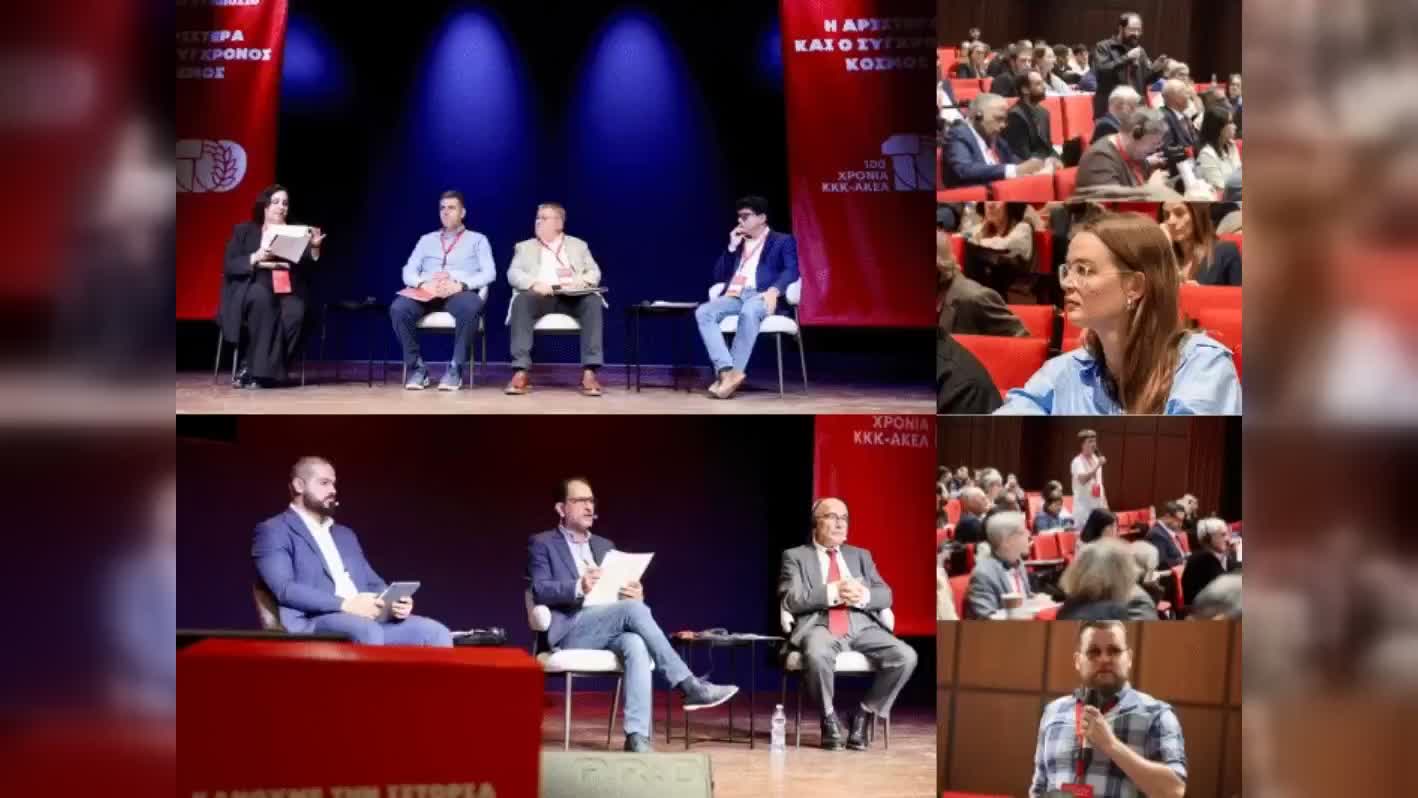
The Progressive Party of Working People (AKEL) brought together representatives of more than 35 communist, left-wing and progressive parties and organisations from around the world at an international symposium held in Nicosia on 7 November, as part of the celebrations marking the 100th anniversary of the founding of the Communist Party of Cyprus (CPC), the predecessor of AKEL.
Image
"The left must demonstrate in practice that an alternative to the existing system is possible."
AKEL Brings Together Left-Wing Parties at International Symposium Marking Its Centenary
Titled “The Left and the Contemporary World”, the symposium took place at the PEO Amphitheatre and brought together party representatives, political figures, academics and members of the workers’ movement. Its five thematic sessions addressed the crisis of contemporary capitalism, neoliberalism, international conflicts and militarisation, the rise of the far right, experiences of social transformation and the challenges confronting the European left.
Opening the proceedings, the Progressive Party of Working People (AKEL) General Secretary Stefanos Stefanou stressed the need to strengthen cooperation and coordination among left-wing forces internationally, particularly amid escalating geopolitical rivalries, armed conflicts and growing social inequalities.
Stefanou stated that the left must put forward a convincing alternative to policies that deepen inequality, weaken the welfare state and subordinate the needs of the majority to the profits of a few. He also highlighted the need to confront nationalism, racism, xenophobia and the rise of far-right and neo-fascist forces.
He emphasised that the left must connect its strategic vision with the everyday struggles of society, understand the changing needs of working people and develop concrete political proposals. Referring to AKEL’s century-long history, he described its enduring achievement as the ability to connect its values and aspirations with the daily struggles of the Cypriot people.
Neoliberalism, workers’ rights and the threat of war
The first session examined the consequences of neoliberal policies, the widening of social inequalities and increasing pressure on workers. Speakers highlighted the contradiction between rapid technological progress and the widening social divide, stressing the need to strengthen public services and social protection.
The second session focused on militarisation, international law and the prospects for peace. Participants underlined the importance of international law as a safeguard for smaller states and declared that it must be defended consistently, without double standards. Particular attention was given to the genocide in Gaza and the need for accountability without exceptions.
The discussion also addressed the contradiction between rising military expenditure in European countries and restrictions on social spending. Regarding Cyprus, speakers stressed the need for an independent, principles-based and multidimensional foreign policy, rather than strategic alignment with the plans of the United States and Israel. They also called for an end to the use of Cypriot territory for offensive military operations.
The defence of peace was linked to the reunification of Cyprus on the basis of a bi-zonal, bi-communal federation with political equality, as provided for in relevant UN resolutions.
The European left and the search for an alternative
The fifth and final session addressed the challenges and prospects of the European left. The discussion focused on economic and social inequalities, pressure on workers’ and social rights, the rise of the far right, militarisation and the growing crisis of confidence in political institutions.
Participants discussed the need to strengthen the left’s presence in society and workplaces, deepen its connections with social movements and develop opportunities for cooperation and joint action among progressive forces.
AKEL General Secretary Stefanou reiterated AKEL’s conviction that unity among left-wing forces is essential, despite the political and organisational differences that exist between them. The left, he stated, must demonstrate in practice that an alternative to the existing system is possible.