
The collapse of Ueno Bank has triggered a major political and social crisis in Paraguay, bringing thousands of people onto the streets and exposing the risks of placing public and workers' pension resources in private financial institutions. Demonstrations by depositors, pensioners and workers have been followed by a nationwide teachers' mobilisation on 9 November, while the Paraguayan Communist Party (PCP), through its newspaper Adelante!, has linked the crisis to the growing influence of financial capital and its connections with political power.
Image
Paraguay: Ueno Bank crisis fuels workers’ and teachers’ protests as Communist Party warns of cost of financial speculation
Bank crisis fuels protests as Paraguayan Communist Party warns of cost of financial speculation
The crisis escalated after the Central Bank of Paraguay placed Ueno Bank under a resolution procedure on 2 November, following the discovery that its solvency ratio had fallen below the required regulatory minimum. The measure temporarily restricted access to accounts held by millions of customers and raised serious concerns over public funds deposited in the institution, including resources belonging to the Institute of Social Security (IPS) and public-sector pension arrangements.
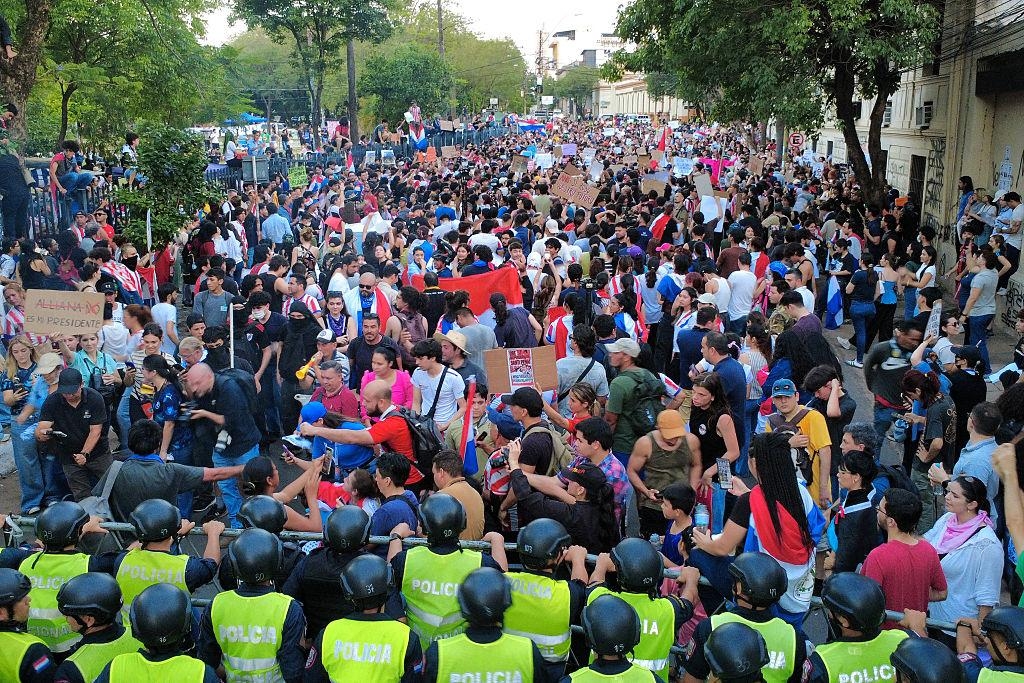
The ensuing protests quickly developed into a broader challenge to the government of Santiago Peña. On 3 and 4 November, depositors, pensioners, workers, students and other citizens gathered in central Asunción, demanding the return of their savings and accountability for the handling of public resources. Demonstrators also called for Peña and Vice-President Pedro Alliana to face political consequences. Clashes with police were reported, including confrontations near the National Congress and the presidential residence.
The political crisis culminated on 6 November, when Peña was removed from office through impeachment proceedings and Pedro Alliana assumed the presidency. Reuters subsequently reported that Peña had been arrested and charged with breach of trust and administration for personal gain. Peña denies wrongdoing. The investigations have focused, among other issues, on his previous business relationship with the group associated with Ueno and the management of public funds deposited in the bank.
The mobilisation continued after the change of government. On 9 November, teachers' organisations launched a nationwide strike and demonstrations, suspending classes and gathering in Asunción and other parts of the country. Their principal demand is a guarantee that pension resources deposited in Ueno will be recovered and protected. The Federation of Paraguayan Educators (FEP) has highlighted approximately US$60 million belonging to the public-sector pension system and demanded the recovery of funds placed by the IPS, which trade union representatives estimate at around US$350–355 million. The unions are also demanding an 8% salary increase, greater investment in public education in the 2027 budget and the resolution of outstanding retirement-related payments.
The mobilisation involves the FEP, the National Union of Educators (UNE), the Organisation of Education Workers (OTEP) and the National Union of School Directors (SINADI), among others. Union representatives were also scheduled to meet President Alliana to present proposals for a special legal mechanism to recover and protect pension resources. The teachers' strike has affected public education and led to the temporary suspension of the school meal programme in some areas.
The crisis is also affecting workers directly employed by companies connected to the Ueno business group. In an article published on 7 November, Adelante! reported that employees of the Monchis delivery platform, operating under ITTI, had been left without their wages because of judicial restrictions affecting the corporate structure. According to information cited by the newspaper, the situation also threatens the livelihoods of more than 900 delivery workers and over 1,000 businesses connected to the platform.
The affected workers have called for intervention by the Ministry of Labour, the judiciary and the Public Prosecutor's Office. They insist that investigations into financial irregularities must proceed, but that workers should not be deprived of their wages or employment because of decisions taken by company executives. They are demanding mechanisms to separate funds needed for wages and viable business operations from assets subject to judicial investigation.
The PCP's newspaper has placed these developments within a broader critique of Paraguay's economic model. In an analysis published on 3 November, Alhelí González Cáceres argued that the Ueno crisis cannot be understood simply as a banking failure or a regulatory problem. It must also be examined in the context of the growing influence of financial capital, the concentration of economic power and the relationship between business conglomerates and the state.
The article points in particular to the exposure of workers' pension contributions to private financial speculation. It cites the IPS's investment of approximately US$345 million in Ueno during the first half of 2026, arguing that these resources represent deferred wages intended to guarantee healthcare, pensions and social protection. Their placement in a private bank in pursuit of higher returns, the analysis argues, subordinated workers' social rights to financial profitability.
The article also highlights the demands raised by trade unions and workers' organisations, including the withdrawal of pension funds from Ueno and the proposal to establish a public social bank through which the IPS could manage its own resources rather than relying on private financial intermediaries.
The latest interventions in Adelante! therefore connect the banking crisis with questions extending far beyond the fate of one financial institution: who controls workers' pension contributions, how public resources are allocated, and who bears the consequences when financial speculation fails. As demonstrations continue and the new government faces pressure to guarantee the recovery of pension funds and workers' wages, the crisis has become a significant confrontation over the use of public resources and the social costs of the country's economic model.