
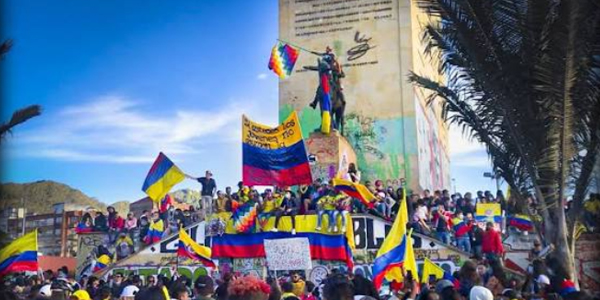
The Colombian Communist Party (Partido Comunista Colombiano, PCC) is backing the national strike and demonstrations called for 19 November against the government’s proposed Economic Rescue Law, arguing that the initiative shifts the burden of the fiscal adjustment onto workers and lower-income households while protecting the interests of large corporations and financial capital.
Colombian Communist Party calls for unity and mass mobilisation in 19 November national strike
The national mobilisation was announced by the Central Unitaria de Trabajadores (CUT), the country's main trade-union confederation, together with other trade-union organisations, Fecode (the Colombian teachers' federation), pensioners' organisations and a broad range of social, popular, peasant, Indigenous, Afro-Colombian, women's, student and political organisations. The call emerged from the National Meeting for the Defence of Life, Dignity, Democracy, Peace, Sovereignty and Social Reforms, attended by more than 1,500 delegates from across the country. The organisers are preparing demonstrations and strike actions throughout Colombia, emphasising their peaceful and mass character.
Opposition to the Economic Rescue Law
PCC identifies the government's proposed Economic Rescue Law as a regressive fiscal reform that would make ordinary people pay for the country's fiscal difficulties. The party argues that the proposal increases the tax burden on working people while offering more favourable conditions to large businesses and investors.
The trade-union organisations have highlighted several provisions of the bill. These include raising VAT on certain everyday consumer products from 5% to 19%, increasing health contributions paid by some workers from 4% to as much as 8%, and lowering the income-tax threshold so that more wage earners would become liable. The CUT also objects to proposed tax reductions for large corporations and major investments.
The unions further warn that the government's proposed powers to reorganise, merge or abolish public institutions could lead to substantial job losses and weaken the provision of essential public services. The CUT has cited the possibility of hundreds of thousands of public-sector jobs being affected. These figures represent the union's assessment of the potential consequences of the bill, rather than confirmed redundancies.
For the PCC, the proposed reform is part of a broader attempt to reduce the social responsibilities of the state, weaken workers' rights and redirect public resources towards the interests of capital. In an article published on 13 November, Semanario Voz, publication of PCC argues that the government's fiscal policy would increase the pressure on working people, peasants and the most vulnerable sections of society, while deepening existing inequalities.
A broader struggle for social rights and sovereignty
The 19 November mobilisation is not confined to opposition to the tax provisions of the bill. The joint call also raises the defence of public education and healthcare, employment, women's rights, the rights of ethnic communities and peasants, and the protection of public assets.
The participating organisations oppose cuts in public spending, privatisation and measures they believe would undermine social and labour rights. They also connect the economic dispute with questions of democracy, national sovereignty and peace. The joint statement rejects the government's proposed anti-terrorism statute and its approach to peace policy, arguing that these measures threaten democratic guarantees and the right to protest.
The organisers propose an alternative approach to the fiscal deficit based on more equitable taxation, strengthening national production and protecting employment, rather than transferring additional costs to working families.
PCC calls for unity, mobilisation and popular organisation
In its 13 November article, entitled “The Rebellion of the People”, the PCC describes the national strike as an expression of accumulated discontent with the government's policies. It argues that the proposed fiscal adjustment protects the interests of capital while sacrificing the state's obligations towards those who depend on their labour to live.
The article draws a contrast between the social and economic policies of the previous government and the current administration, particularly concerning wages, purchasing power, food prices, subsidies and public investment. It also warns that austerity and reduced state expenditure could aggravate the difficulties already facing a population affected by widespread informal employment, inequality and inadequate access to social rights.
The party calls for unity among workers and popular sectors, insisting that the response to the government's measures must go beyond isolated protests. Its emphasis is on sustained mobilisation and the development of popular organisation capable of defending existing social gains and advancing demands for social justice.
A nationwide mobilisation
The national strike is scheduled for Thursday, 19 November, with demonstrations and activities planned in different regions of Colombia. The CUT has called on its affiliated unions, regional branches and federations to coordinate with social organisations, student movements, Indigenous and Afro-Colombian communities and political forces.