

The change in voting positions in the UN vote against the blockade on Cuba prompted criticism from communist and workers’ parties, which accused their governments of yielding to US pressure and abandoning longstanding positions of opposition to the blockade.
Image
Communist and workers' parties condemn governments for abstention on UN vote against Cuba blockade
Communist and Workers’ Parties condemn governments’ abstentions on UN vote against Cuba blockade
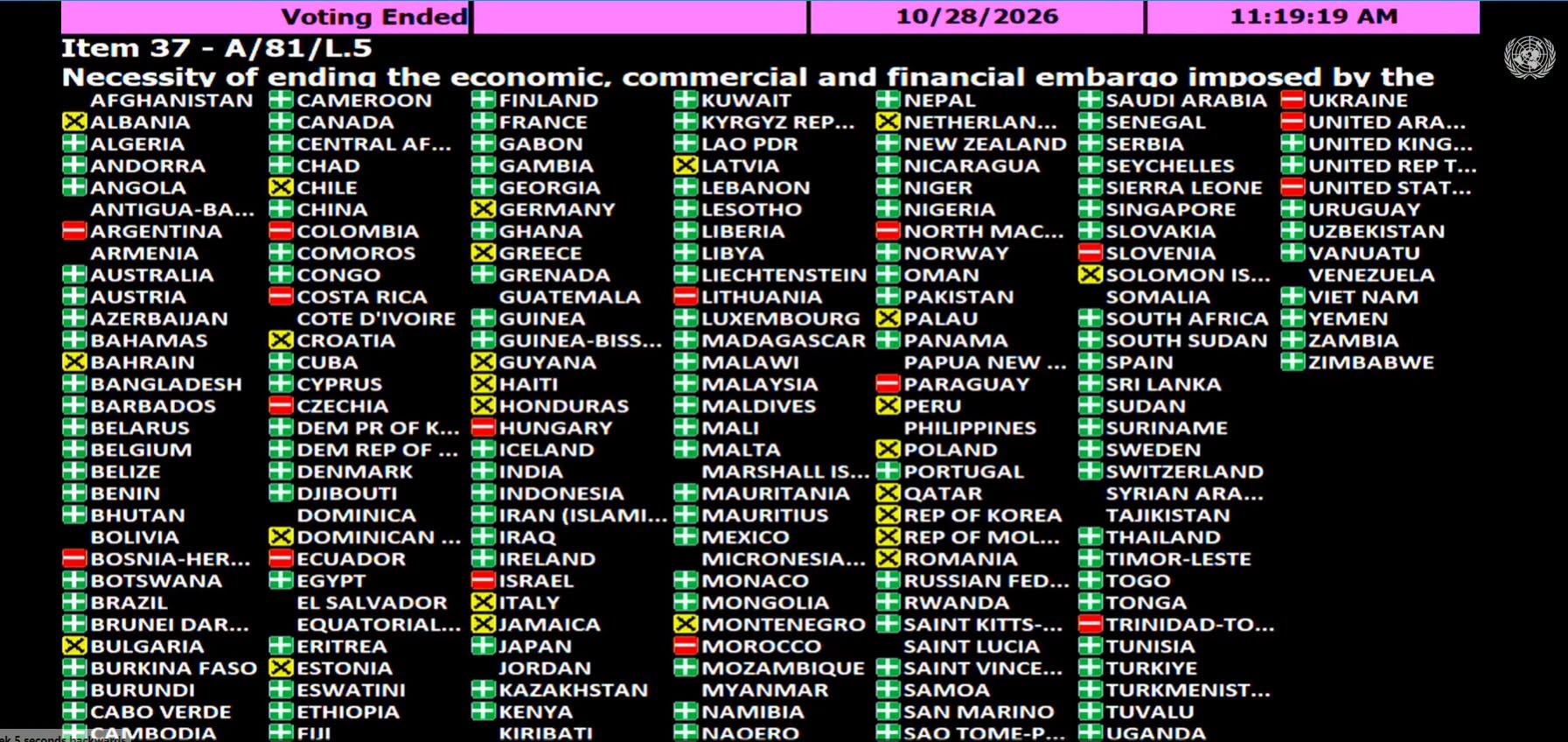
The United Nations General Assembly voted on 28 October to call for an end to the United States’ economic, commercial and financial blockade against Cuba. Although the resolution was adopted for the 34th consecutive year, the result marked a significant decline in international support: 130 countries voted in favour, 17 against and 25 abstained. In 2025, the resolution had received 165 votes in favour, seven against and 12 abstentions. The change came amid an intensified campaign by the Trump administration to persuade governments to abandon their traditional support for the resolution. Germany, Italy, Greece, the Netherlands and several other European countries abstained, while Trinidad and Tobago was among the countries voting against it.
The change in voting positions prompted criticism from communist and workers’ parties, which accused their governments of yielding to US pressure and abandoning longstanding positions of opposition to the blockade.
KKE condemns Greek government’s abstention
The Communist Party of Greece (KKE) issued one of the strongest reactions on 29 October, condemning the New Democracy government’s decision to abstain. The party noted that Greece had supported the resolution for more than three decades and described the abstention as “disgraceful and unacceptable”.
In a statement issued by the International Relations Section of its Central Committee, the KKE said the government had aligned itself with the US campaign against Cuba’s resolution. It argued that the decision demonstrated Greece’s involvement in US-NATO plans and made the government complicit in the blockade, which causes suffering and deprivation for the Cuban people. The party also warned that such a stance could help legitimise the pretexts for a possible imperialist intervention against Cuba.
The KKE stressed that the Greek people have longstanding feelings of friendship and solidarity with Cuba and pledged to continue its practical internationalist support for the Cuban Revolution.
Party of Labour of Austria calls out government’s position
The Party of Labour of Austria (PdA) and its Youth Front had called on the Austrian government to vote in favour of the Cuban resolution before the General Assembly meeting. In an open letter, party chairman Otto Bruckner and Youth Front chairman Moritz Pamminger urged Chancellor Christian Stocker, Vice-Chancellor Andreas Babler and Foreign Minister Beate Meinl-Reisinger not to submit to pressure from Washington.
On 28 October, the PdA and its Youth Front took part in a solidarity rally organised by the Austrian-Cuban Society outside the United Nations headquarters in Vienna. Speaking at the demonstration, PdA executive member Markus Zeyringer criticised the US blockade as a decades-long policy of economic and political destabilisation. He highlighted the effects of the intensified restrictions on fuel supplies, including their consequences for electricity generation, hospitals, public transport and other essential services.
The party also recalled the historical solidarity extended by Cuba to other countries, including its medical assistance, and called for the immediate lifting of the blockade and the removal of Cuba from the US list of state sponsors of terrorism. The PdA described the deteriorating vote as evidence of the impact of US political pressure on other governments.
Italian communist parties oppose the government’s abstention
In Italy, the Communist Refoundation Party (Partito della Rifondazione Comunista) had explicitly urged the government to maintain its traditional vote in favour of the resolution. On 23 October, national secretary Maurizio Acerbo announced that he had written to Foreign Minister Antonio Tajani, asking Italy to uphold its longstanding position.
Acerbo argued that the blockade violated the principles of national sovereignty and self-determination and inflicted serious harm on the Cuban population by restricting access to medicines, medical equipment, food and energy. He also highlighted the extraterritorial effects of US sanctions on European companies and financial institutions, arguing that opposing the blockade was in Italy’s own interest.
Despite this appeal, Italy abstained on 28 October. The Italian Foreign Ministry subsequently defended the decision by criticising Cuba’s political and economic system and calling for reforms, while acknowledging that the US embargo had negative economic and humanitarian consequences.
The Communist Front (Fronte Comunista) and the Communist Youth Front had also called on the Italian government to resist US pressure and vote in favour of the resolution. In a joint statement on 26 October, they highlighted the impact of the energy blockade and the contribution of Cuban medical personnel to healthcare services in Calabria. They organised a solidarity gathering in Rome on 27 October. Their campaign continued after the vote, with the abstention representing the outcome they had sought to prevent.
Parties reaffirm solidarity with Cuba following the vote
Alongside the communist parties that condemned their governments for abstaining or voting against the resolution, other parties responded to the UN vote by congratulating Cuba and reaffirming their commitment to international solidarity.
On 29 October, the Central Committee of the Communist Party of Turkey (TKP) sent a message to the leadership of the Communist Party of Cuba, congratulating the Cuban people on the renewed majority in the UN General Assembly and praising the Cuban delegation's firm stance. The TKP acknowledged the decline in support for the resolution compared with previous years, attributing the increase in abstentions and opposing votes to US imperialist pressure and interference in other countries. It stressed, however, that the result would not weaken international solidarity with Cuba, but rather strengthen the determination to intensify it.
For the communist and workers’ parties opposing these government decisions, the issue goes beyond the annual UN resolution. They present the vote as a question of international solidarity, national sovereignty and resistance to economic coercion. Their statements also underline that the adoption of a non-binding resolution does not itself end the blockade: continued political mobilisation and practical solidarity with Cuba remain necessary.