

Communist and workers’ parties in several countries are campaigning in support of the international dockworkers’ day of action scheduled for 30 October 2026.
Image
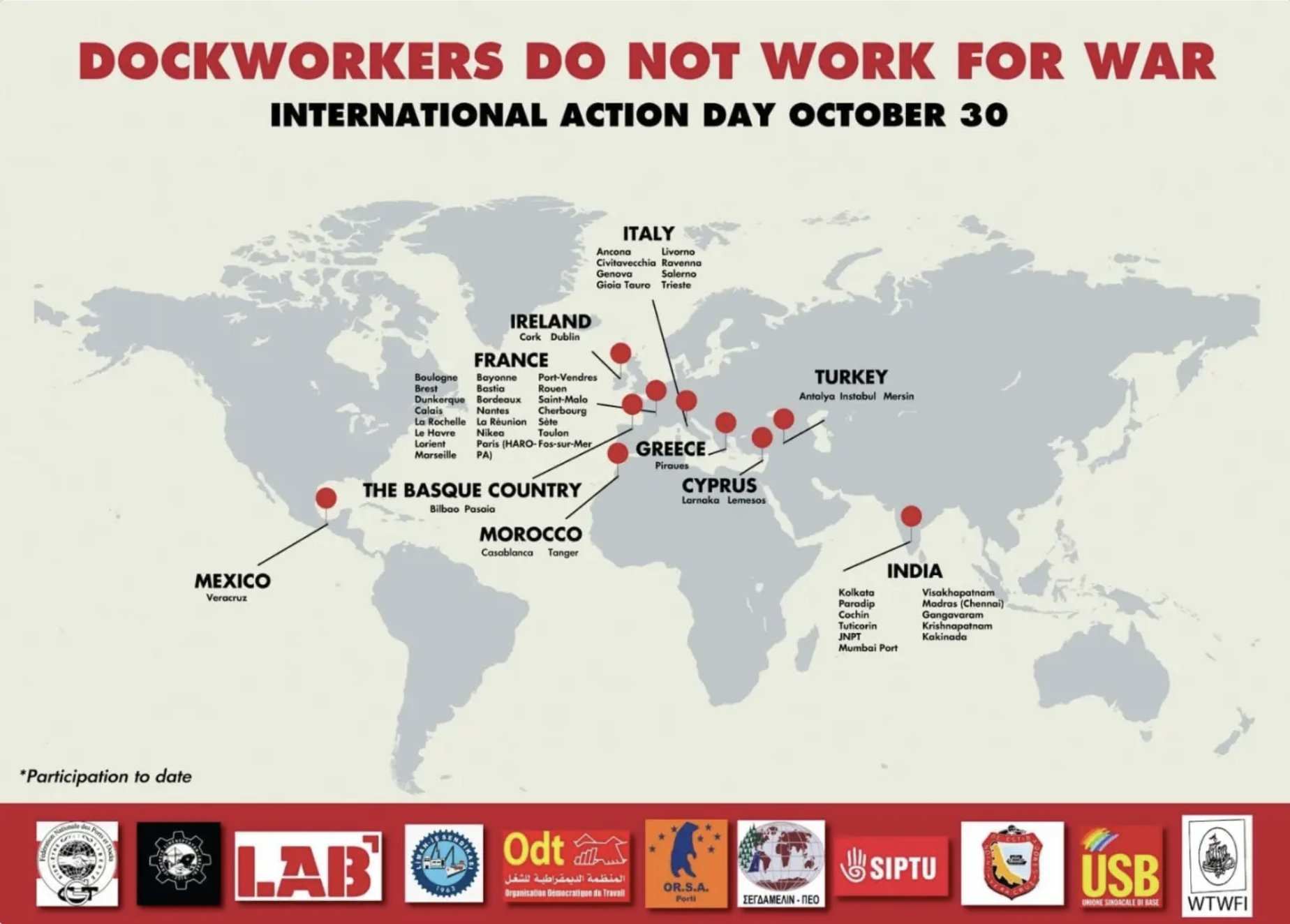
Communist and workers’ parties mobilise in support of International Dockworkers’ Action Against War on 30 October
Communist and workers’ parties mobilise in support of International Dockworkers’ Action Against War
The initiative, coordinated by port workers’ unions across Europe and the Mediterranean, aims to oppose the use of ports to transport weapons and military equipment to war zones and to resist the militarisation of strategic infrastructure.
The action follows an international meeting of dockworkers’ unions held in Istanbul in May. Its organisers include CGT Ports and Docks in France, ENEDEP in Greece, LAB in the Basque Country, Liman-İş in Turkey, ODT in Morocco and USB in Italy. The network subsequently welcomed ORSA Porti of Gioia Tauro in Italy. The participating unions initially represented workers in more than 40 ports, and the World Federation of Trade Unions (WFTU) now reports that the 30 October action is expected to involve more than 60 ports, with participation potentially extending to 100 or more.
Greece: KKE campaigns for the Piraeus strike
The Communist Party of Greece (KKE) has launched a campaign in support of the mobilisation through its Attica Party Organisation. In an announcement published in the party newspaper Rizospastis on 10 October, the organisation called on workers, young people and the wider population to support the dockworkers’ action.
The KKE is promoting the message “Dockworkers do not work for war” and the demand for “Ports of the peoples and peace—not bases for the imperialists”. The party has also invited artists to contribute work addressing the international day of action and the planned strike at the port of Piraeus. In its appeal, the Attica organisation described the mobilisation as a response to war and its consequences for working people.
Italy: USB and left-wing organisations prepare mobilisation
In Italy, the USB trade union is a central organiser of the initiative. On 14 October, its national transport group reaffirmed its support for the international action and announced preparations for a general strike in Italy against war, rearmament and the rising cost of living. USB argues that transport and port infrastructure must not be used to facilitate military operations and arms shipments, and that public resources should instead meet social needs.
France: CGT Ports and Docks at the centre of the initiative
In France, the principal organising role belongs to the CGT Ports and Docks federation, one of the signatories of the Istanbul Declaration. The French Communist Party (PCF) has also drawn attention to the planned action in its coverage of the wider autumn labour movement, identifying the CGT federation’s call for a 30 October day of action and strike against war and the militarisation of ports. The campaign connects opposition to military escalation with demands for peace, improved wages and the defence of social rights.
International support from the WFTU
The World Federation of Trade Unions has endorsed the action and called on affiliated organisations and workers internationally to support it. At a press conference in Rome on 15 October, WFTU Secretariat representative Cinzia Della Porta expressed the federation’s solidarity with the mobilisation and urged workers to resist involvement in the production, loading and transport of weapons destined for active war zones. Her statement also linked the campaign to opposition to the war economy and militarisation, and to solidarity with Palestine and Cuba.
A campaign linking peace and workers’ rights
The organisers’ demands extend beyond opposition to arms shipments. The Istanbul Declaration calls for an end to the genocide of Palestinians and recognition of an independent Palestinian state within the 1967 borders, with East Jerusalem as its capital. It also opposes US-Israeli military aggression in West Asia and against Iran, expresses solidarity with the peoples of Cuba, Venezuela and Sudan, and rejects the conversion of ports into military bases.
At the same time, the unions demand real wage increases, secure employment, shorter working hours, improved pensions and stronger occupational health and safety protections. They also oppose the use of automation and artificial intelligence to eliminate jobs or weaken workers’ rights. Their central argument is that workers should not be made participants in military operations through their work in transport and logistics.
The published announcements document active preparations and political support, but the final number of participating ports and the forms of action in each country remain to be confirmed.