
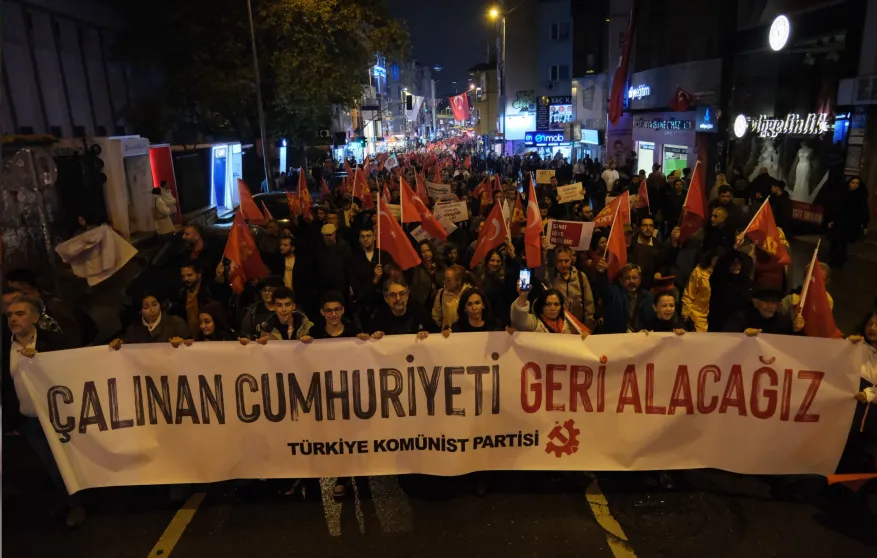

Responding to a call from the TKP (Communist Party of Turkey), thousands of citizens gathered in Ankara, İstanbul, and İzmir and took to the streets on 29 October, on the 103rd anniversary of the founding of the Republic of Turkey.
Communist Party of Turkey marches "to take back the stolen Republic"
Held under the slogan “We Will Take Back the Stolen Republic,” the demonstrations called for a republic based on equality, secularism, independence and workers’ power. The party argued that the capitalist class and its political representatives had undermined the Republic’s founding principles through exploitation, privatisation and dependence on imperialist powers.
Ankara: A struggle for equality, secularism and independence
The Ankara march began at 5:30 p.m. at Kolej and proceeded along Ziya Gökalp Street to Sakarya Street. Participants chanted slogans including “Capitalism out, this country is ours!” and “We will not be soldiers of imperialism!”
Addressing the crowd, TKP Ankara Provincial Chair Banu Ünver argued that the Republic’s fundamental achievements—independence, sovereignty, public ownership and secularism—had been dismantled by the capitalist class. She traced the counter-revolutionary process to the 12 September 1980 military coup, identifying pro-Americanism, reactionism, hostility towards workers and privatisation as its defining features. She called for a new republic built through workers’ struggle.
Izmir: “We will not leave the Republic to the bosses and bigots”
The march in Izmir began at 7 p.m. in Karşıyaka, with participants gathering near the İZBAN station and proceeding through the bazaar.
Speaking after the march, TKP Central Committee member Berkay Kemal Önoğlu described the Republic as an achievement of the working people and criticised large corporations for celebrating its anniversary while benefiting from privatisation and the exploitation of public resources. He argued that the Republic must not be left to big business and reactionary forces, calling instead for a republic of working people based on equality, sovereignty, freedom and socialism.
Istanbul: October 29 as a day of struggle
The Istanbul march began at 7:30 p.m. from Kadıköy Söğütlüçeşme Metrobus Station and ended at Rıhtım Square. Thousands participated, including workers from Şua İnşaat and Panista, who have been pursuing unpaid wages and other labour demands through the “We Are on the Bosses’ Heels” solidarity network.
TKP Central Committee member Alpaslan Savaş argued that the Republic had been weakened by a counter-revolution that replaced independence with collaborationism, citizenship with communalism, secularism with religious conservatism, and public ownership with market fundamentalism. He said that, under present conditions, 29 October had become a day of struggle rather than simply a celebration.
Savaş also criticised corruption and the enrichment of politicians, bureaucrats and business interests at the expense of ordinary people. He highlighted the difficult conditions facing pensioners and opposed the expansion of child labour through the vocational education programme MESEM. He also criticised the proposed “Mecca Agreement,” which he said could draw Türkiye into a regional conflict alongside Saudi Arabia and Pakistan.
Addressing the question of Turkish-Kurdish relations, Savaş argued that genuine fraternity could not be achieved through ethnic, religious or neo-Ottomanist rhetoric. Turkish, Kurdish and other workers, he said, faced exploitation by the same employers, and lasting solidarity required common class struggle.
He concluded by calling for a socialist republic guaranteeing workers’ rights and universal access to housing, education and healthcare, and ensuring that national wealth was shared equally. He stressed that such a transformation could only be achieved through the collective struggle of working people.
What the Republic means for TKP
For the Communist Party of Turkey (TKP), “upholding the Republic” means defending the progressive principles associated with the foundation of the Republic against decades of counter-revolutionary erosion. These principles include secularism, independence, equality, citizenship and the idea that public affairs should be organised in the interests of society rather than private capital. TKP argues that the Republic’s original promises have been undermined by successive governments, particularly through privatisation, growing religious influence in public life, dependence on imperialist powers and the weakening of workers’ rights.
However, TKP’s position is not simply a call to restore the Republic as it once existed. The party presents the struggle to reclaim it as inseparable from a broader struggle against capitalism and the political and economic forces that have dismantled its founding principles. In its account, the counter-revolution began long before the present government, with the 1980 military coup marking a decisive turning point towards pro-Americanism, reactionary politics and policies favouring capital. The Republic, therefore, cannot be genuinely defended without challenging the power of the ruling classes that have benefited from its transformation.
Ultimately, “upholding the Republic” is for TKP a call to establish a socialist republic based on the power and interests of working people. Its vision goes beyond national independence and secularism to include public ownership, social equality, decent living conditions and universal access to housing, education and healthcare. The party also insists that the unity of the country’s different communities must be built on common class interests rather than ethnic, religious or nationalist divisions. In this sense, reclaiming the Republic is presented not as a nostalgic defence of the past, but as a political project for a different future.