
The Communist Party of Venezuela (PCV) has intervened in recent days on three major issues: workers' demands for decent wages and year-end bonuses, the resumption of military cooperation with the United States, and the ongoing judicial intervention against the party.
Communist Party of Venezuela supports workers’ mobilisation and condemns US military agreement
The Communist Party of Venezuela (PCV), led by General Secretary Óscar Figuera, has intervened in recent days on three major issues: workers' demands for decent wages and year-end bonuses, the resumption of military cooperation with the United States, and the ongoing judicial intervention against the party.
PCV backs workers demanding decent wages and bonuses
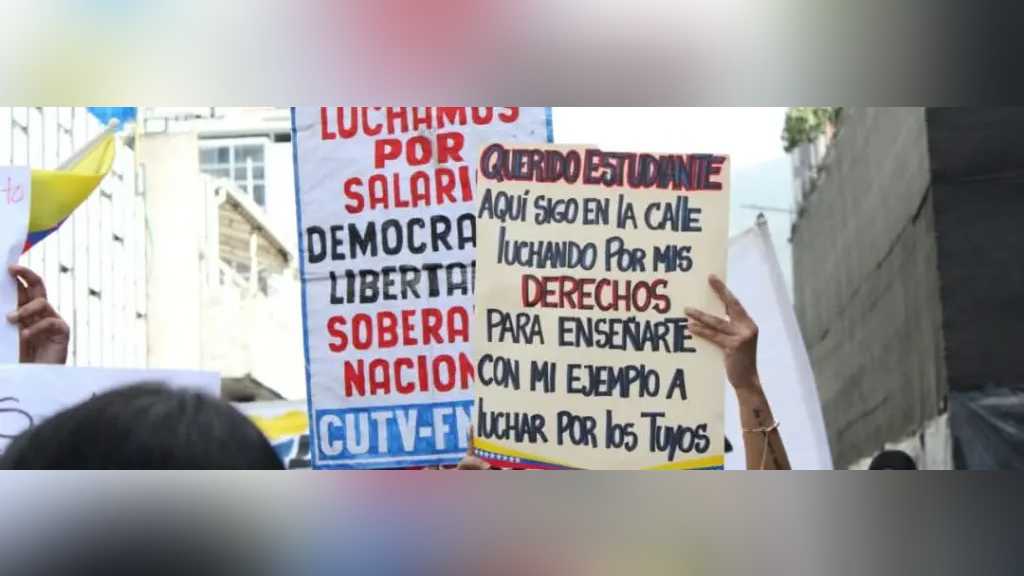
The PCV has expressed its support for the growing mobilisation of public- and private-sector workers, particularly in healthcare, education and universities, who are demanding better incomes and respect for their labour rights.
On 24 November, the party's Political Bureau issued a statement supporting the workers' protests and solidarity actions. General Secretary Oscar Figuera backed the demand for a year-end bonus equivalent to at least four months of workers' comprehensive income, or more where provided for by collective agreements. He argued that all regularly received bonuses should be recognised as part of wages and therefore included in the calculation of year-end payments and other labour entitlements. He invoked Article 91 of the Venezuelan Constitution, the Organic Labour Law and collective agreements in support of this position.
The party's intervention followed a 12-hour national strike on 16 November, called by more than 120 trade-union and professional organisations. Workers in healthcare, basic education and public universities participated in the action, demanding decent wages, improved working conditions and year-end bonuses calculated on the basis of their full income rather than the official minimum wage alone.
The dispute centres on the government's announced payment of a total of 150 dollars in year-end bonuses, while unions are demanding that the calculation reflect a monthly comprehensive income of 240 dollars. The legal minimum wage remains at 130 bolívares, worth less than 20 US cents at the exchange rate. Trade unions argue that the government's reliance on bonuses rather than salary increases undermines collective agreements, social benefits and workers' long-term entitlements.
On 24 November, workers from several sectors also attempted to march towards the Miraflores presidential palace in Caracas to demand a response from the government. The police blocked their passage on Avenida Baralt. Human-rights organisation Provea reported that at least five workers were injured and that police officers temporarily confiscated two mobile phones from demonstrators. The workers warned that they might consider an indefinite strike if the government continued to ignore their demands.
The PCV called on the population to join the mobilisation planned for 25 November and reaffirmed its support for the workers' struggle.
PCV condemns renewed military cooperation with Washington
On 24 November, Figuera also condemned the presence in Venezuela of US Secretary of War Pete Hegseth and the signing of a technical-military cooperation agreement between the Venezuelan and US governments.
At a press conference presenting the Political Bureau's statements, the PCV General Secretary questioned why the agreement had been kept secret from the population and had not been debated in the country's institutions, including the National Assembly. He argued that the agreement represented a further surrender of national sovereignty and could violate the Venezuelan Constitution.
Figuera linked the agreement to the Trump administration's regional policy and the Monroe Doctrine, which he described as a historical instrument of intervention, colonial tutelage and aggression against the peoples of Latin America and the Caribbean.
The PCV's criticism extended beyond the military agreement. Figuera also rejected what he described as US Treasury control over Venezuelan public revenue accounts, the transfer of substantial oil interests to transnational corporations, and plans to increase and renegotiate the country's external debt under unfavourable conditions.
The party directed its criticism at both Washington and the Venezuelan authorities. It condemned US interventionist ambitions while accusing the government headed by Delcy Rodríguez of accommodating US demands at the expense of national sovereignty. Figuera called for the broadest possible patriotic, popular and anti-imperialist unity, bringing together workers, the working class, intellectuals, middle strata and other social sectors to oppose foreign intervention and domestic forces supporting Washington's plans.
Challenge to nomination of judge involved in judicial intervention against the PCV
The party also announced that it would formally challenge the nomination of lawyer Michel Adriana Velásquez Grillet for a position on the Supreme Tribunal of Justice (TSJ).
The PCV bases its objection on her role as reporting judge in Constitutional Chamber ruling No. 1,160 of 11 August 2023, which transferred the party's leadership and electoral registration to a different leadership group rather than the one elected by its membership.
Figuera described the ruling as the judicial seizure of the Communist Party. He argued that it disregarded the leadership elected at the party's 16th Congress in November 2022 and denied its members the right to defend themselves. The PCV intends to submit evidence to the Judicial Nominations Committee to support its objection.
Figuera also recalled that the party had previously requested proceedings against the judges of the Constitutional Chamber, but had received no response. He called for a comprehensive review of judicial decisions that, in the party's assessment, violated constitutional and legal guarantees.
The PCV said it would not formally challenge other candidates for judicial and prosecutorial positions, but would politically support initiatives by other social and political organisations against candidates accused of violating rights, particularly those involved in the persecution of workers, trade unionists and social activists.