
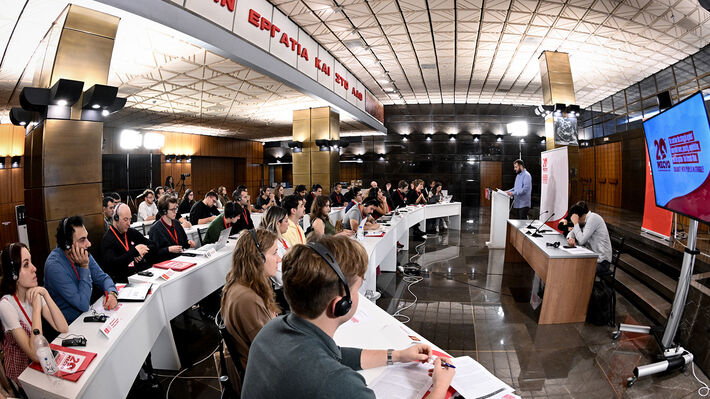
The 20th Meeting of European Communist Youth Organisations (MECYO) opened in Athens on 15 November, bringing together representatives of 20 organisations from across Europe at the headquarters of the Central Committee of the Communist Party of Greece (KKE) in Perissos.
European communist youth organisations meet in Athens: joint struggle against war, exploitation and anti-communism
Hosted by the Communist Youth of Greece (KNE), the two-day meeting is being held under the slogan: “We continue the struggle against imperialist wars, poverty, exploitation and the system that breeds them. Solidarity with the peoples in struggle!”
The meeting provides a framework for communist youth organisations to exchange experiences from their activities among students, young workers and other sections of the population, and to discuss ways of strengthening international coordination. Its agenda reflects the growing emphasis placed by the participating organisations on opposition to militarisation, military expenditure and the developing war economy, alongside struggles over education, employment, housing and living conditions.
The meeting is taking place at a moment when demonstrations and strikes involving young people and workers have spread across several European countries. The KNE has presented the gathering as an opportunity to connect these struggles and strengthen the internationalist cooperation of communist youth organisations.
Twenty organisations participate
The 20 organisations attending the meeting are: Communist Youth of Austria (KJÖ); Young Communist League of Britain (YCL); Union of Communist Youth (UJC), France; Young Communist Movement of France (MJCF); Socialist German Workers' Youth (SDAJ); Swiss Communist Youth Union; Communist Youth of Greece (KNE); Connolly Youth Movement, Ireland; Workers' Party Youth, Ireland; Collectives of Young Communists (CJC), Spain; Communist Youth Front (FGC), Italy; Young Socialists of the Socialist Workers' Party of Croatia; United Democratic Youth Organisation (EDON), Cyprus; Communist Youth Movement (CJB), Netherlands; Portuguese Communist Youth (JCP); Revolutionary Communist Youth Union (Bolsheviks), Russia; League of Communist Youth of Yugoslavia (SKOJ), Serbia; Communist Youth of Sweden (SKU); Communist Youth of Turkey (TKG); Communist Youth Union (KSM), Czech Republic.
KNE: Turning popular discontent into organised struggle
The political framework for the meeting was set out by KNE General Secretary Thodoris Kotsantis in his introductory intervention. He argued that the recent mobilisations in Europe demonstrate that young people and workers in different countries face common problems, despite differences in their national circumstances.
Kotsantis referred to demonstrations in France, Spain, Portugal, Italy, Germany, Belgium, Albania and elsewhere. He identified job insecurity, rising prices, energy poverty, deteriorating education, housing costs, repression and involvement in imperialist wars as recurring issues driving popular discontent.
He highlighted the common messages emerging from these movements: “Their profits or our lives” among young people in Greece; “Their profits, our misery” in France; “Money for schools, not for war” among Italian students; and “We fight for our future, not their wars” among German school students.
According to Kotsantis, the significance of these movements lies not only in their scale but also in the possibility of connecting them politically and organisationally. He argued that spontaneous protest does not automatically develop into revolutionary consciousness. Communist youth organisations, he said, must intervene in these struggles, connect immediate demands with the underlying causes of social problems, organise young workers and students, and strengthen the communist movement.
He also warned against allowing popular anger to be channelled into electoral alternatives that preserve the existing economic and political system. The struggle, in his view, must go beyond opposition to individual governments and challenge the capitalist system itself.
The KNE General Secretary concluded by calling for the recruitment and organisation of more young people and for a stronger anti-capitalist orientation in the youth movement.
Experiences from across Europe
The central part of the meeting consisted of contributions from the participating organisations, which presented their experiences in the struggles taking place in their respective countries. The discussions revealed a number of common themes, particularly the relationship between military expenditure and the deterioration of public services, the role of young people in recent mobilisations, and the need to strengthen communist organisation within these movements.
The representative of the Communist Youth of Austria described the deterioration of living conditions among workers and young people amid intensifying international rivalries and wars. He argued that growing demonstrations for peace and social rights create opportunities for communist intervention. The task, he stressed, is to strengthen ideological and political work so that the movement challenges capitalism rather than remaining limited to individual demands.
The Young Communist League of Britain focused on solidarity with Palestine and opposition to the British government's turn towards a war economy. Its representative criticised the allocation of large sums of public money to military purposes and support for Ukraine, arguing that these expenditures divert resources from healthcare, education and social provision. The solidarity movement for Palestine was presented as an important field of activity among young people.
The Young Socialists of the Socialist Workers' Party of Croatia stressed the importance of common internationalist action by workers and young people. Their contribution drew connections between the historical experience of the anti-fascist struggle and contemporary international solidarity, including the international dockworkers' mobilisation of 30 October.
The representative of Cyprus's United Democratic Youth Organisation (EDON) emphasised the importance of coordination and joint initiatives among European communist youth organisations while respecting the independence of each organisation. She linked the struggle for the reunification of Cyprus and against the consequences of the island's division to the broader struggle for workers' rights, peace and socialism.
The Communist Youth Union of the Czech Republic (KSM) addressed militarisation and preparations for war across Europe. Its representative argued that the consequences of military preparations are borne by working people and that communists have a responsibility to organise a popular response. Referring to the international dockworkers' strike, he stressed that the struggle against war has an international character and cannot be reduced to electoral tactics.
The Young Communist Movement of France (MJCF), the youth organisation of the French Communist Party (PCF), focused on the student and school mobilisations that have taken place since September. Its representative highlighted the slogan “Money for education, not for war” and argued that the struggle for peace is inseparable from the defence of young people's social and educational rights.
The Union of Communist Youth (UJC), affiliated with the Revolutionary Communist Party of France (PCRF), gave a broader account of the recent protests and the political tasks facing the revolutionary movement and identified two priorities for its intervention: strengthening class-oriented organisation within student associations and trade unions, and building the revolutionary party.
The Socialist German Workers' Youth (SDAJ) described protests against increased military expenditure and plans for military recruitment. Particular attention was given to school students' participation in walkouts and demonstrations against militarisation. The representative also discussed solidarity initiatives concerning Palestine, Cuba and Iran, and opposition to German foreign policy.
The Workers' Party Youth of Ireland addressed the effects of imperialist war and the shift towards a war economy on the everyday lives of workers and young people. Its representative stressed that similar problems are generating resistance in different countries.
The Connolly Youth Movement placed its contribution in an internationalist and historical context, referring to the centenary of Fidel Castro's birth. The Cuban Revolution was presented as an inspiration for peoples seeking a way out of capitalist crisis and imperialist conflict. The organisation also highlighted the 30 October international dockworkers' mobilisation and its message that workers should not be made to work for war.
The Communist Youth Front of Italy (FGC) described the recent wave of student and workers' demonstrations in Italy. Paolo Spena referred to the student mobilisations of 16 October and 30 October, the latter taking place alongside the general strike and international dockworkers' action. He also announced a further general strike planned for 20 November.
The Communist Youth Movement of the Netherlands (CJB) described its work in schools, neighbourhoods and workplaces, alongside emerging protests against the country's involvement in imperialist conflicts. Its representative emphasised the importance of building anti-capitalist organisation at the local level.
The Portuguese Communist Youth (JCP) focused on the housing crisis and rising living costs. Its representative described the large mobilisations over housing and the role of class-oriented organisations and communists in organising two general strikes, numerous sectoral actions and workplace assemblies. She also highlighted the participation of thousands of young people who were taking part in strike action for the first time. The JCP stressed the need for common action among communist youth organisations and solidarity with peoples engaged in struggle.
The Revolutionary Communist Youth Union (Bolsheviks) of Russia explicitly criticised Russia's imperialist intervention and its rivalry with the Euro-Atlantic camp. Its representative argued that the consequences of imperialist war extend beyond the battlefield: workers also experience them through inflation, worsening living standards, intensified exploitation at work and increased state repression.
The League of Communist Youth of Yugoslavia (SKOJ), from Serbia, addressed the consequences of Yugoslavia's dissolution, capitalist restoration and external dependence. Its representative also discussed the emergence of the so-called Student List in Serbian politics, describing it as an attempt to reform the existing bourgeois political system by channelling popular anger over government policies into a new political formation.
The Collectives of Young Communists (CJC) of Spain discussed the housing crisis, the eviction of 87-year-old Maricarmen and the deterioration of living conditions among working people. Its representative connected the housing issue with rising military expenditure and cuts to social spending, as well as shortages in education. The CJC also criticised attempts by social-democratic forces to channel workers' struggles into electoral politics ahead of the 29 November elections. It argued that each mobilisation should be used to strengthen opposition to capitalist power rather than simply replace one government with another.
The Communist Youth of Sweden (SKU) reported on its solidarity activities in support of Palestine and Cuba, as well as workers' struggles against the war economy and for social and democratic rights.
The Swiss Communist Youth Union highlighted the deterioration of living conditions, attacks on rights and the shift towards military expenditure. Its representative announced that the organisation would contribute to a popular mobilisation planned for 20 November against rising prices and Switzerland's involvement in imperialist war.
The Communist Youth of Turkey (TKG) described its activities in schools, universities and workplaces, carried out alongside the party under difficult conditions. Its representative linked the deterioration of young people's living conditions with Turkey's increasingly active involvement in international rivalries and conflicts. She also referred to workplace deaths and the need to turn popular anger into organised opposition to the capitalist system. The TKG's slogan, “We Are Not Without a Future – We Will Be the Future!”, was also highlighted in the public event at the Polytechnic.
Seminar addresses anti-communism and repression
Alongside the country reports, the meeting held a seminar entitled “The Struggle of Communist Youth Organisations Against Anti-Communism and Repression, Which Are Intensifying Under Conditions of Imperialist War”.
Representatives of all 20 organisations exchanged experiences of anti-communist measures and state repression in their respective countries. The discussion examined how bourgeois governments and the European Union promote anti-communism and how fascist forces are used as a reserve against the working-class movement.
The seminar also addressed the responses developed by communist youth organisations to these pressures, including their efforts to continue political and organisational activity under conditions of restrictions, intimidation and persecution.
Internationalist event at the Athens Polytechnic
The meeting coincided with the 53rd anniversary commemorations of the November 1973 Polytechnic uprising against the military dictatorship in Greece. On Sunday afternoon, the KNE Central Council organised a major internationalist event at the historic Polytechnic complex in Athens under the title: “From the Streets of Europe to the Road of Overthrow: November 1973–2026 – History Is Written Through Class Struggle”.
KNE General Secretary Thodoris Kotsantis delivered the main speech. Representatives of the UJC of France, the CJC of Spain, the FGC of Italy and the TKG of Turkey addressed the gathering. Delegations participating in the MECYO meeting and veterans of the anti-dictatorship struggle were also present, alongside a large KKE Central Committee delegation.
Towards stronger international coordination
The first day's proceedings demonstrated the extent to which the participating organisations are attempting to connect struggles that often develop separately within national borders. The experiences presented covered student demonstrations, housing campaigns, strikes, opposition to military recruitment, solidarity with Palestine and Cuba, and resistance to the growing militarisation of European economies.
The meeting also revealed differences in the specific conditions and political priorities of the organisations. Nevertheless, the common emphasis was on the need to strengthen communist organisation within the movements, rather than allowing spontaneous protest or electoral alternatives to determine their direction.
The 20th MECYO is scheduled to conclude on 16 November.
(Photo: 902.gr)