
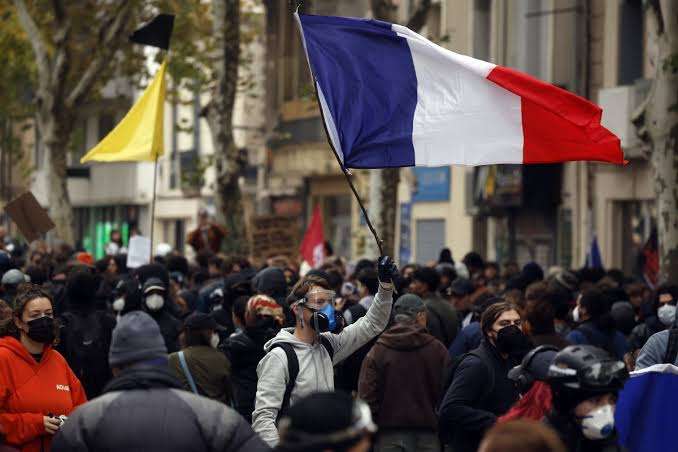

The demonstrations held across France on 14 November brought together workers, students, high-school pupils, Yellow Vest activists, trade unionists and social organisations around a broad range of demands.
French communists join converging struggles for social justice, education and democratic rights
The mobilisation, the fifth consecutive Saturday of protests against the rising cost of living, also addressed wage increases, the defence of public education, violence against children and police violence. Communist activists took part in the demonstrations, alongside the CGT and other organisations, supporting the convergence of struggles against austerity and the government's policies.
In Paris, the demonstration brought together several organisations under the banner of social justice, peace and dignity. The march began at Place de la République and proceeded towards Place de la Nation via Bastille. The French Communist Party (PCF) and CGT activists were among those participating. In Lyon, Nantes, Bordeaux and other cities, demonstrations also brought together different sections of the popular movement.
The Interior Ministry counted 106,000 participants nationwide, including 24,000 in Paris. The youth inter-union coordination, comprising the Union étudiante, Union syndicale lycéenne, UNEF and FAGE, claimed 200,000 demonstrators nationally. Although participation was lower than during the previous Saturday's mobilisation, the demonstrations showed that social discontent had not subsided and that different struggles continued to find common ground.
Against the cost of living and the distribution of wealth
The struggle against the cost of living remained a central theme. The Yellow Vest movement and other participants continued to demand higher wages, improved purchasing power and measures against rising prices. Workers and trade unionists also raised demands concerning employment, pensions and the defence of public services.
The PCF has argued that the resources exist to meet these demands, but that wealth is distributed according to the interests of major corporations and financial capital. In its statement following the 5 November mobilisation, the party highlighted the record dividends paid to shareholders and the public money transferred to multinational companies without sufficient conditions or democratic control.
The party demands that public resources be redirected towards useful production, social needs and the ecological transition. It also rejects the government's austerity-oriented budget, arguing that the answer to the country's economic difficulties cannot be to make workers and young people pay the price.
The demonstrations of 14 November gave renewed expression to these demands. For the PCF, the task is to transform the successive days of protest into a sustained movement capable of winning concrete improvements in living and working conditions.
Young people at the forefront: education rather than militarisation
The mobilisation also demonstrated the continuing determination of high-school pupils and students to defend the right to education and demand adequate resources for schools and universities.
The Mouvement des Jeunes Communistes de France (MJCF) has placed these demands at the centre of its campaign, “Des profs plutôt que des missiles” (Teachers Rather Than Missiles). Its General Secretary, Bastien Bonnargent, argues that the government cannot claim that there is no money for teachers, school facilities and accessible education while increasing military expenditure by billions of euros.
The MJCF stresses that the demands of young people are inseparable from those of workers defending public services. When students demand more teachers and railway workers demand sufficient staffing to operate trains, they are defending the same principle: public services must meet the needs of the population rather than be sacrificed to austerity and militarisation.
The youth inter-union organisations have consequently called for further mobilisation on 17 November, including blockades of educational establishments and participation in demonstrations. The PCF and MJCF are urging students, apprentices, teachers and workers to continue the struggle together.
Against police violence and the proposed “licence to kill” law
Another major issue raised on 14 November was opposition to the proposed legislation that would introduce a presumption of legitimate self-defence for police officers and gendarmes when they use their firearms.
Critics of the bill have described it as a “permis de tuer” – a licence to kill – arguing that it would weaken accountability for police shootings and aggravate an already serious problem of police violence. The issue was particularly prominent in Paris and Lyon, where demonstrators carried placards denouncing police violence and demanding justice for victims.
The mobilisation brought together families of victims, anti-police-violence collectives, human-rights activists and political organisations. The proposed law is due to be examined by the Senate on 19 November.
The defence of democratic freedoms and the right to demonstrate is an essential part of the wider social struggle. The PCF's position is that the response to social discontent cannot be repression, intimidation or the restriction of democratic rights.
The protection of children and the defence of human dignity
The demonstrations also included organisations campaigning against violence towards children and adolescents. Their participation broadened the mobilisation beyond the immediate demands concerning wages and purchasing power, highlighting the need for stronger public protection and social services.
The different causes represented in the demonstrations reflected a common rejection of policies that leave individuals and families exposed to insecurity while reducing the resources available for public services. The presence of these organisations alongside trade unionists and youth movements illustrated the potential for a broader popular movement based on solidarity.
PRCF calls for a general strike and highlights workers' unity
The Pôle de Renaissance Communiste en France (PRCF) also took part in the 14 November demonstrations, reporting activities by its militants in Lille, Lyon, Vénissieux, Marseille, Paris and Nice. Its political message was summed up in the slogan “Tous ensemble, grève générale jusqu'à la victoire” (All together, general strike until victory). The organisation argues that the successive demonstrations against the cost of living must develop into a general strike capable of bringing together workers and popular sectors around common demands.
The PRCF placed particular emphasis on the relationship between wages and militarisation, using the slogan “L'argent pour les salaires, pas pour la guerre” (Money for wages, not for war). In its account of the demonstrations, it highlighted the presence of French and red flags in Lille, anti-war and pro-wage slogans in Lyon and Vénissieux, and the defence of peace, democratic freedoms and the Republic in Marseille. In Nice, it noted the singing of The Internationale.
Alongside its participation in the demonstrations, the PRCF organised a Marxist café in Paris on 14 November, featuring historian Annie Lacroix-Riz in a discussion on Jean Moulin and the history of the French Resistance. The event, which reportedly filled the venue, reflected the organisation's effort to connect contemporary mobilisation with the historical experience of anti-fascist struggle.
The PRCF's intervention adds a more explicitly class-oriented and anti-militarist dimension to the wider movement. It argues that the next step must be the convergence of struggles in a general strike, rather than a succession of separate demonstrations.
Continuing the mobilisation
The next important date is 17 November, when youth organisations are calling for school blockades and demonstrations, while trade unions are preparing further strike action and mobilisation in the public and private sectors.
The French Communist Party calls for the mobilisation to continue and for the convergence of these struggles to become a lasting force capable of changing the country's political and social priorities.