

The Communist Party of Greece (KKE) and its youth organisation, the Communist Youth of Greece (KNE), have launched a three-day programme in Athens to mark the 53rd anniversary of the Polytechnic uprising of November 1973.
Image
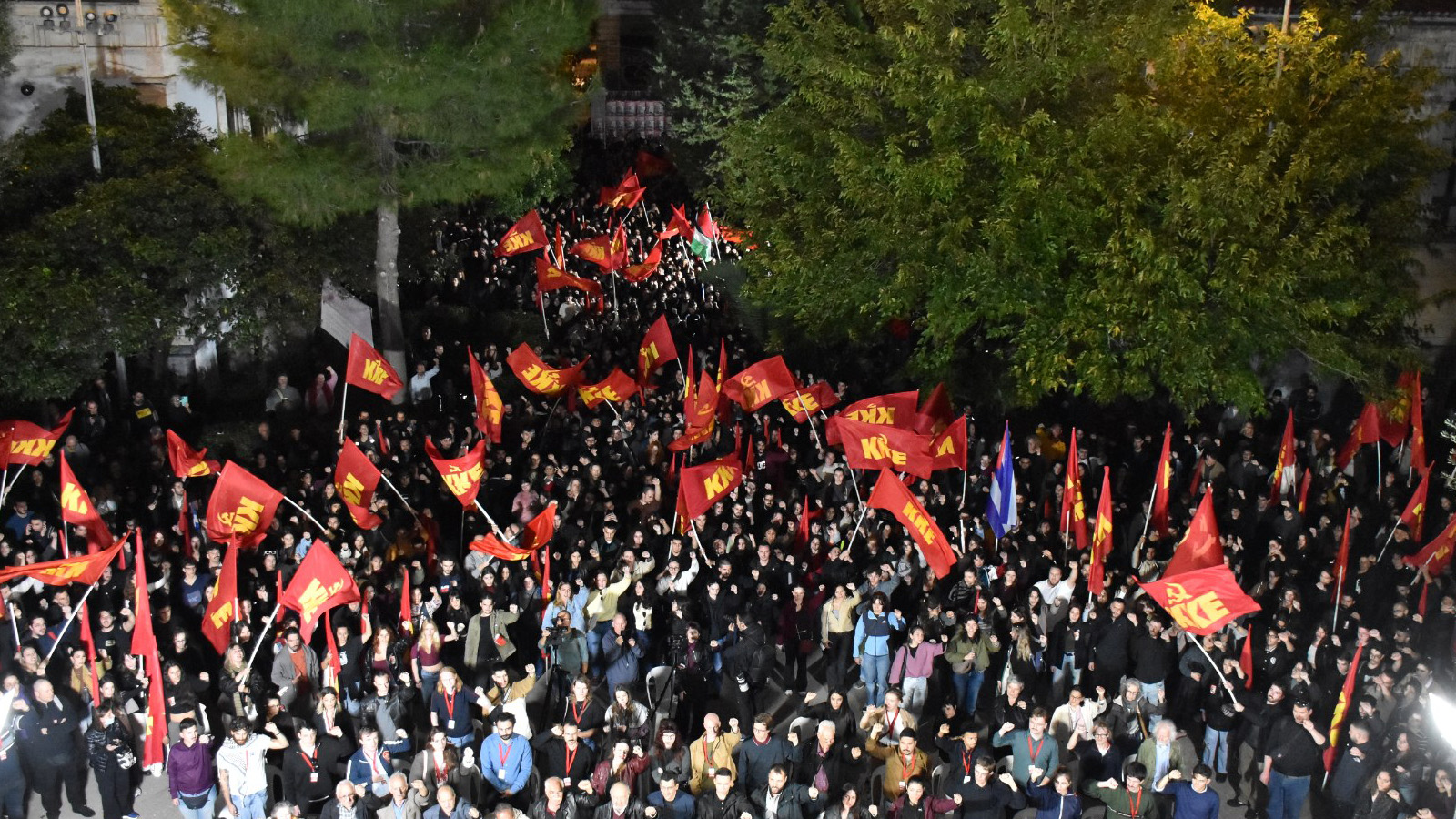
Big internationalist event by KKE and KNE in Athens, to mark anniversary of Polytechnic Uprising
KKE and KNE mark 53rd anniversary of Polytechnic Uprising with internationalist youth gathering
The events combine commemoration of the struggle against the military dictatorship with calls for contemporary struggles against imperialism, NATO and the policies of the Greek government.
The gates of the historic Polytechnic complex on Patission Avenue opened on 15 November, drawing large numbers of visitors, particularly young people. Participants laid flowers, visited exhibitions and attended commemorative and cultural activities. Trade unions affiliated with the All-Workers Militant Front (PAME), self-employed workers, women's organisations, conscripts and retired military personnel also took part in a wreath-laying procession from Kaniggos Square to the Polytechnic.
The anniversary programme will culminate on Tuesday, 17 November, with the traditional mass anti-imperialist march to the US Embassy in Athens, alongside demonstrations in other Greek cities. The slogans “Bread – Education – Freedom” and “Out with the USA and NATO” remain central to the mobilisation. KKE and KNE are presenting the anniversary as an occasion to connect the historical struggle against dictatorship with opposition to Greece's involvement in imperialist conflicts, military preparations and the war economy.
KKE: The people must be protagonists of political developments
In its statement for the anniversary, the KKE Central Committee's Press Office paid tribute to the student, working-class and popular uprising, describing it as the culmination of the struggle against the dictatorship. The party recalled the role played by its members and KNE cadres, who continued organising resistance under conditions of illegality, persecution, imprisonment, torture and exile.
The KKE argues that the military dictatorship established in April 1967 served the interests of capitalist power and its international allies, particularly the United States and NATO. It maintains that the transition to parliamentary democracy did not resolve the problems facing workers and popular strata, which it links to contemporary military preparations, economic difficulties and the risk of wider conflict.
The party also criticised the Greek government's energy and geopolitical policies, arguing that they serve the interests of capital and involve the country in dangerous international arrangements. It pointed to expensive NATO armaments and argued that military expenditure comes at the expense of education, healthcare and other social needs.
Drawing a political lesson from the Polytechnic uprising and the wider anti-dictatorship struggle, the KKE declared that change comes when the people themselves become protagonists, acting together with the communists, rather than relying on political manoeuvres at the top or the search for supposed political saviours. The statement also called for the strengthening of the workers' movement ahead of the nationwide general strike scheduled for 25 November, under the slogan “No sacrifice for their profits and their wars”.
KNE internationalist event: From the streets of Europe to the struggle for change
A major internationalist event organised by the KNE Central Council took place at the Polytechnic under the title “From the Streets of Europe to the Road of Overthrow: November 1973–2026 – History Is Written Through Class Struggle”.
The event featured an address by KNE General Secretary Thodoris Kotsantis and greetings from representatives of communist youth organisations from France, Spain, Italy and Turkey. The delegations were in Athens for the 20th Meeting of European Communist Youth Organisations. Anti-dictatorship resistance veterans and a sizeable KKE Central Committee delegation, including members of its Political Bureau, also attended.
Kotsantis emphasised the continuing relevance of the Polytechnic uprising, arguing that mass participation by workers and young people in the anniversary events, together with the march to the US Embassy, was an answer to attempts to erase the uprising's political message. He paid tribute to KKE and KNE members who resisted the dictatorship and reaffirmed the organisations' commitment to the revolutionary overthrow of capitalism and the establishment of socialism-communism.
He urged young people not to accept individual solutions or reconcile themselves to limited expectations. He said that organisation, collective action, solidarity and political consciousness are necessary to turn popular discontent into a movement capable of challenging the existing system. “Every step, every small or big victory, every young person who decides not to compromise,” he argued, brings society closer to liberation.
Experiences from communist youth organisations abroad
The international contributions provided an opportunity to exchange experiences of recent struggles and discuss the work of communist youth organisations in different countries.
Basile Ponceau, representing the Union of Communist Youth (UJC) of France and its party, the Revolutionary Communist Party of France (PCRF), described the growth of demonstrations in France during October. He said that the movement had begun among young people demanding more teachers, increased funding for public education and the renovation of deteriorating school buildings. Workers and trade unions subsequently joined the mobilisation, connecting educational demands with struggles against rising living costs, austerity and police repression.
Ponceau stressed the need to move beyond spontaneous mobilisation by strengthening class-oriented work in student associations and trade unions and building the revolutionary party. He said that the recent struggles had brought new young members into the organisations, including secondary-school students who had participated in school blockades.
The representative of the Communist Youth of Turkey (TKG), Kumsal Yıldırımlı, spoke about the difficulties facing young people in Turkey, including poverty, unemployment and the lack of prospects. She argued that communist youth organisations must challenge the widespread feeling among young people that they have no future. Under the slogan “We Are Not Without a Future – We Will Be the Future!”, she presented the struggle against despair as an important part of the organisation's work.
Paolo Spena, representing the Italian Communist Youth Front (FGC), described the recent wave of student and workers' mobilisations in Italy, highlighting the demonstrations of 16 and 30 October and the general strike planned for 20 November. He stressed the influence of the international dockworkers' mobilisation and the growing opposition among young people to the government's military spending plans. The slogan “Money for schools, not for war” has become a central demand of the student movement, reflecting the contrast between deteriorating school facilities, teacher shortages and inadequate educational funding, on the one hand, and increased expenditure on armaments, on the other.
Jorge Perez-Huet, representing the Spanish Collectives of Young Communists (CJC), discussed the recent mobilisations in Spain, particularly the general strike of 11 November, struggles over housing and the eviction of 87-year-old Maricarmen. He argued that the housing crisis, deteriorating living conditions and the lack of prospects facing young people are not isolated problems but expressions of the contradictions of capitalism. He also connected the growing militarisation of the economy and increased military expenditure with the lack of resources for education and other public services.
The programme will reach its culmination on 17 November with the march to the US Embassy, 53 years after the Polytechnic uprising became a defining moment in the struggle against the Greek military dictatorship.