
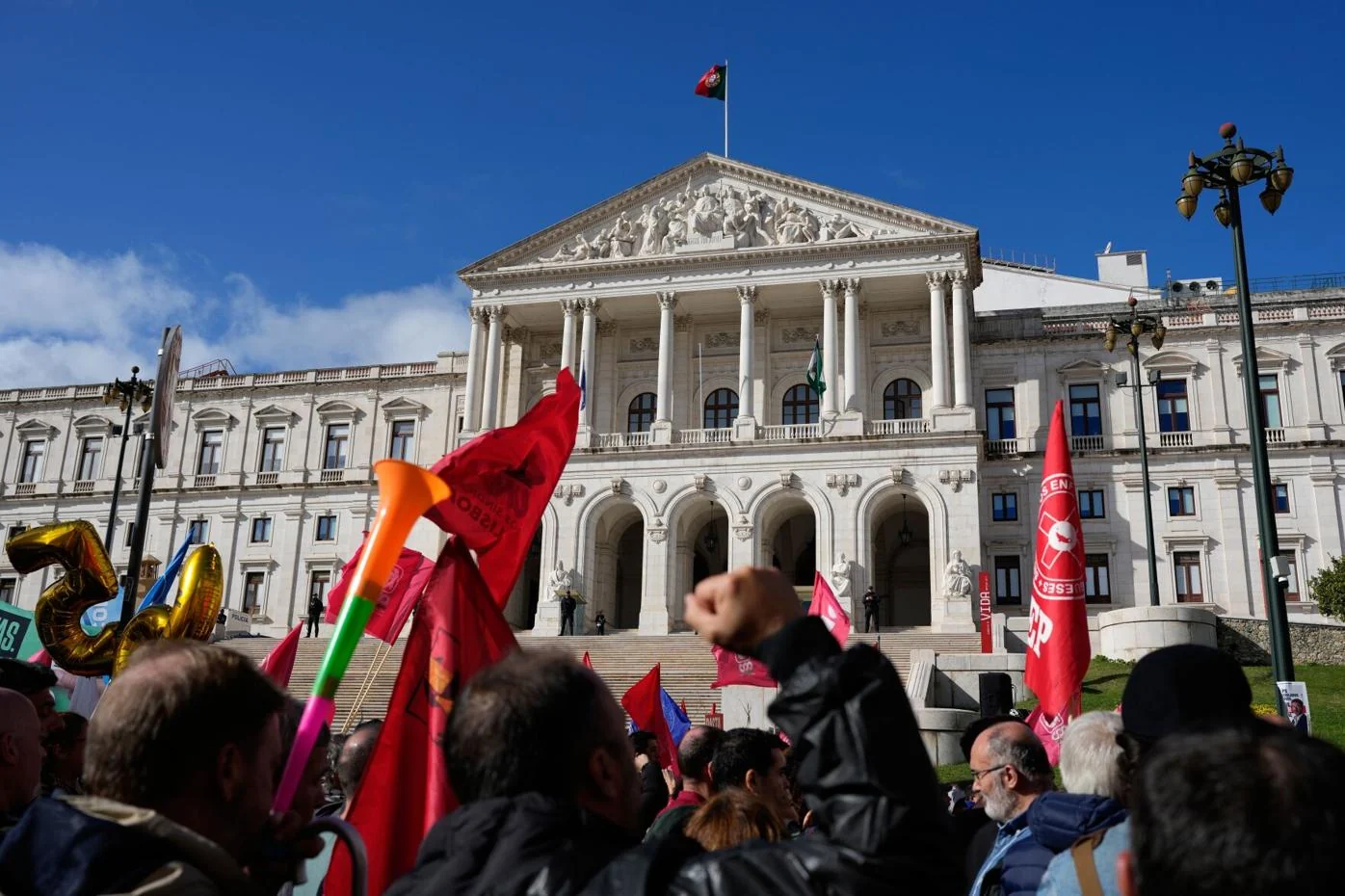

Hundreds of workers, trade unionists, pensioners and other demonstrators gathered outside Portugal’s Assembly of the Republic in Lisbon on 24 November to protest against the proposed 2027 State Budget, demanding higher wages and pensions and opposing policies they consider responsible for the deterioration of living and working conditions.
Portuguese Communist Party joins workers’ protest against 2027 state budget
The mobilisation was called by the General Confederation of Portuguese Workers (CGTP-IN) under the slogan “Higher wages and better pensions! Against the rising cost of living!” It took place on the day of the final parliamentary vote on the budget. The Portuguese Communist Party (PCP) participated in solidarity with the workers, with General Secretary Paulo Raimundo joining the demonstration. The protest was also attended by representatives of trade unions in healthcare, education and large retail businesses. It coincided with an intersectoral national strike involving workers in these three sectors.
The demonstration continued the wave of workers’ mobilisation organised throughout November. The CGTP-IN had already brought tens of thousands of people to Lisbon on 21 November in a national demonstration demanding higher wages and pensions, affordable essential goods and services, and the defence of public healthcare, education, housing and social security. The union federation had called for the 24 November action as a further expression of workers’ demands on the day the budget was to be approved.
PCP denounces budget priorities favouring big business
Addressing the political debate surrounding the mobilisation, Paulo Raimundo reiterated the PCP's rejection of the 2027 State Budget. He argued that the changes introduced during parliamentary discussions had not altered its fundamental direction. According to Raimundo, the final version continued to provide tax advantages to large companies, further reductions in corporate income tax and additional public-private partnerships, while failing to address the problems confronting working people.
Raimundo also criticised the government's housing policies, arguing that the measures adopted had not brought down rents and had instead contributed to higher housing costs and mortgage payments. He called for a substantial expansion of public housing, rent regulation and greater stability for rental contracts.
In his parliamentary intervention on 24 November, Raimundo highlighted the gap between the difficulties faced by ordinary people and the benefits granted to major economic groups. He pointed to low wages and pensions, the rising cost of living, shortages of doctors and nurses, and the lack of sufficient personnel in public services. He also criticised cuts affecting higher education and scientific research, and the continued precarious employment of researchers.
Among the measures advocated by the PCP were a minimum increase of 5%, or 80 euros, in pensions; fixing the price of a gas cylinder at 20 euros, compared with the 45 euros he cited as its current price; reducing VAT on electricity, gas and telecommunications; strengthening public healthcare and public housing; and increasing taxation on large capital while combating tax havens.
Raimundo explicitly connected the parliamentary debate with the street mobilisation, recognising those who had gathered outside the Assembly to reject the budget. He also referred to the struggles of housing activists, students defending public education, patients demanding access to medical care and farmers facing rising production costs.
Mobilisation continues despite parliamentary approval
The State Budget for 2027 was ultimately approved on 24 November, with the Socialist Party (PS) abstaining. The PCP voted against it, alongside Chega, Iniciativa Liberal, PAN, Livre and the Left Bloc, while the governing PSD and CDS supported it.
For the PCP, the protest demonstrated that parliamentary approval does not settle the social questions raised by the budget. Raimundo argued that the struggle must continue beyond the parliamentary vote, both in workplaces and in the streets, against policies that place the interests of major economic groups above wages, pensions, housing and public services.
The party maintains that a change of government alone would not be sufficient without a break with the economic and social policies responsible for the problems facing workers and the wider population. It called for continued unity and mobilisation around demands for better living conditions, social rights and a different direction for Portugal.