
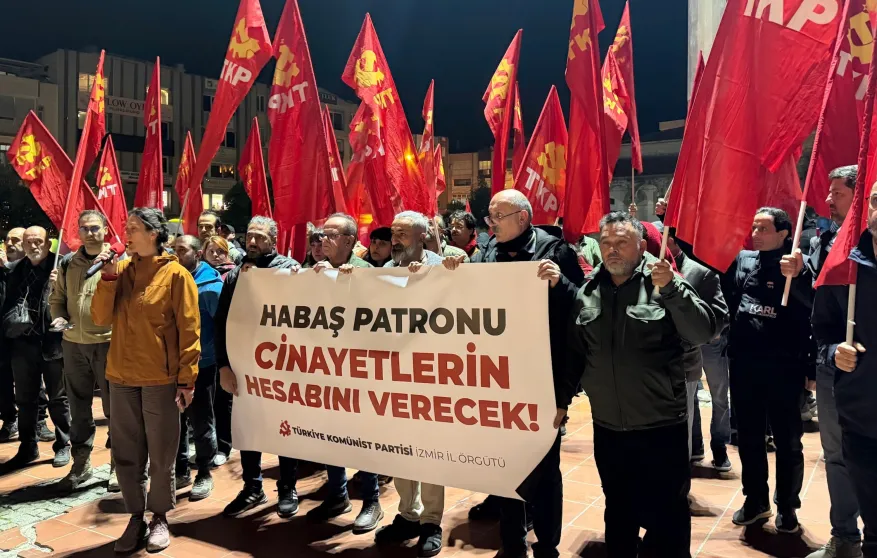

The Communist Party of Turkey (TKP) organised a protest in Aliağa following the deadly explosion at the HABAŞ iron and steel plant, denouncing the disaster as a workers’ massacre and holding the company’s owners responsible for the unsafe working conditions.
TKP takes to streets following factory explosion
A devastating explosion followed by a fire occurred at the HABAŞ iron and steel plant in Aliağa, İzmir, on 9 November. The disaster claimed the lives of 17 workers and injured 15 others, two of them seriously, according to the latest figures reported on 10 November.
The explosion took place during maintenance work at the plant’s electric arc furnace. Initial statements by the İzmir Governor’s Office suggested that an overhead crane had broken loose and fallen into the furnace during molten-steel operations. Subsequent preliminary findings announced by the Ministry of Labour indicated that a falling object had damaged natural-gas and oxygen pipes during maintenance, triggering the explosion. Investigations are continuing to establish the exact sequence of events and determine responsibility.
The scale of the disaster has once again drawn attention to the dangerous working conditions at the plant. HABAŞ has a long record of serious workplace accidents, including explosions, molten-steel spills, crane failures and falls from height. Previous incidents have killed and injured numerous workers over several decades. Just days before the latest explosion, on 5 November, another worker, Eyüp Eğinli, died when a heavy-machinery tyre exploded during inflation. On 21 October, Hakan Doğan died after falling from a height while working at the facility.
TKP: “HABAŞ is a factory that grinds people up”
In response to the disaster, the İzmir Provincial Organisation of TKP organised a protest in Aliağa. Party representatives also went to the hospital and the factory to seek information from the authorities and express solidarity with the families of the workers.
Speaking on behalf of the Party delegation, TKP İzmir Provincial Chair Tuğçe Sezen Gedik described the explosion not as an unfortunate accident but as a “workers’ massacre”. She called HABAŞ “a factory that grinds people up” and held the company’s owners responsible for the deaths.
Gedik stated that, according to information from workers, approximately 26 workplace accidents occur at the factory every month. She also pointed out that three fatal workplace accidents had taken place there in the preceding six weeks. Yet, she argued, the deaths had become so commonplace that they were no longer even attracting public attention.
She described the distress of families who spent the day trying to find out whether their relatives were among the dead or injured, while receiving no clear information from the authorities. The Party expressed solidarity with the families and condemned the failure to provide them with timely and reliable information.
Gedik also drew attention to the relationship between low wages, excessive working hours and workplace deaths. Workers earning around the minimum wage of 28,000 lira, she said, are forced to work overtime because they cannot make ends meet. Exhaustion, long shifts and inadequate safety measures expose them to increasingly serious risks.
She rejected the idea that workplace safety could be ensured simply by displaying warning signs around the factory. Proper safety requires machinery and equipment to be stopped for maintenance and inspection, and effective precautions to be implemented before workers' lives are put at risk. According to accounts from former workplace safety specialists at the plant, such measures are often considered only after a worker has died.
A wider crisis of workplace safety in Turkey
The disaster in Aliağa is not an isolated incident. It reflects a broader pattern of workplace deaths in Turkey, where workers in industry, construction, agriculture and transport continue to lose their lives under unsafe conditions.
According to the Workers’ Health and Occupational Safety Assembly (İSİG), at least 1,736 workers died in work-related incidents in the first nine months of 2026. The organisation recorded 226 deaths in September alone. These figures underline the scale of the problem and the persistent failure to guarantee safe working conditions across the country.
The burden falls particularly heavily on workers with little bargaining power, including those employed through subcontractors and those without trade union representation. At HABAŞ itself, several of the workers killed in previous incidents were employed by subcontracting companies. The pursuit of uninterrupted production, cost reduction and profitability, at the expense of proper maintenance and safety measures, has repeatedly placed workers' lives in danger.
Gedik emphasised that workers are employed in the most difficult and dangerous jobs for the lowest wages, whether in mines, textile factories, construction sites or industrial plants. “We no longer want to die,” she declared, rejecting the idea that the latest disaster should be followed merely by the announcement of casualty figures and official condolences.
She recalled the names of workers who had died at HABAŞ in previous years, including Kadir Özdemir, Raif Çatan, Şaban Karaca and Oktay Eryılmaz, as well as Hakan Doğan and Eyüp Eğinli, who died in October and November 2026. The Party insisted that these workers must not be reduced to statistics or forgotten.
Gedik also accused HABAŞ of prioritising its commercial interests, referring to the company's steel exports to Israel and alleging that workers were losing their lives while the company protected its profits.
Concluding her speech, she stressed that the wealth of Aliağa is created by its workers, not by the factory owners. “This country does not belong to the bosses. We are the ones who produce everything in this country,” she said, insisting that workers have the right to live and work in humane conditions.
TKP vowed that the deaths would not be forgotten and that those responsible would be held to account.