
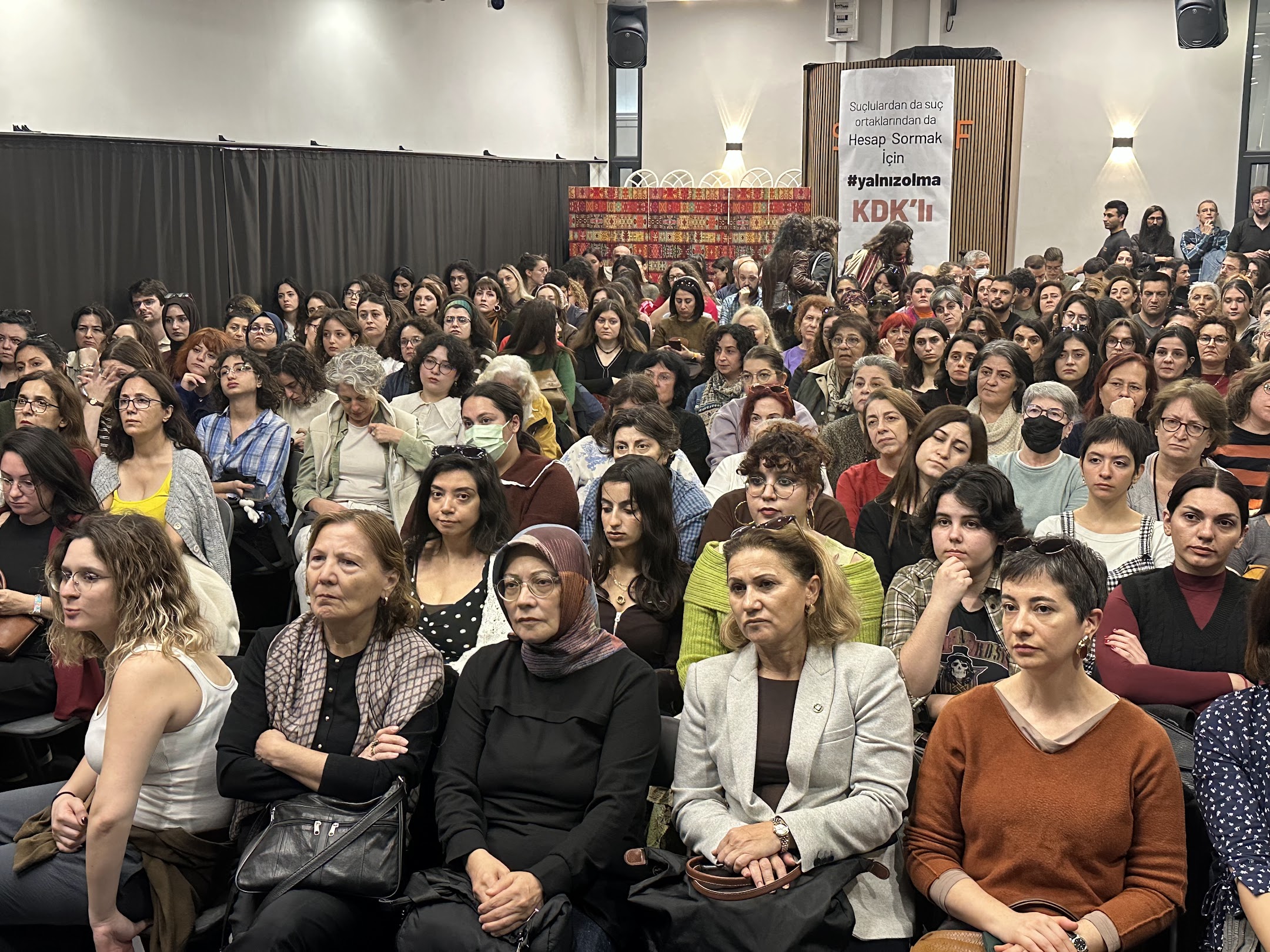

The Women's Solidarity Committees (Kadın Dayanışma Komiteleri – KDK), an initiative associated with the Communist Party of Turkey (TKP), have announced a nationwide campaign against individual armament, to begin on 25 November, the International Day for the Elimination of Violence against Women.
TKP's women's solidarity committees launch nationwide campaign against individual armament
The announcement was made at a public meeting in İstanbul addressing the connections between violence against women, poverty, social inequality and the spread of firearms.
The initiative builds on the committees' previous “You Are Guilty” campaign, which held the government accountable for failing to fulfil its responsibility to prevent violence against women. KDK representative Senem Doruk İnam said that the committees would now take this campaign further by organising a countrywide struggle against the widespread availability of guns.
According to figures presented by İnam at the meeting, one in every two women killed in Turkey is murdered with a firearm. She further stated that 84% of firearm-related murders are committed with unlicensed weapons. These figures were presented by KDK and have not been independently verified in the report.
İnam argued that the easy availability of guns, including through online platforms and messaging applications, puts women and children at risk. She cited cases in which perpetrators had reportedly obtained weapons through informal sellers, Facebook and Telegram. She questioned why authorities capable of rapidly identifying people expressing opposition to the government online were not taking comparable action against those selling and distributing illegal firearms.
Violence against women is rooted in social and class relations
The İstanbul meeting brought together journalist Filiz Gazi, lawyer Hande Gündoğdu and KDK representative Senem Doruk İnam. Their discussions examined the social, economic, legal and political dimensions of violence against women.
Filiz Gazi argued that poverty and the withdrawal of public services have created conditions in which religious sects and conservative networks can expand their influence, particularly in poorer neighbourhoods. She referred to districts including Zeytinburnu, Güngören, Bağcılar, Gaziosmanpaşa and Sultangazi, arguing that women deprived of education, economic independence and access to public institutions are particularly vulnerable.
Gazi also criticised approaches to women's liberation that remain detached from class inequalities. She argued that understanding the conditions of working-class women requires confronting poverty and the way economic deprivation shapes everyday life. She also highlighted the spread of organised crime and drug networks into working-class neighbourhoods, including the recruitment of children into criminal activities.
Lawyer Hande Gündoğdu stressed that the struggle against violence cannot be separated from the struggle for equality. Referring to the experience of women's organising and Marxism, she stated: “The liberation of women is possible through the liberation of the class.”
Gündoğdu criticised judicial practices that have historically granted unjustified reductions in sentences to men convicted of murdering women, sometimes on the basis of women's ordinary behaviour. She argued that improvements in this area have resulted from organised women's struggle rather than simply from legislative changes.
She also emphasised that formal legal rights are insufficient when women lack the economic and social support needed to exercise them. Women may face violence when seeking divorce, demanding alimony, working or asserting custody rights, while the lack of public support services makes it harder for them to leave abusive situations. KDK's reporting and solidarity line, she noted, provides women with legal and psychological support.
Against the isolation of women and the normalisation of violence
İnam argued that women are increasingly encouraged to believe they are alone and powerless in the face of violence. She criticised the government's declaration of an “Year of the Family”, pointing out that many women are killed inside their own homes and that the family cannot be treated as a guarantee of women's safety.
She also linked violence against women to the exploitation of labour and insecure employment. Referring to workers killed at HABAŞ and women who lost their lives in the Dilovası perfume factory fire, she argued that women's struggle cannot be separated from workplace safety and the broader struggle against exploitation.
The meeting concluded with a call for women to participate in the committees' nationwide campaign against individual armament beginning on 25 November. KDK representatives also invited participants to the workers' rally planned for 29 November in Kartal, İstanbul, against poverty, corruption and imperialist policies.
Through this initiative, the Women's Solidarity Committees are seeking to broaden the struggle against violence beyond responses to individual crimes. Their campaign connects the prevention of violence with controlling the spread of firearms, strengthening public social support, challenging impunity and building collective organisation among women and working people.