
The following article written by Aydemir Güler and entitled "When There Is No Anchor, You Drift" was published in soL, organ of the Communist Party of Turkey (TKP). It reflects on the expansionist Neo-Ottomanist policy of the government.
Communist Party of Turkey on government's drifting foreign policy
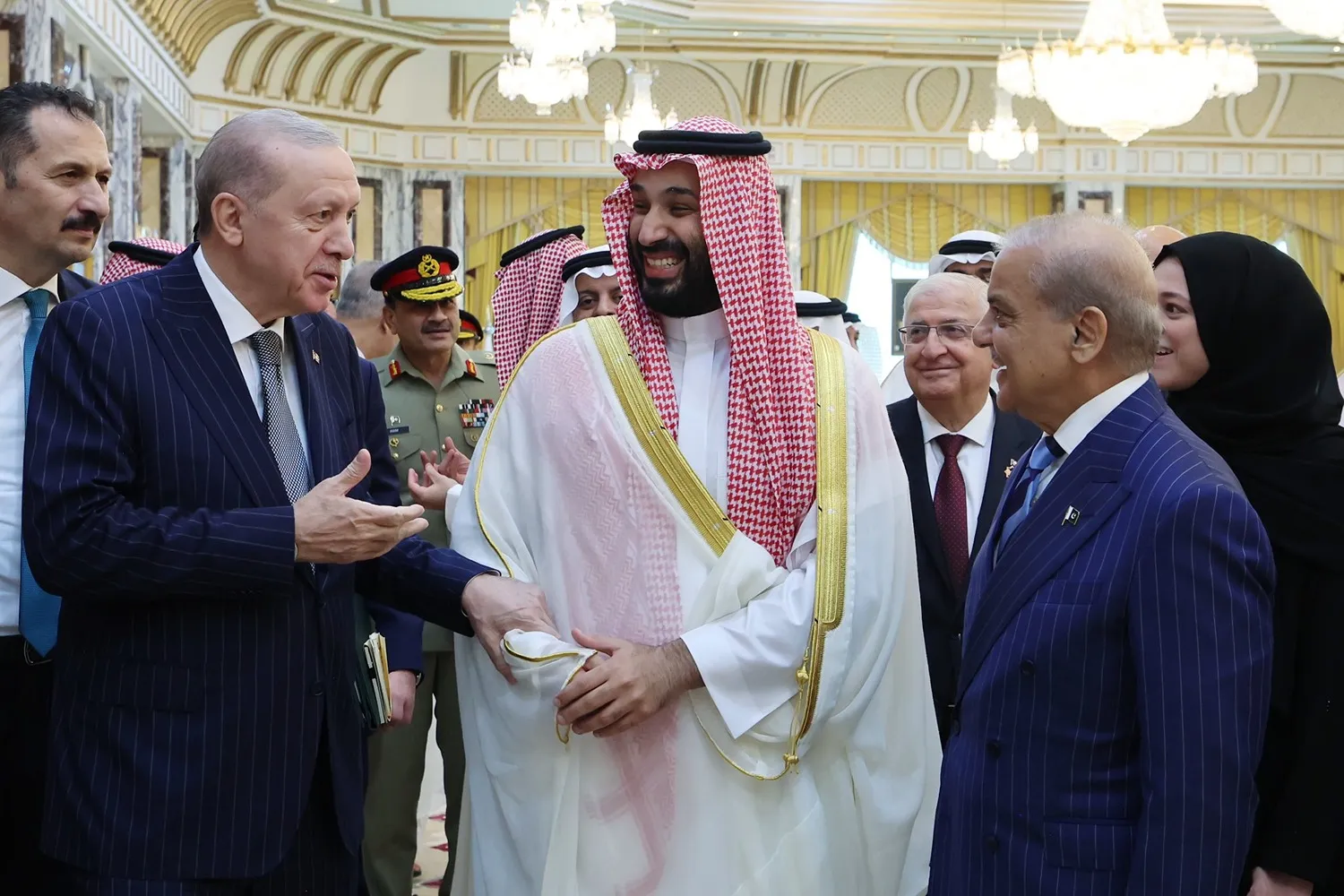
Apparently, the Mecca Agreement has a secretariat. A retired Pakistani lieutenant general has been appointed to this position. We do not know who chose him or what he is going to do. But when Saudi Arabia, unable to cope with the Yemeni resistance, cried out for help, we heard the Turkish Foreign Minister’s response: “We are men of our word.”
In general, a state is expected to fulfil the requirements of an agreement it has signed. In international relations, the replacement of the “law of the jungle” by law was an important historical advance. We owe this advance to the modernization of states. And modernization, which was connected to the Enlightenment and the bourgeois revolution, cannot be separated from institutionalization and the establishment of rules.
Of course, arbitrariness, uncertainty and the absence of oversight were never absolute. What should be understood by the lack of institutions and rules is that politics was determined directly by what the balance of power at any given moment allowed. This had been left behind; a knot had been tied in history that could not be undone and returned to what came before.
Then they untied that knot. Today, the old order of arbitrariness has risen from its grave and returned. It is roaming all over the world… Like a zombie!
If Hakan Fidan were defending the modern state and modern diplomacy, we might even overlook the sexism contained in the phrase “we are men of our word”! But that is not the case at all.
The information we have about the Mecca Agreement consists of nothing more than a press release. It was clear what the release wanted people to remember: Turkey, Pakistan and Saudi Arabia would each regard an attack against one of the others as an attack against itself and would respond jointly. This provision of the agreement was hyped up with a suggestive comparison to NATO…
The agreement was signed on 7 August. The Grand National Assembly of Turkey went into recess on 11 August, before the Mecca Agreement could come before it. We hope that when it reconvenes on 1 October, the Mecca Agreement will also be discussed.
Until then, there is no agreement; it has no legal effect. Fidan can make whatever claims he wishes about himself, but the Republic of Turkey has no obligation toward Riyadh because of the Yemen crisis. First, the Assembly has to approve the Agreement.
For quite some time now, we have not known what the Grand National Assembly is authorized to do and what it is not. By “we,” I mean all of us, including members of parliament. MPs have an additional peculiarity: they do not seem to care about this either. But one thing is clear: deploying the Turkish Armed Forces abroad does not happen simply because an international agreement enters into force. The Assembly must also decide on the deployment — in the commonly used terminology, the parliamentary authorization motion, or tezkere, must be passed.
If institutions and rules were functioning, both the agreement and the subsequent issue of sending troops abroad would be expected to be debated and assessed not only in Parliament but also by the public. Because what we are talking about is war!
This remains the case even though the citizens of the Republic of Turkey have, for a very long time, confused the whereabouts of their children, whom they assume to be responsible for the country’s security — in which country, in which sea — and have even gradually lost interest in the matter. In other words, Parliament will reconvene and the Mecca Agreement will be discussed. Those who swagger around declaring themselves “men of their word” will have to appear not only before MPs but before the public as well, and explain why we should help the Saudi dynasty out of the corner it has been backed into in its unjust war against Yemen! And the public will not merely listen to this charade…
At the same time, there is no such thing as the modern state — which is tied to institutionalization and the establishment of rules, and is therefore the product of historical progress — necessarily doing everything right. People also have the right to resist wrong and evil, even when they are dressed up in legal forms. It is the people’s right to oppose an unjust war, especially an unjust war to be waged in Yemen, whose traumatic memories will never fade; beyond merely objecting, they have the right not to accept a decision taken in that direction and, moreover, to struggle to prevent its implementation. Our job is not simply to sit and listen to what is discussed in Parliament.
We are certain of this: Turkey cannot be reduced to an updated version of the “Yemen song”! Our people will not watch passively as they are left without an anchor and dragged toward war. They will not watch, because the Mecca Agreement is not the first disgrace. In recent months, although less striking than the prospect of fighting at the other end of the Arabian Peninsula, various costs of our drift have accumulated. The Yemen issue represents far more than the final drop that causes an already full glass to overflow.
By costs, I mean the Russia-Ukraine war. Through its NATO membership, Turkey had inevitably found itself aligned with Ukraine. Having concealed this position for a while, it has increasingly made it explicit and has in fact become involved in the war.
Since 22 July, at least three of our citizens have lost their lives and more than thirty have been injured in drone attacks targeting Turkish-flagged commercial and fishing vessels sailing in the Black Sea. The number of ships anchoring at the Marmara entrance to the Istanbul Strait and delaying their voyages for security reasons is increasing rapidly. Maritime workers are demanding safety for their lives…
Being a “man of your word” is not enough to come to the Saudi king’s aid. But to protect its own citizens and ensure the safety of commercial activities, Turkey does not need to sign any agreement at all!
However, there are other relations between the AKP and the Ukrainian government, which, by threatening to join NATO, pushed the start button on provocation toward war with Russia…
Selçuk Bayraktar began marketing armed unmanned aerial vehicles to Kyiv in 2019. He did not merely sell them; he also donated some products. That was not enough: he then attempted to build a factory in Ukraine, and the facility was damaged by Russian attacks. But, as might be expected from someone whose name is mentioned among the AKP’s potential future leaders, the son-in-law said that construction would resume and that plans for joint production with Ukraine would be “pursued with determination”… The claim to be a “man of his word” is not Fidan’s monopoly!
So, are we not allowed to debate Turkey's decision to build an arms factory in a country at war? If someone says, “No, it is a private enterprise; in a free market everyone can invest their capital wherever they want,” will it not be the right of our people to put an end to a system of capital that does not value the country’s security as much as it values profit?
And today, when war cannot be reduced to armies physically confronting each other on land, what more would Turkey have to do before it could be considered to have entered the Russia-Ukraine war? Throw the Montreux Convention on the Turkish Straits into the trash and allow NATO fleets free access to the Black Sea? Allow our land, sea and airspace to be used to attack Russia? If we do not exercise our right to put an end to militarism, these will be the next steps.
From Yemen to Ukraine, all of this may still sound fantastic. But the sailors who have been killed and wounded, the UAV shot down near Ankara last December, and the other drones flying and sailing along our Black Sea coast are not fantasies; they are reality. While we are on the subject, a note: the question of which country the Elmadağ drone belonged to has been left shrouded in uncertainty. Here too, we have to conclude not that science and technology have been helpless, but that the institutions and rules capable of explaining a threat that reached as far as the capital no longer exist. How could they? It is even theoretically possible that the drones targeting us were produced in Turkey!
On the eastern flank, Iran is in the possibility of a third wave. We can be sure that the picture will not be complete without something happening on the Western front. The warming of the Athens–Nicosia–Tel Aviv axis continues…
Turkey needs new councils and institutions. Our new anchor should not be formed by being a “man of our word” or anything of the sort, but by principled and virtuous values. Peace will be at the forefront of these.
There will be no room here for imperialism, above all NATO. The military will be primarily responsible for defending the country, and politics for the security of its citizens. Everything will be decided by the people’s representatives, and every decision will be subject to the oversight of an organized people.
All of this is not merely possible; it is necessary. Because we have been left without an anchor and are drifting toward a war. Preventing this is no longer a matter of choice; it has become a necessity.