
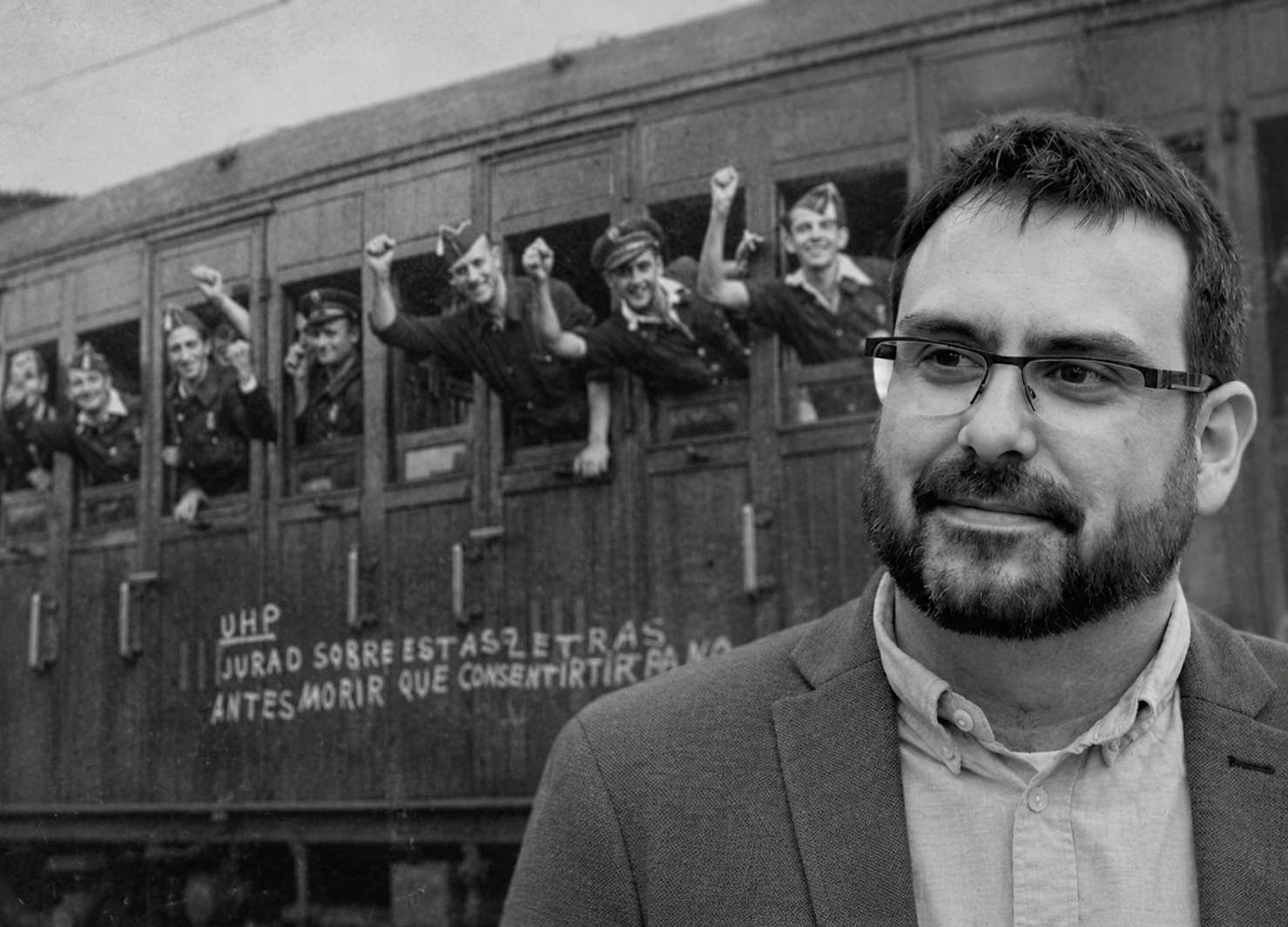
General Secretary of the Communist Party of the Workers of Spain (PCTE) Astor García wrote an article for the International Communist Press, on the 90th anniversary of the International Brigades. Thousands of volunteers from different countries came together in the International Brigades and fought the fascist forces in the Spanish Civil War.
EXCLUSIVE: General Secretary of PCTE Astor García on International Brigades
On the 90th Anniversary of the Founding of the International Brigades
Ástor García. General Secretary of the CP of the Workers of Spain
Ninety years ago, in the autumn of 1936, thousands of men and women from dozens of countries began arriving in Spain. Many were communists. Others were socialists, trade unionists or antifascists who had come to understand that what was happening in Spain was not simply a Spanish affair. They left their homes, crossed borders and travelled to a country that many of them barely knew. Some would never return. They became members of the International Brigades, whose history remains one of the most important chapters in the memory of the twentieth-century workers’ movement.
We remember and honour the International Brigades for their heroism and their internationalism, but their significance goes beyond both. Their very existence raises a political question of much wider importance: why did tens of thousands of workers from other countries come to see the war in Spain as their own war too?
To answer that question, we have to look at the character of the conflict itself. The term that later became internationally established, the “Spanish Civil War”, describes one obvious aspect of what happened between 1936 and 1939. Part of the army rose against the Government of the Republic, and the partial failure of the coup led to a war fought mainly within Spain’s borders. But a definition can be correct and still incomplete. The war in Spain was a civil war, but it was also much more. It was a war against a military and fascist uprising, a major episode in the European crisis of the interwar period, a conflict shaped from its earliest days by foreign intervention, an arena of confrontation between fascism and the workers’ movement, and a deep revolutionary crisis in which the question of political power became practical rather than merely theoretical.
By the time the first volunteers arrived, Europe was already moving rapidly towards another major war. Hitler had been in power in Germany since 1933. Mussolini had ruled fascist Italy for more than a decade. The European workers’ movement had suffered major defeats, while the most aggressive forms of political reaction were gaining ground. The German experience had already shown that fascism could not be understood as a purely national phenomenon. Its victory in one country changed the balance of forces across the continent.
The Spanish military uprising immediately became part of this wider international crisis. Germany and Italy provided decisive support to the rebel forces. Their intervention began within weeks and eventually included troops, aircraft, military equipment, specialists and extensive military assistance. It cannot be separated from the broader direction of European politics in the 1930s. The major capitalist powers of Europe responded by promoting the policy of “Non-Intervention”. In formal terms, this policy was meant to prevent the internationalisation of the war. In practice, it left the Spanish Republic in an extremely difficult position when it came to acquiring the weapons it needed, while Germany and Italy continued to support the rebels materially. The Soviet Union eventually became the principal state providing military assistance to the Republic. The conflict was therefore Spanish in terms of the territory where it was fought and the social contradictions from which it emerged, but it also formed part of the international crisis that would lead to the Second World War.
The Communist International and the men and women of the International Brigades understood this connection in very concrete terms. For a German communist who had seen Hitler destroy the organisations of the workers’ movement at home, fighting in Spain did not mean joining a foreign war. The same was true for many Italian antifascists. Similar conclusions were drawn by volunteers from France, Britain, the United States, Poland, Yugoslavia and many other countries. A fascist victory in one country altered the political conditions in the others. Their internationalism was therefore not based on abstract solidarity. It came from a concrete understanding of the struggle itself. Capitalism operated internationally, reaction was advancing internationally, and the war taking shape in Europe was international in character. The response of the working class could not remain confined within national borders.
Yet the international dimension alone does not explain the Spanish war. We also have to look at what happened inside Spain after the partial failure of the coup in July 1936. The uprising was intended to destroy by force the political and social movement that had developed during the preceding years. Where the coup was defeated, however, the immediate result was the opposite: the political crisis deepened dramatically. In many cities, workers’ organisations and popular mobilisation played a decisive role in stopping the military insurrection, while the republican state apparatus was seriously weakened across large parts of the country. Thousands of workers took up arms. Committees, councils and militias were formed. Workers’ organisations began to perform functions that had previously belonged to the state, and industrial and agricultural collectivisations developed in many areas. Political authority became fragmented, and for a time bodies created directly by workers’ and popular mobilisation assumed an extraordinary importance.
This did not mean that an organised and centralised revolutionary power already existed in July 1936. There was no single political leadership of the process and no common strategy shared by the different workers’ organisations. The Communist Party of Spain was still relatively weak compared with other forces that had a longer history. The political bodies created after the failure of the coup were also highly diverse. But the absence of a unified revolutionary power does not mean that there was no revolutionary situation. A revolutionary situation is defined precisely by the crisis of the old power and by the fact that the question of what will replace it remains open. In Spain, the question of power had become practical. Who held the weapons? Who organised production? Who controlled the territory? Which institutions could enforce decisions? Which class was capable of leading society? These were no longer questions for some future debate. They had moved to the centre of political life.
The process had not begun in July 1936. Two years earlier, in October 1934, the working class had led one of the major proletarian insurrections in Western Europe during the interwar period, especially in Asturias. For several days, revolutionary bodies, armed structures and embryonic forms of workers’ power emerged. The uprising demonstrated the extraordinary combativeness of important sections of the Spanish proletariat. It also revealed clear limitations: political fragmentation, uneven development across the country and the absence of a revolutionary leadership strong enough to operate on a national scale.
The events of July 1936 brought those problems back under far more dramatic conditions. The struggle against fascism now unfolded within a profound crisis of power. For that reason, any interpretation that reduces the war to a simple opposition between fascism and democracy is inadequate. That opposition was real and had enormous material consequences. A victory for the rebels meant the destruction of workers’ organisations, the abolition of political and social rights and brutal repression, as events would later confirm. But because defeating fascism militarily was an immediate necessity for the working class, an even more difficult strategic question arose: how should the antifascist war relate to the revolutionary struggle?
The answer could not be to ignore the military demands of the conflict. The republican camp had to turn a vast but dispersed popular mobilisation into a force capable of fighting for months and years against an enemy that had professional units, a clear chain of command and the military support of Germany and Italy from the outset. Supply, coordination between fronts, the training of commanders, the unification of units and the rational use of resources were matters on which the survival of the Republic depended. The PCE understood early the importance of building a centralised military capacity and played a major role in that process. No revolutionary process could have survived an immediate military defeat. Such a defeat would also have meant the physical and political destruction of the working-class forces that had driven the process opened in July.
The real difficulty was that organising the war was never a purely military matter. Every military solution also changed the political balance inside the republican camp. It altered the relationship between the bodies that had emerged from popular mobilisation and the state institutions that were trying to recover their capacity to govern. Bringing the militias into a regular army, concentrating powers and restoring state functions could improve military effectiveness.
The familiar discussion between “war” and “revolution” is too narrow to explain the Spanish process. The revolution was not waiting behind military victory as a second task that could simply begin once the first was completed. Relations of power were changing throughout the war itself. Every decision about the army, the state, production, property or political alliances helped determine which forces would emerge stronger and what political horizon the masses were being asked to fight for. Winning the war was indispensable, but the content of that victory also depended on the social and political power being built while the war continued.
These problems were closely connected to the broader evolution of the international communist movement. From the early 1920s, the Communist International had placed the question of winning the majority of the working class at the centre of its political thinking. The policy of the united front emerged from this problem. After the revolutionary wave opened by the October Revolution of 1917, European capitalism had achieved a degree of stabilisation, while social-democratic organisations retained considerable influence over millions of workers. Communists could not simply ignore that reality. Unity in concrete struggles could help mobilise broader sections of the class, develop their political experience and challenge social democracy for leadership of the workers’ movement. At the same time, such unity was supposed to preserve the political and organisational independence of the Communist Parties. Agreement in action did not mean the disappearance of strategic differences.
The rise of fascism made this question much more urgent. The Nazi victory in Germany in 1933 was a historic defeat for the international workers’ movement. The Seventh Congress of the Communist International, held in 1935, tried to overcome political tendencies that had made it more difficult to build broad resistance to fascism. Dimitrov argued for starting from concrete conditions, rejecting rigid formulas and finding forms of struggle and political language capable of reaching much wider sections of the masses.
This orientation responded to a real problem. A Communist Party that could not work with sections of the working class still following other organisations was condemning itself to isolation. In the face of a fascist offensive, unity in action could become a matter of survival for the workers’ movement. But the move from the proletarian united front to broader forms of Popular Front also raised a different problem. An alliance between working-class organisations might contain profound political differences, but it still rested on a relatively homogeneous social basis. An alliance that included bourgeois and petty-bourgeois sectors had a different character. Its members could share an immediate enemy while pursuing fundamentally different historical objectives.
The Spanish experience brought this contradiction into particularly sharp relief. Communists, socialists and anarchists coexisted in the republican camp alongside bourgeois republicans, small property owners and other social groups whose interests were not the same. Defeating Franco gave them an immediate common objective, but it did not abolish class differences within the alliance. For communists, the key question was therefore how to maintain the broadest possible unity against fascism without allowing that unity to turn into the political subordination of the proletariat. This problem became even more complex as the PCE increasingly defined the conflict as a “National-Revolutionary War”.
The concept captured two real dimensions of the Spanish war. It was national because the rebel camp depended heavily on foreign military intervention. Nazi Germany and fascist Italy were not simply political supporters of Franco. Their intervention directly affected the military balance, and the defence of republican territory could therefore also be understood as a defence of national independence against those powers. At the same time, the war was revolutionary because it unfolded within a profound crisis of the political and social order. The armed mobilisation of the proletariat, the emergence of organs of popular power and the crisis of the old state apparatus gave the struggle a content that went far beyond the restoration of the pre-coup legal order. In that sense, the concept of a National-Revolutionary War is much richer than the image of a civil war between two equivalent Spains. It allows us to understand the different dimensions of the conflict at the same time.
The difficulty was that the balance between those dimensions could shift. As the “national” element became more prominent, the class content of the conflict risked moving into the background. The defence of Spain against German and Italian intervention encouraged the idea of a broad national camp united against domestic and foreign fascism. That interpretation made it possible to bring together classes whose interests coincided around certain immediate aims but diverged sharply when it came to transforming the social order.
It was in this context that the idea of a “democratic Republic of a new type” gained importance. The proposal sought to give lasting political form to the broad antifascist coalition through a regime supported by forces extending well beyond the working class and the peasantry. In doing so, it also introduced the idea that intermediate stages existed between capitalist power and workers’ power. In practice, this formula set limits on the transformations considered possible by subordinating any socialist perspective to the defence of the Republic. Once preserving the antifascist bloc became the overriding criterion, the strategic limits of the process were already being defined.
At that point, the question of which class would lead the process increasingly moved into the background. The opposition between fascism and antifascism came to dominate almost the entire political field, even though the internal contradictions of the antifascist camp had not disappeared.
The final phase of the war exposed those contradictions very clearly. As long as victory still seemed possible, the need to defeat Franco made it possible to keep together political and social forces with very different interests. Once defeat began to seem unavoidable, that unity started to fracture. In March 1939, Colonel Casado’s coup against the Government of Juan Negrín opened the final major conflict within the republican camp. Some forces wanted to end the war immediately and seek an agreement with Franco. Others, including the communists, argued for continuing resistance. Antifascist unity had not eliminated the contradictions within the republican bloc. It had only subordinated them temporarily to a common necessity.
There is a broader lesson here. No political alliance abolishes the objective interests of the classes that make it up. Revolutionary politics therefore cannot confuse temporary compromises with a permanent strategic community. For a Communist Party, the important question is not simply with whom an agreement can be reached. It is also what that agreement does to the independent organisation of the working class, to its political consciousness and to its ability to intervene in the struggle for power.
Seen from this perspective, the significance of the International Brigades becomes even clearer. The brigadistas came to Spain because they understood that a defeat of the working class in one country strengthened its enemies elsewhere. They also understood that some struggles may take place within national borders while carrying consequences that go far beyond them. The International Brigades were, in this sense, one of the most concrete expressions of proletarian internationalism in modern history. Their experience shows that workers in different countries share historical interests that do not disappear because they live under different states. Internationalism is therefore not simply a matter of expressing solidarity with struggles taking place elsewhere. It means understanding that apparently separate struggles can form part of the same historical process.
Those who came to Spain in 1936 experienced this reality in the harshest possible way. Many German and Italian antifascists who fought in Madrid, Jarama, Guadalajara, Brunete or the Ebro had already spent years fighting fascism in their own countries. For them, Spain was another front in a war that had already begun. For other brigadistas, Spain would be the first battle in a war that would engulf the whole continent only a few years later. When the Second World War officially began in September 1939, the war in Spain had ended only five months earlier.
Communist memory loses much of its value when it turns defeats into comfortable stories and heroes into figures without contradictions. Respect for those who came before us requires something more demanding. We have to study the conditions in which they acted, the problems they faced, the decisions they made and the limits that we can identify in those decisions today. We should not judge from the comfort of the present those who had to act under bombardment, military defeat and an extraordinarily unfavourable international balance of forces. But there would be little point in studying history if we refused to draw political conclusions from it.
The war in Spain raises questions that remain relevant today. How should tactics relate to strategy? How can unity be built without sacrificing political independence? How should communists work alongside forces representing different social interests? How can the most violent forms of reaction be fought without reducing communist politics to antifascism? How can immediate necessities be addressed without turning them automatically into strategic goals? How can the national dimension of a conflict be understood without losing sight of its class content? And how can an internationalist policy be developed in a world still organised through capitalist states and rivalries between powers? The answers given in 1936 cannot simply be transferred to the present. History does not provide recipes. It does, however, provide experience, and the communist movement possesses few resources more valuable than the accumulated experience of generations of workers who confronted similar problems before us.
The International Brigades are part of that experience. Ninety years ago, their members crossed borders to join a war that was geographically distant but politically their own. They did so not because Spain was their homeland, but because their class was fighting there. That may be the most important lesson to preserve from the International Brigades ninety years later. At a moment when Europe was moving towards catastrophe, tens of thousands of workers gave practical form to an idea that remains central to communist politics: when exploitation, reaction and war operate internationally, the working class can achieve emancipation only by acting as an international force as well. The borders they crossed still exist. So does the reason they chose to cross them.