
The following article written by Matthew Read and entitled "Right-left confusion" was published in Unzere Zeit, organ of the German Communist Party (DKP).
German Communist Party on Berlin elections
It's another blow for the Merz-Klingbeil gang. The grand coalition, which had governed Berlin since 2023, was the most unpopular state government in Germany in the months leading up to the capital's election. Despite desperate attempts to turn things around with surprise candidates, the CDU and SPD were punished last Sunday. The Social Democrats were hit the hardest: The self-proclaimed "Berlin party," which has held seats in the Senate continuously since 1990, suffered its worst result ever. This is the consequence of the party headquarters at the federal level prioritizing the profit interests of real estate corporations over the successful referendum in Berlin and over its own party resolutions with its proposed ban on socialization initiatives.
Disarmed in the housing debate, SPD lead candidate Steffen Krach attempted to capitalize on the wave of panic following the AfD's victory in Saxony-Anhalt. In the final weeks before the election, he drove a loud techno bus through Berlin under the slogan "Krach against Nazis." But in the heavily indebted and unaffordable city, this approach backfired: Upon leaving their polling stations, 70 percent of voters said the Social Democrats had "lost sight of the concerns of ordinary people." In the end, more trade unionists voted for the AfD than for the SPD.
The Greens, who also portrayed themselves as an anti-fascist bulwark, emerged from the election similarly devastated. They were not only overtaken by the AfD, but also lost their stronghold in the gentrified Friedrichshain-Kreuzberg district to the Left Party.
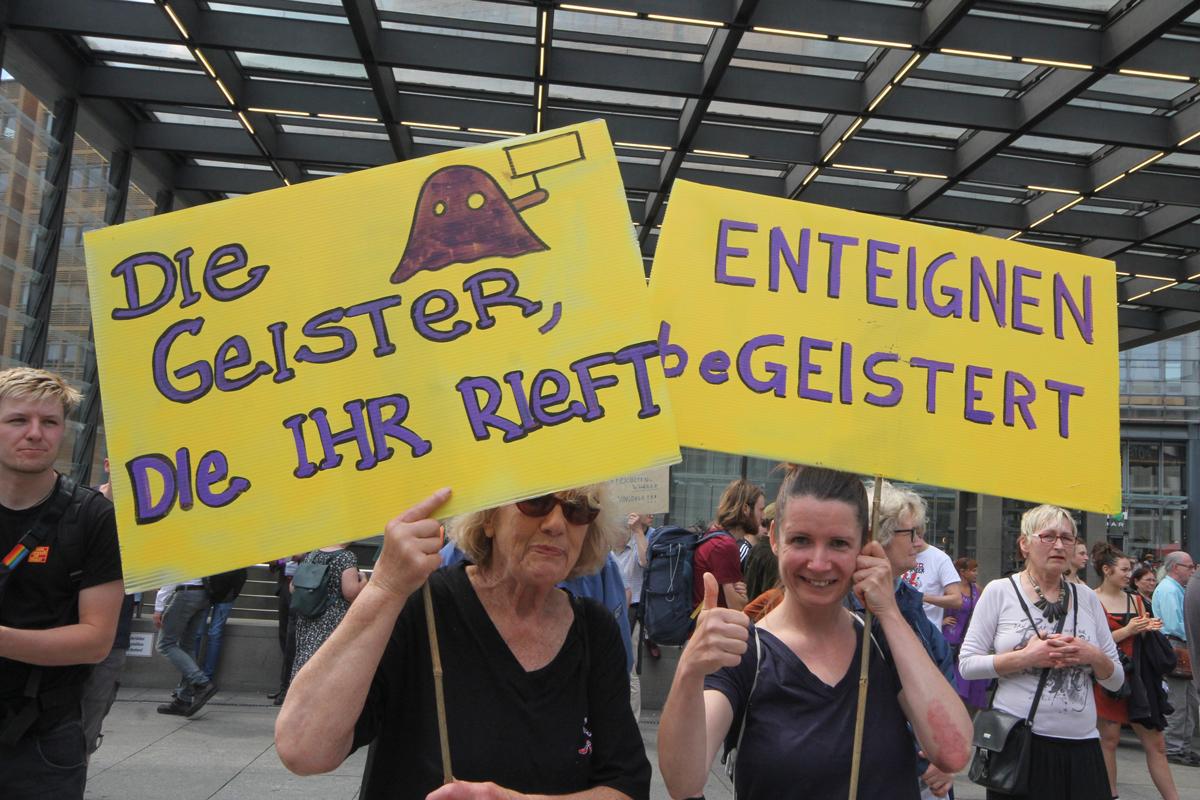
The latter appears to be the winner in Berlin at first glance. During the election campaign, she emphasized the unaffordability of the capital and promised to finally implement the expropriation of real estate companies, a measure demanded by a referendum years ago. In recent weeks, the party leadership has been striving to unite the right and left wings of its state branch: sometimes opposing arms production in the city, sometimes calling for the closure of the Russian House and supporting sanctions against Russia. At times, she expressed solidarity with the people of Gaza, at others, she condemned the very activists protesting against the genocide. This balancing act was enough to defeat the CDU at the ballot box. However, the potential coalition partners, the Greens and the SPD, as well as the mainstream press, are now doing everything in their power to shatter this unity and help the "right wing" of the Left Party come to power. In doing so, they are wielding the sledgehammer of accusations of antisemitism in all media outlets.
The success of the Left Party in Berlin reflects the general trend within the party. It is increasingly attracting disillusioned Green and SPD voters, thereby becoming younger, more urban, and more western. While it achieved its best result to date in the capital, it suffered its heaviest defeat on the same day in Mecklenburg-Western Pomerania. In Berlin itself, the Left Party's strongholds have shifted from the eastern outskirts—now dominated by the AfD—to the more gentrified city center.
This shift coincides with the party's further drift away from its former pacifist positions. According to an Infratest dimap poll, 63 percent of Left Party voters in Berlin are convinced by the anti-Russian threat narrative (compared to only 26 percent of AfD voters). Those who adopt the logic of warmongers find it difficult to expose militarization. Accordingly, the arms race played almost no role in the Left Party's election campaign. Instead, the party spoke extensively about the "garbage chaos," affordable housing, and public transportation. But how can a municipal housing program and free train tickets be implemented while billions are being poured into rearmament? The same applies to the much-touted socialization of real estate companies, which, under a red-red-green coalition government, will at best amount to an expensive repurchase of privatized apartments—if it even happens at all. The right-wing members of the "Left" state association, gathered behind the state chairman Maximilian Schirmer, gladly take over the "gun and butter" scepter of the SPD, which is drifting to the right.
The reshuffling of seats in the Berlin House of Representatives has not strengthened the peace movement. None of the represented parties will consistently address the connection between social cutbacks and militarization. The dismantling of campaign promises began on election night. With a grand coalition that continues its "business as usual" approach at the federal level, and a Left Party integrated into a moderated state government, the AfD would be able to cement its status as the "only alternative." Among Berlin's working class, it already holds the top spot.
(Photo: Rudi Denner / R-mediabase)