
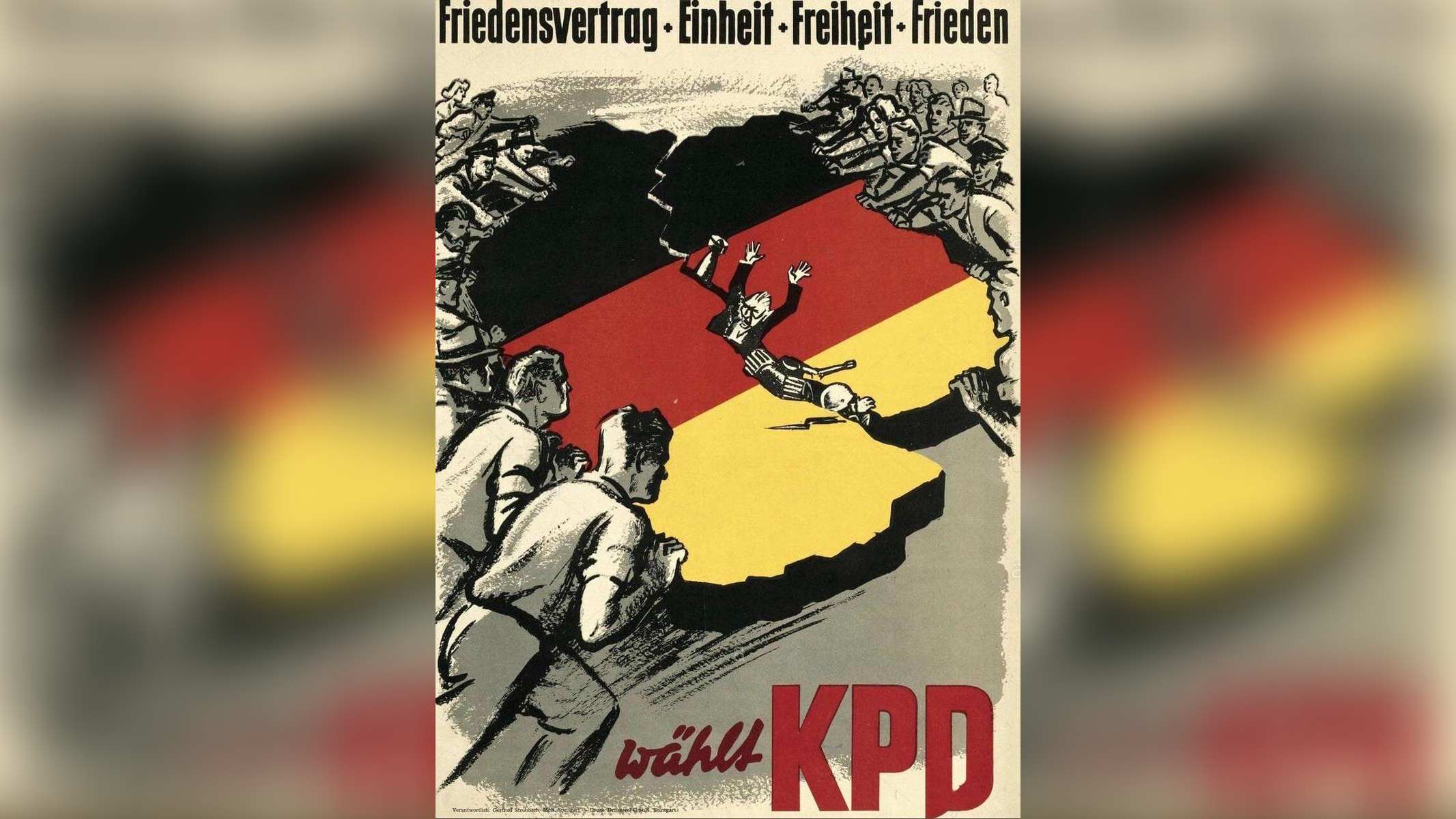
A paper was presented at the 8th meeting of the Executive Committee of the German Communist Party (DKP) entitled "On the significance of the national question for the strategy of the communists". An abridged and slightly edited version of the speech given on this subject was published in Unzere Zeit, organ of DKP.
German Communist Party on national question
The most important thing – and this must be absolutely clear before any discussion or engagement with the topic – is this: The objective of this presentation is for us to develop our own vision of what our country should look like and how it will become our country. It is not enough to simply list what is bad. We need positive goals and challenges that empower people to become active and effective themselves.
We are forced to take a position for two reasons:
- This country is in the midst of the decline of the capitalist system. Like its predecessors, the current government is increasingly ruining it at an alarming pace. Furthermore, those in power are drastically increasing the risk of war.
- The AfD doesn't just present itself as the alternative for Germany in its name. It taps into the hopes of many people that there is a positive future for this country. It appropriates the concepts of nation, fatherland, and whatever else, and portrays itself as the only force that can stop the decline of this country. It plays the nationalist card as an answer to people's concerns about their social security.
Therefore, our goal must be to develop a different vision for people of what the future of this country can look like. We want to, and must, develop our own narrative.
Nation and State
The nation is a political and social construct. The concept arose from the bourgeoisie's need for a unified sphere of influence. The great nations (Great Britain, La Grande Nation) were always also colonial powers, empires. This also explains why we speak of German imperialism as having come too late and fallen short, and why we derive its particular aggressiveness from this. While Britain, France, Portugal, Spain, and the Netherlands were already consolidated states and major colonial powers, the territory of the later German Empire was still a patchwork of a few large ones—primarily Prussia and Bavaria—and many small principalities, whose divergent special interests stood in the way of unification. Thus, according to Alfred Norden, the later German Empire of 1871 was more of a multinational state than a nation-state.
The German Reich only entered the race for the colonial division of the world in the last quarter of the 19th century, acquiring colonial possessions that were widely scattered and of little economic value:
- In Africa, the German Empire subjugated Togo, Cameroon, German South West Africa (all in 1884) and German East Africa (1885).
- In the Pacific, these were the Bismarck Archipelago and Kaiser-Wilhelm-Land (both in 1884), the Marshall Islands (1885), the Marianas and Caroline Islands, and the Palau and Samoa Islands (all in 1899).
Norden describes the situation after the Franco-Prussian War of 1870/71 as follows: “Saturated and strengthened by the billions in French war reparations, the German bourgeoisie soon opened a new, dark chapter of the oppression of peoples with colonial policy at the beginning of the 1880s.”
Nationalism played a major role in the formation of the German Reich. It was the unifying force that enabled the merging of the many small states. In this context, it is also significant that the bourgeois revolution of 1848 failed in this regard as well, and that German unification did not occur until 1871. "While the people of Berlin triumphed in the barricade battle of March 18-19, 1848, this victory was squandered by the bourgeoisie, who, out of fear of the young working class—which had provided the majority of the fighters and casualties of March 18 and 19—voluntarily submitted once again to the feudal powers and entered into that fatal alliance which left its mark on Germany for the next seventy years," writes Norden.
It also becomes clear that the national question cannot be separated from the question of whether it arises in an oppressed or an oppressing nation. Lenin pointed this out to us. We addressed this in detail during the 4th meeting of the Party Executive and came to the conclusion that present-day Germany is an oppressing nation that simultaneously consciously submits to US imperialism and to the common struggle of imperialism against its loss of hegemony.
Tension field
Manfred Sohn states the following in the invitation to a symposium of the Marx-Engels Foundation:
"The arc of tension surrounding the national question is already identified in the 'Communist Manifesto': 'Communists have also been accused of wanting to abolish the fatherland, of nationality. The workers have no fatherland. You cannot take from them what they do not have. Insofar as the proletariat must first conquer political power, rise to become the leading class of the nation, and constitute itself as a nation, it is itself still national, though by no means in the bourgeois sense.'"
This was written at the turn of the year 1847/1848. It must therefore be taken into account that the nation-building process in Europe was not yet complete at that time – Germany was still a patchwork of principalities. Nevertheless, it is obvious that there is a tension between the statement that the proletarians had no fatherland and the statement that they should constitute themselves as a nation, with regard to the practical policies to be derived from this.
This tension continues to shape the communist world movement to this day.
I would like to preface this introduction with a thesis: Communist parties have always failed in their task of 'raising the proletariat to the leading class of the nation,' that is, in establishing parties with mass influence capable of victory, whenever they have insisted solely on the first sentence. Historically, they have always been successful when they have based their policies on both sides of these paragraphs from the 'Manifesto,' that is, when they have also pursued national policies in accordance with these statements.
Sohn arrives at the following interim conclusion regarding the debate on the national question from a Marxist perspective:
- Nation is a structure of human societies that did not exist before capitalism and will no longer exist in developed communism.
- They also exist in socialism as – as Walter Ulbricht rightly formulated it – a relatively independent stage of the epochal transition from capitalism to communism and thus from the era of class societies to a classless society.
- The nation thus serves as a bridge between the final phase of class society (i.e., capitalism) and the first stage of communism (i.e., socialism).
- Within the nation, the dissolution of class society historically begins. However, this is only possible in the form of a socialist nation.
- With regard to the German nation, the GDR is the fermenting yeast in this historical process that still needs to be fought for. That is why it lies so heavily and indigestibly in the stomach of German capital.
- The fermentation becomes all the more intense as the decline of the German nation unfolds in the course of decolonization, which is historically completing before our eyes – that is, the liberation of the world from 500 years of oppression by Western Europe and its American daughter state.
- This decline, which can be seen in deindustrialization, loss of prosperity, social cutbacks, militarization, increasing lack of prospects especially for young people, and other symptoms, reopens (if it does not end catastrophically) Ulbricht's perspective of a socialist German nation.
AfD and anti-Germans
Lenin urges us to carefully examine the specific characteristics of each country. First, let's look at two examples that we encounter in Germany.
Number 1: the AfD. The name alone encompasses two important terms in the political and, above all, ideological debate: "Alternative": this reflects the discontent of parts of the population, and especially the working class, with the policies of governments in recent years/decades. "For Germany": this slogan is used to attack migrants, "parasites," and women (who supposedly don't bear enough children), fueling a reactionary nationalism that often takes on chauvinistic traits and, by ignoring the class question, promotes elements of a national community.
Number 2: the anti-Germans. Gerhard Hanloser argued about them in the "junge Welt" newspaper on April 11, 2024. "The anti-Germans may have disappeared as 'anti-Germans.' But even as a perceptible scene, they were 'mainstream in cult-like garb.' Meanwhile, parts of their positions have become part of the German 'reason of state.' They are not a forgotten fringe phenomenon, but rather a current expression of the 'misery of the German condition,' characterized by militaristic thinking, pro-Western conformism, and contempt for the left's history of internationalism and anti-imperialism. For manifold reasons, they serve the official German 'reason of state' of unconditionally supporting Israel. There is nothing critical about this anymore; an anti-German stance in the positive, emphatic sense of nonconformity, non-adjustment, and anti-state sentiment can no longer be discerned in this attitude."
Hanloser continued: “When the GDR collapsed in 1989/90, the West German left was thrown into turmoil. The newly enlarged Germany, under the leadership of Chancellor Helmut Kohl, posed a threat, not only to other countries, not only to everything that could be considered ‘un-German,’ but also to the left itself. In the early 1990s, a self-defined ‘anti-German’ sentiment and attitude was widespread within the radical left. The initial slogan, ‘Never again Germany!’” This seemed not only justified in light of the explosion of everyday racism that immediately followed German reunification. The pogroms in Rostock and Hoyerswerda, the dramatic increase in antisemitic desecration of cemeteries, and the resurgence of new great power ambitions showed that the alarming criticism of Germany during reunification, which was heard abroad and shared by significant segments of the left, was prophetic.
National nihilism
Far more dangerous than the anti-German sentiment, which is primarily confined to left-wing circles, is the fact that the question of nationhood receives little or no attention from most left-leaning groups. The party leadership has rightly placed it on the agenda, and the Marx-Engels Foundation has contributed to the discussion with a symposium.
In 1935, at the Seventh World Congress of the Communist International, Georgi Dimitrov stated: “For a long time, our comrades in Germany failed to adequately consider the wounded national sentiment and the outrage of the masses against the Treaty of Versailles; they treated the vacillations of the peasantry and the petty bourgeoisie with disdain; they were late with the program of social and national liberation; and when they finally formulated it, they failed to apply it according to the concrete needs and level of the masses; they even failed to popularize it generously among the masses.”
A significant element of this underestimation—just as with the underestimation of fascism—was that the Communist International and the KPD (Communist Party of Germany) had assumed that the next objective was socialism. The shift towards a policy of defending capitalist state structures was a laborious and painful process.
The factors at play today are different. The counter-revolution and the loss of the Soviet Union, as well as German reunification, play a major role. Both have fueled anti-communism enormously and deprived us of the GDR, a country we could have honestly considered our fatherland. We rightly describe Germany's resurgence, with its aggressively proclaimed imperialist plans abroad and its increasingly repressive measures at home, as a reactionary-militarist transformation of the state. Continuity can be found in the European strategy of German capital. All of these factors have contributed to growing unease with this Germany on the left – even to the point of national nihilism.
In an article in the "junge Welt" of April 8, 2015, Andreas Wehr points us to the ideological background of this nihilism, which comes disguised as "Hurrah Europe," and concludes: "The battleground of the 'nation-state' is being abandoned without an adequate new one being named. The exploited and socially disadvantaged are left to their own devices, as their traditional organizations, trade unions, and left-wing parties no longer offer them any prospects. In the literal sense, they are being offered stones instead of bread."
Germany
The difficulties many of us have with "Germany" stem partly from historical reasons: Founded in war. Collaborating with the "hereditary enemy" to suppress the Paris Commune. Aggressive imperialism. Colonialism and the "Hun speech." Nazi dictatorship with its "Do you want total war?", concentration camps, and genocide. No liberation in 1945 from the people. Resurgence of the old powers after 1945. "Reunification" and a new attempt at world power with the bombshell of 1999: war against Yugoslavia. Russophobia and support for Ukrainian fascists. Arms deliveries to Israel and denial of the genocide against the Palestinian people. Sucking up to the USA and its war against Iran. Resurrection of militarism. Racism and xenophobia. Historical revisionism. Kicking down, bowing down to those above. Most Germans saw no guilt after 1945, seeing themselves more as victims. And then there's the social democracy, which not only produced a bloodhound but also sees itself as a pillar of the state.
German literature contains hundreds of examples showing that revolutionary minds have always had difficulty with this fatherland.
Bertolt Brecht:
“O Germany, pale mother!
How defiled you sit
among the nations.
Among the tainted
you stand out.
O Germany, pale mother!
How have your sons
made you
that you sit among the nations
a laughingstock or a fear!”
Or Erich Kästner:
"Do you know the land
where the cannons bloom?
You don't know it?
You'll get to know it!
There, the office managers stand
proud and bold
in their offices, as if they were barracks.
There, freedom doesn't ripen.
There, it remains green.
Whatever is built –
it always becomes barracks.
Do you know the land
where the cannons bloom?
You don't know it?
You'll get to know it!"
Many were driven out of the country. For those who remained, often only their thoughts were free.
And this is a country we are supposed to love? This nation of poets and thinkers, which became the "nation of judges and executioners"?
In January 1969, Gustav Heinemann (SPD), Federal President from 1969 to 1974, was asked in an interview with "Der Spiegel" whether he didn't love this country. Somewhat curtly, he replied: "Oh, nonsense, I don't love countries, I love my wife, that's it!" This was at a time when the struggles against the suppression of Nazi crimes had just begun, and patriotism still meant that Hitler was an accident.
This is – after the historical and political element – the second thing that makes life difficult for us in this Germany: the ideological overload of a nationalism interwoven with the decline of capitalism and serving only the aggressive glorification of one's own state. Behind the "we," in the worst case, the grimace of the national community, of the master race, of chauvinism and jingoistic patriotism appears; at the very least, it is a sentimental incantation that glosses over contradictions and class issues.
Also on October 3, 1990 in Berlin: 10,000 people demonstrate against reunification under the motto "Germany – shut up". (Photo: German Federal Archives, Image 183-1990-1003-036 / Settnik, Bernd / CC-BY-SA 3.0 / Edited by: UZ)

Our nation
We must and can ideologically free ourselves from these burdens. We see the nation as the classics taught us: as a field of class struggle. We deal with our own history as Brecht tells us in his poem: "Let others speak of their shame, I speak of mine." Seen in this light, we are indeed patriots. With the "Appeal of the Central Committee of the Communist Party for the Construction of an Anti-Fascist Democratic Germany" from June 1945, the KPD presented a clear, analytical, and forward-looking document that assesses history and outlines political tasks without nationalist rhetoric. The second document that can serve as a guide for us today is Ulbricht's speech of April 21, 1966: "The Path to the Future Fatherland of the Germans." ( See UZ of July 31 )
However, we must not make the mistake of dismissing an emotional attachment to the piece of earth on which we live. Heinrich Heine offers a perspective on this in his poem "Night Thoughts":
"Germany will last forever,
it is a perfectly healthy country.
With its oaks and its linden trees,
I will always find it again."I didn't long for Germany so much,
If the mother weren't there;
the fatherland will never perish,
but the old woman may die.
It is our family, our friends, our comrades who cherish our lives. This can be said in rebuttal to any nationalist ranter. Our love belongs to humanity.
To clarify this conceptually, we distinguish between national consciousness, which reflects the “conditions of existence, historical development, current situation and the essential tasks arising from this of the nation from the standpoint of a particular class”, and nationalism, which developed with the evolution of the bourgeoisie into a reactionary class and is itself reactionary and divisive.
The nation is our battleground, without pandering to nationalism. Everything revolving around the nation and how we deal with it is always a minefield because the topic is emotionally charged: love of country, patriotism, nationalism – these are the words we have to contend with, and the difficulty lies in addressing the question "What do we want for this country?" without falling into the emotional trap. The nation is the battleground of the working class – nothing more, but also nothing less. We cannot pretend that we don't care what becomes of this country. And we must provide answers now and not defer to socialism, which will supposedly sort everything out.
Connections
Often, we can only imagine socialism as the only way out of Germany's misery. Ultimately, that's true – but we live here and now. And here and now, people are being politically, socially, legally, and ideologically oppressed, disenfranchised, persecuted, and harmed. We, like most other leftists, are busy denouncing this state.
This is clearly demonstrated by the proposed slogan "For a Government of Peace." Regardless of whether one agrees with this slogan exactly or not, it represents the task we must solve and sets the direction in which we must develop our policies. The Marx-Engels Foundation's invitation to the symposium on the national question formulated it as follows: "The national question—that is, the interests of the working class and other working people, as well as youth—is not only relevant for the peoples oppressed by imperialism. It is also relevant for the peoples of the developed capitalist states. If the communist parties in these countries want to become mass parties again, they will have to answer their people's question: 'If you are right in what you say—what does that mean for my life here in this country?' It cannot be enough to point out that they live in an imperialist country that has been plundering other countries for centuries and that the interests of other peoples now take precedence."
Nevertheless, these positions are necessary – especially if we want to answer a question that reactionaries repeatedly use to divide the working class. We define clearly: Our class brothers and sisters are all members of the working class who live here, regardless of their origin. We must oppose all nationalist attempts at division. The national question cannot be separated from the class question.
In the struggle against the general attack on our social rights, we will develop a mass platform – and that means presenting a vision of what a real alternative for Germany would have to look like: proud and independent, peaceful, democratic and social, humanistic, committed to humanity and nature, protecting the vulnerable, and upholding the integrity of property. We will develop our own narrative and not simply adopt that of our opponents.
We will develop key demands, align our propaganda and, above all, our agitation accordingly, and develop a corresponding alliance policy. We will develop viable demands that people can embrace. This means, first and foremost, that we will research their actual situation, their needs, and their views, take them seriously, and respond to them with our agitation. Dialectically speaking: We will address the internal contradictions. We will overcome the accusatory stance and frame the question as follows: What should the Germany look like in which we can and want to live?
Brecht's "Children's Hymn" summarizes the direction well, correctly and beautifully:
"Grace spares neither effort nor passion
nor reason,
so that a good Germany may flourish
like any other good country."That the nations do not turn pale
as before a robber,
but extend their hands
to us as they do to other nations.And neither above nor below
other peoples do we want to be,
from the sea to the Alps,
from the Oder to the Rhine.And because we want to improve this land,
we love and protect it,
and it may seem dearest to us,
just as their land is to other nations.