
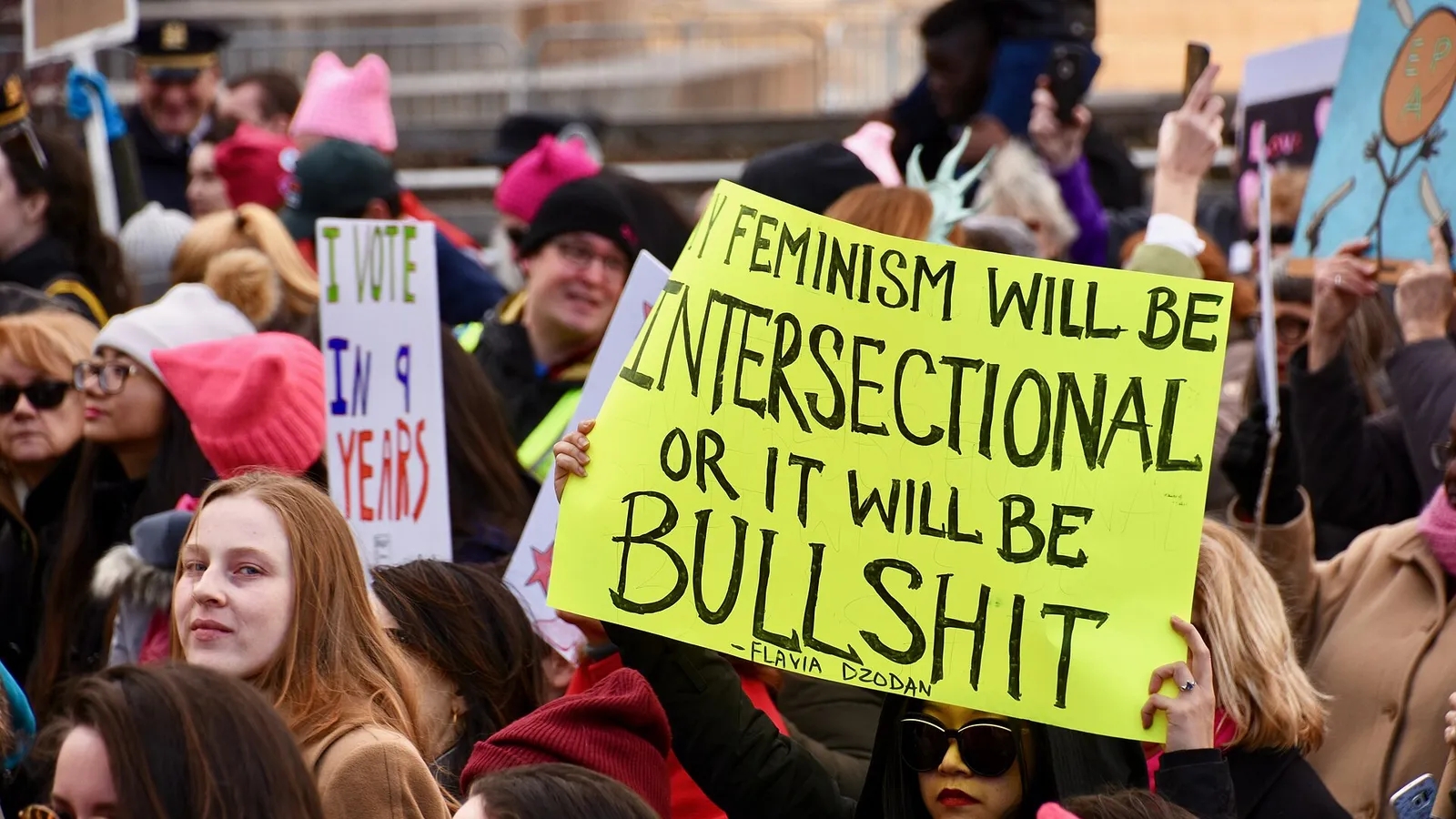

The following article entitled "Intersectionality or class struggle?" was published in the September issue of Manifest, organ of the New Communist Party of Netherlands."
New Communist Party of Netherlands on intersectionality
Two episodes of Tim Hofman's BOOS podcast with Bob Scholte and Sylvana Simons sparked a debate last month about intersectionality and class struggle. Does the narrative of intersectionality, identity, and 'woke' drive the working class into the hands of the far right? Or do intersectionality and class struggle actually go hand in hand?
Bob Scholte, founder of media platform Left Laser, wondered aloud in the podcast what Black Lives Matter and organizations like BIJ1 and Omroep Zwart had actually achieved, because, in his view, the 'intersectional' narrative had not resonated with (people of color from) the working class. To achieve success, a more class-oriented narrative would be needed. A week later, Tim Hofman spoke about this with BIJ1 founder Sylvana Simons, who wondered: can't it be both? She believes that “precisely when you connect everything, you are talking about class struggle.”
This sparked a societal debate. Everything was discussed in it, except for a critical exposition of exactly how intersectional theory relates to, or differs from, Marxism. That question is central to this article.
Class struggle and emancipation
Within the social movement, those who advocate for intersectionality are concerned with the position and rights of women, ethnic and religious minorities, people of color, LGBTI people, people with disabilities, and various other specific groups of people who face forms of discrimination, a lack of specific facilities, or, more generally, a disadvantaged position in society in diverse ways.
Communists stand for social justice and equality. For us, that is beyond question. Anyone familiar with the history of the communist movement will therefore know that communists have fought for every oppressed group and against every form of discrimination.
For example, in the field of women's emancipation. In the Netherlands, the Communist Party of the Netherlands (CPN) has always supported this struggle in word and deed, and in the post-war period, it was the initiator of the Dutch Women's Movement (NVB). The revolution that led to the creation of the Soviet Union, the first socialist state, began with the massive strike of female textile workers in Saint Petersburg. We still celebrate the start of that strike, March 8 in our calendar, as International Women's Day. The socialist state that emerged from this revolution was the first modern, major country where women were granted the right to vote and be elected, where abortion was legalized, and where countless provisions were made, such as a public and universally accessible network for childcare.
Another example is the fight against racism and colonialism. Not only was Marxism the primary source of inspiration for a series of anti-colonial movements in Africa and Asia in the last century, but support for the liberation movements in word and deed was one of the membership conditions of the Communist International, founded in 1919. In the Netherlands, the CPN was the only party that fought for the independence of Indonesia.
There are countless other examples to mention. For communists, every struggle for emancipation has always been linked to the struggle for the emancipation and liberation of the classes exploited and oppressed under capitalism, primarily the working class, but also poor farmers, civil servants, and small business owners.
Materialism and the importance of class
What distinguishes communism from other emancipation movements, however, is that, thanks to its founders Karl Marx and Friedrich Engels, it is based on a scientific worldview. For communists, it is not merely about combating symptoms, but about scientifically explaining societal problems and tackling them at the root.
An important premise in the scientific, Marxist approach is materialism: the insight that human thought is shaped by objective, material reality. Our ideas are therefore not separate from the social conditions in which we live.
The way of thinking in a society—and more generally, politics, law, and culture—does not appear out of thin air. This forms the superstructure, which is connected to a base formed primarily by economic relations: the ownership of the means of production and the organization of labor. Base and superstructure constantly influence each other, but material production and the resulting social relations form the foundation of society.
Views such as racism and sexism must also be understood societally from this perspective. No one is born with racist or sexist views; such ideas are learned and reproduced within a specific societal reality. They are therefore not merely individual phenomena, but societal phenomena.
For example, the oppression of women and sexism are linked to the historical development of economic phenomena such as the division of labor, private property, and inheritance. 1 Historically, racism developed on the basis of economic phenomena such as slavery, colonialism, competition, and war, whereas in capitalism it serves to divide population groups, treat labor unequally, exploit it further, and pit it against one another. 2
Materialism is important for seeing the essence of such problems and not remaining at the surface. For example: although women have been and often still are oppressed by men, the man per se is not the cause of that oppression, but rather the economic and social relations that underlie the reproduction of women's unequal position and sexist views. Clara Zetkin, Alexandra Kollontai, and countless other Marxist champions of the women's movement therefore understood that the struggle of working-class women must be directed primarily against the capitalist class, which perpetuates these social relations. That is precisely why working-class women have objectively common interests with men – which naturally does not mean that sexism does not exist among working-class men or that one speaks out against it.
How does this Marxist approach, which places class struggle at the center, relate to intersectionality?
What is 'intersectionality' and where does it come from?
Over the past decade, intersectionality, also known as intersectional thinking, has rapidly gained popularity at universities, government institutions, and within certain parts of the social movement. Intersectionality originates from a critique by American legal scholar Kimberlé Crenshaw. She argued that a person's position can only truly be understood from the 'intersection' of their identity traits, such as sex or gender, ethnicity, and class.
The theory of Crenshaw, who is not a Marxist, was popularized around 1990. It was a period of deep crisis for the labor movement. Along with the crisis of the international communist movement, class-oriented movements for women's emancipation, anti-racism, and other emancipation issues also faded into the background. Trade unions were decimated under social democratic leadership, their role limited to a negotiating party for collective labor agreements, and membership stagnated: the remaining union members were largely located in sectors that had been organized in previous decades. This fueled the misconception that class struggle was limited to the struggle for higher wages for (old, male, and/or white) workers.
In those historical circumstances, the influence of the Marxist approach weakened within various emancipation movements, while groups of people felt unrepresented by the consensus-seeking labor movement. In that context, some emancipation movements embraced the intersectional approach.
Intersectionality and class
In abstract terms, this approach to intersectionality seems innocent and almost self-evident. But there is a catch. Intersectionality does not distinguish itself from Marxism because it acknowledges that various identity traits must be brought together to understand one's position and experience, and that these different battlefields are interconnected. After all, we have seen that communists have always acknowledged and been at the forefront of these various battlefields. The 'innovation' introduced by intersectionality is that class is supposedly only one of those identity traits. Different forms of oppression coincidentally converge at a 'crossroads,' where class plays no particular role.
Where class is reduced to a single identity category among many others, the materialist insight that the relationship between labor and capital constitutes the fundamental contradiction of capitalist society also disappears. In essence, therefore, this approach denies materialism. It denies that the economic basis and class are fundamental issues underlying all other social relations.
From this approach, the dialectical connection between various societal issues can no longer be properly grasped scientifically. Capitalism appears as merely a sub-issue alongside other societal problems (which are interpreted as 'colonialism', 'patriarchy', 'climate crisis', and so on), whereas capitalism is in fact the foundation.
Intersectionality is therefore often linked to postmodern approaches, which take idealism rather than materialism as their starting point. Postmodernism elevates individual experience to the absolute criterion of truth. If a specific form of oppression is not experienced, this is readily viewed as a 'privilege'—as if it were a privilege not to be discriminated against. The capitalist class is no longer seen as the problem, but rather the privileged man, white person, etc. In a few extreme cases, we have even seen that this can lead to a toxic and unsafe atmosphere within social movements—even though we do not deny that creating a safe environment for everyone ('inclusivity') is often precisely the goal.
By reducing the importance of the class question, intersectionalism fosters reformism. Despite all kinds of radical terminology (including 'anti-capitalism'), we see no strong perspective in intersectional circles on the overthrow of capitalist power and the construction of a socialist society.
Capitulation or battle
It is the working class that produces. Inherent in class society is the fact that the exploiting class is merely a minority, deriving its power from appropriating a portion of the working population's production. It is precisely this dependence that gives the working class under capitalism the ability to impose its will through striking, and even to organize production in a radically different way, without the intervention of an exploiting class. In other words: the working class has the unique ability to eliminate the economic basis for oppression by building socialism-communism. This insight into the role of the working class is important for a revolutionary perspective.
Anyone who merely attempts to address specific forms of oppression and inequality without engaging in class struggle therefore lacks the capacity to overthrow the underlying cause of oppression—capitalism. At most, one can advocate for equal treatment within capitalism, which for the bourgeoisie means, for example, 'more women at the top' and for workers, that men and women are exploited equally. These may represent substantial changes for individuals, but as long as the labor-capital power dynamic remains unchallenged, the capitalist class retains just as much power as before and can reverse these changes whenever it suits them. Furthermore, the capitalist economy, based on profit-seeking and competition, remains a fertile ground for the reproduction of all kinds of reactionary views and discrimination.
Following the counter-revolutions and the decline of the labor movement at the end of the last century, bourgeois ideologists declared "the end of history": capitalism, or what they described as 'democracy', would be invincible. In this sense, intersectionality is essentially a capitulation: it accepts that the working class would no longer be able to fulfill its revolutionary role, and limits itself to combating unequal treatment and cultural manifestations within that system.
As communists, we do not go along with that. We recognize that the working class is the revolutionary subject: that is the social force that holds the objective position within social relations to bring about a revolutionary upheaval of society. In that struggle for a better society, we stand up against all injustice, against every form of discrimination, for equality and social justice, for a socialist society “in which the free development of each individual is the condition for the free development of all.”
(Photo: Alec Perkins / CC BY 2.0)