

The following article written by Jouke Bakker and entitled "The rich want war, the youth a future", was published in Manifest, the organ of the New Communist Party of Netherlands (NCPN), on 4 September.
New Communist Party of Netherlands on militarisation
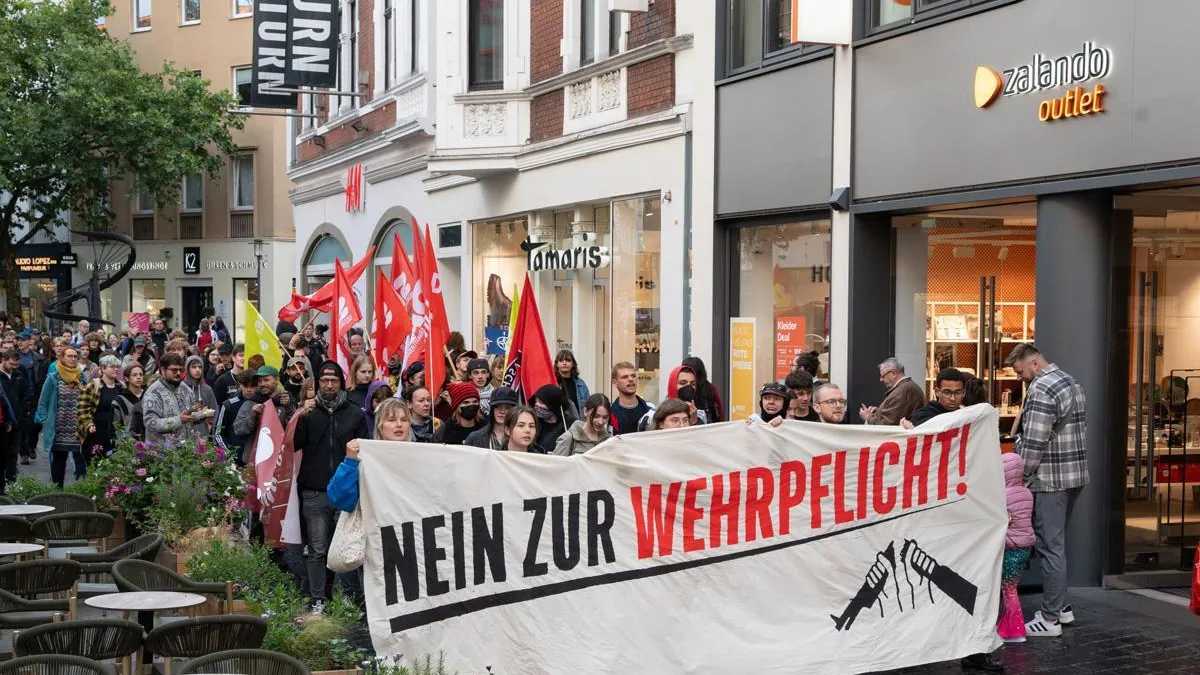
On December 5, 55,000 German students went on strike. From large cities like Berlin and Munich to small towns like Döbeln, from Augsburg in the south to Wilhelmshaven in the north—in short, strikes took place throughout Germany. In more than 90 locations, students did not attend school. On March 5, the second strike took place; this time, 50,000 students took to the streets in more than 130 cities. The third strike was on May 8, the day of the anti-fascist victory. On this day, 45,000 students went on strike, this time in even more than 150 cities. What could possibly be going on in our neighboring country to the east that is causing so many students to take to the streets?
During the first strike, the German parliament voted on an amendment to the conscription law. Since then, every eighteen-year-old has received a letter in the mail containing a survey that men are required to complete. If someone is deemed fit for the army based on this questionnaire, they are invited for a medical examination. In just six months, more than 300,000 letters have already been sent. The measure has not yet been very successful: only 530 volunteer soldiers have emerged from it, whereas 100 times as many students have taken to the streets up to three times, and 28% of the men have ignored the survey, for which they risk a fine.
Making medical examinations mandatory is the next step in the complete abolition of conscription, which will be introduced from July 2027. The German army is already trying to prepare young people for this measure: men who explicitly indicate in the survey that they are not interested in the army receive invitations for a medical examination. This happened, among others, to a student involved in the campaign in Schleswig-Holstein. According to current German law, the army is not allowed to do this, yet it happens: the desperation of the civilian population for cannon fodder is only becoming clearer.
Furthermore, the amended law contains another measure: men between the ages of 17 and 45 are not allowed to leave the country for longer than three months without permission from the army. After much controversy, the Minister of Defence clarified that, for the time being, this permission is granted automatically. This rule will only be implemented once military service becomes compulsory. A stay of execution.
Why conscription?
The reintroduction of conscription is said to be necessary for the 'security' of Germany, the EU, and NATO. The army, the Bundeswehr, must even expand to such an extent that it becomes (again) the largest conventional army in Europe, according to Chancellor Friedrich Merz.1 This 'security', however, has nothing to do with that of the population, but solely with the protection of the interests of German capital, which even wishes to strengthen its position within the imperialist pyramid. Conscription is therefore not aimed at the defense of national borders, but is part of a far-reaching militarization that is already leading to an increase in conflicts and wars, endangering the safety of working people worldwide.
At the same time, German capitalists, together with the government, are also seeking other ways to strengthen their competitive position. For instance, the government intends to make working hours more flexible (effectively abolishing the eight-hour workday) and is raising the threshold for reporting sick: workers must visit the doctor in person to obtain a doctor's certificate—previously this could be done by telephone—and this is now required from day 1, whereas previously day 4 was customary.
The militarization and broader attack on the achievements of the working class must be viewed within the context of the intensified inter-imperialist contradictions. The position of German capital on the world stage has weakened in recent times vis-à-vis emerging imperialist powers, as is also the case for other parts of the EU-NATO bloc, including the Netherlands.
For decades, the bourgeoisie relied solely on a professional army. This served primarily for small-scale interventions abroad. However, international relations seem to be forcing the bourgeoisie to reduce conscription, as the small scale of a professional army is no longer sufficient to protect the interests of the capitalist class. The reintroduction of conscription, however, also changes the class character of the army: ordinary workers are forced into the army, where they receive military training. It becomes more difficult for the bourgeoisie to maintain ideological control over soldiers. This open manifestation of the dictatorship of capital thus creates opportunities for the labor movement to take root among the soldiers.
Although the reintroduction of conscription is thus clearly part of the bourgeoisie's strategy, it simultaneously creates the conditions for the undermining of its rule. Time will tell whether this will prove fatal. The example of the German youth is, in any case, hopeful: they are firing the starting gun for the working class's struggle against renewed warmongering. Instead of believing the lies of capitalism and defending their 'freedom' to be exploited into the trenches, German schoolchildren are choosing resistance.
Organization at the grassroots level
A (school) strike does not, of course, come out of the blue: a great deal of work preceded it. Following the announcement of the amendment to the conscription law, the 'Schulstreik gegen Wehrpflicht (conscription)' campaign was launched, and strike committees were established throughout Germany. Initially, these committees were primarily city- or municipality-wide, involving many non-students as well, but increasingly, committees are being set up by students attending the same school together.
The committees form the basis of the strikes. The strikes are shaped during their regular meetings. For instance, the students discuss how to mobilize their fellow students for the strikes, but also how to involve them in organizing them. Every student is therefore welcome in the committees, as long as they are opposed to conscription. This clear focus is an important factor for the success of the campaign, as it reaches the enormous group of students who are not yet active in the class struggle but do realize that conscription is not in their interest. The involvement of these students in the campaign is precisely what leads to their political development.
A major strength of the campaign lies in the close cohesion of the various committees. For instance, national conferences were held after each of the three strikes, where hundreds of representatives from local strike committees gathered to discuss the campaign's strategy and goals. This resulted in strategic unity and widely supported demands directed at the national government: no reintroduction of conscription or other forced service, and no militarization.
The campaign also makes use of existing structures in which students are organized, such as student councils (SVs), comparable to a student council in the Netherlands. Every school has such an SV. In addition, there are umbrella forms of the SV at the district and state levels, namely the BSV and LSV, respectively. Depending on the state, SVs have formal rights that can be useful for the committees. For example, SVs in North Rhine-Westphalia have the right to convene the entire school twice a year for a meeting (a wonderful opportunity to mobilize for the strike), whereas an SV in Bavaria has virtually no say. These bodies are also often filled with hobbyists and careerists. In any case, the existing structures can play a major role in a strike by opening doors to more ways to mobilize fellow students or simply by legitimizing the strikes. And the students will not be deterred by the student unions that are not (yet) politicized and refuse to support the strikes: the strikes will go ahead no matter what!
'Merz leck eier'
The students also face repression, not only from the police and politicians, but especially from school boards and even the secret service. With every strike, the repression intensifies. The schools themselves take many measures, such as bag checks to confiscate flyers and the like, and by deliberately scheduling exams during a strike. Several schools have even gone so far as to lock their gates, making it impossible for young people to leave the school grounds and join their comrades on the street. Apparently, you are allowed to learn anything at school, as long as it isn't organizing yourself to stand up for the interests of yourself and your fellow students.
The police also took action during the strikes. For instance, students in Munich were beaten and sent home, and a high school student was fined for the slogan on his protest sign: “Merz, just die on the Eastern Front yourself” was deemed a threat. In Berlin, a high school student was arrested after picking up a protest sign with the slogan “Merz leck eier” (Merz lick balls). Since then, this slogan has grown from the fight against conscription into a general expression of opposition to the Merz government. It is even so popular that the slogan was not allowed to participate in the election for Youth Word of the Year. “Mehrzweckeier” (multipurpose eggs) was submitted as an alternative, but this too was censored, despite having finished in the top 10.
In addition to repression, attempts are also being made to neutralize the movement. For instance, the sentiment in mainstream media and politics leading up to the first strike was positive. The Social Democratic Minister of Defence even published a statement of sympathy on December 5. According to him, it was good that students took to the streets; they simply did not understand that the reactivation of conscription is simply necessary.
During a previous school strike campaign, Fridays for Future, the bourgeoisie, particularly the German, succeeded in hijacking the leadership of the campaign. The legitimate resistance of young people against the destruction of the climate for the profit of big capital was transformed into support for 'green' capital in the competitive struggle against 'grey' capital. In the campaign against conscription, the bourgeoisie is failing to neutralize the movement. What is different this time?
Vanguard of the German working youth
Last spring, the mainstream press in Germany made a major discovery: the Socialist German Workers' Youth (SDAJ, also a sister organization of the CJB) plays a key role in the strikes. It will surely not surprise the reader that communists are opposed to imperialist war and militarization, and therefore also intervene in the resistance against it.
As part of a CJB delegation, I attended the SDAJ's biennial Whitsun camp just north of Münster, where we had the opportunity to learn more about school strikes and their role in them. This well-attended edition had been renamed 'Pfingstcamp gegen die Wehrpflicht' (Pentecost Camp Against Military Service). At this camp, we spoke with our German comrades, including many members of strike committees. There were workshops on topics such as imperialism, the significant role of the German bourgeoisie in the introduction of conscription, and how the communist method differs from radical and reformist forms of activism. Furthermore, there was a panel discussion with participants from, among others, the North Rhine-Westphalian LSV, the trade union youth, and the umbrella strike committee of Münster. We also held a bilateral meeting with representatives of the SDAJ. That is a meeting held when affiliated organizations come together to discuss developments in their respective countries and specific experiences, a tradition in the international communist movement.
Thus, as early as 2024, the SDAJ was exploring militarization, and conscription in particular. At that time, the militarization of today was still in its infancy, and there was no question of reactivating conscription. However, it did not take long for the situation to change: the German army had to become the largest in Europe again. To be able to borrow the necessary billions for this purpose, the constitution was even amended, and in late August 2025, the Merz government announced the bill to amend the conscription law. Almost immediately, the 'Schulstreik gegen Wehrpflicht' campaign was launched. The first committees were set up, as mentioned, initially city- or municipality-wide, but increasingly also at the schools themselves—at the grassroots level. Two months later, tens of thousands of German schoolchildren made it clear that the reintroduction of conscription was unacceptable.
Committee vs. coalition
To understand how such a large strike was organized in such a short time, we must look at the strategy of communists. In every movement, roughly two forms of organization can be distinguished: the committee and the coalition.
The committee form entails that people are organized for their concrete interests. In this case, it concerns the common interest of working-class youth not to be forced to die for the interests of capital. These committees are made as accessible as possible to unorganized people. For many of them, the committee serves as a starting point for the development of their class consciousness. The working class and its allies must liberate themselves, and the necessity of doing so becomes clear from their own experience. The involvement of workers in the committees therefore serves to build that conviction.²
Opposite the committee form stands the coalition. This form focuses on uniting (people from) various political organizations, often under the guise of 'left-wing unity' rather than unity based on objective interests. The bodies supposed to organize the students, the strike committees, thus become a battleground between different political forces. Students find themselves in a coalition in which the participating organizations compete with one another for attention and endlessly debate matters that seem unrelated to the fight against conscription.³
In some places, the coalition structure prevails, and strike committees consist primarily of non-students. Consequently, political forces attempt to divert the focus of actions against conscription to other issues, such as Palestine. While solidarity with the Palestinian people is obviously important, this should not become the focus of the strike committee. Many students have not yet developed the awareness to support the Palestinian cause, certainly not in Germany, and will therefore become alienated from the movement. Ultimately, this harms both arenas of struggle: instead of students being organized around their concrete interests and learning the importance of (international) solidarity through experience (and in conversation with their new comrades), they are expected to have already undergone this political development before they can join the struggle.
In shaping the movement, the SDAJ strives to adopt the committee model and establish committees at the grassroots level. Through their intervention in the local committees, the members and sympathizers of the SDAJ, who are also students, are leading this effort—as many of them told us at the camp. The intervention is bearing fruit: "In some places, the Schwerpunkt of the school strikes is already with the school committees," stated a representative of the SDAJ during the bilateral meeting.
The Netherlands is still lagging behind
Just as in Germany, the bourgeoisie in the Netherlands is also seeking ways to boost their weakened position in the imperialist pyramid. Like the German capitalists, they find these in militarization and a policy of dismantling. For instance, the government regularly talks about the gradual reintroduction of 'conscription' (formally, military service still exists). The army is supposed to grow to over 100,000 people by 2030, and even further thereafter. To achieve this goal, 'Defense' must grow by nearly twenty percent in just four years. The reader can decide for themselves whether this is even remotely possible without coercion.
The 'Defense Memorandum 2026' outlines the plan: escalating coercion step by step. The steps are the same as those of our eastern neighbors, only they are already further advanced. The major difference is that in the Netherlands, unlike Germany, coercion applies not only to men but also to women—so much for equality under capitalism. Before the first mandatory surveys may be sent out, the 'Conscription Framework Act' must be amended, which, given the urgency felt by the government and capital, surely will not take long.
Even outside of the reintroduction of conscription, the army is attempting to recruit young people. For instance, the army has introduced the 'service year,' in which young people between the ages of 18 and 27 are given the 'opportunity' to be a soldier for a year. This program is specifically aimed at young people who do not know what they want to study, if they can even afford it, and is promoted as an opportunity for personal development. Furthermore, the 'National Resilience Training' (NWT) has started. MBO and HBO students can choose this as a minor. During the NWT, a student is trained as a reservist in ten weeks. For this, they are not only paid but also receive 30 study credits: normally, that is the equivalent of half a year's worth of credits!
Furthermore, arms manufacturers and related industries are attempting to recruit young people for militarization. This begins in education, which is increasingly being placed at the service of the military industry, as described in the report by the 'Advisory Council for Science, Technology and Innovation' entitled 'Knowledge Offensive for Defence'. According to this mouthpiece of big capital, universities and universities of applied sciences should commit to developing dual-use technology (applicable for both civilian and military purposes) and collaborate more closely with the arms industry. The Ministry of Defence has also installed a so-called 'MINDBase' at several educational institutions in recent years. These are deployed to bring researchers together with the arms industry to stimulate dual-use research.
Given all these developments, it is clear that Dutch working-class youth can also expect the reintroduction of conscription. The only question is when. The imperialist ambitions of the bourgeoisie, within the framework of the imperialist alliances in which they participate, are considerable—and cannon fodder is required for this. It is not without reason that the Netherlands has participated in more than 130 wars and interventions since the Second World War.
It is therefore not surprising that few young people are willing to enlist, without coercion, for a state that is solely occupied with dismantling their education and services. In Germany, too, we see that the first 'service obligations' yield little, and the SDAJ is therefore focusing on deepening the campaign. German students are continuing the struggle: the fourth strike has already been announced for September 25. It is up to Dutch working-class youth to follow their example and, drawing on the experience of our eastern neighbors, to also put a stop to the militarization! The first step: the nationwide peace protest in Amsterdam, on Sunday, September 27, starting at 1:00 PM.
- https://www.bundeskanzler.de/bk-de/aktuelles/erste-regierungserklaerung-kanzler-merz-2347354
- Want to read more about the communist strategy? See the Political Resolution of the 10th Congress of the CJB, https://www.voorwaarts.net/documenten/ .
- See also https://www.voorwaarts.net/links-rechts-kieskompassen-oogkleppen-voor-de-arbeidersklasse/