

The following article written by the Astor García, General Secretary of the Communist Party of the Workers of Spain (PCTE), was published in Nuevo Rumbo, the publication of the Party.
PCTE on issue of Ceuta: "The wrong border"
Whenever a sufficiently large group of desperate people approaches a border, someone appears ready to declare an invasion. Without tanks, without soldiers, without artillery; the mere images of exhausted and disoriented people are enough to bring out the self-proclaimed professional patriots and armchair generals. What happened in Ceuta has provided yet another opportunity to witness this.
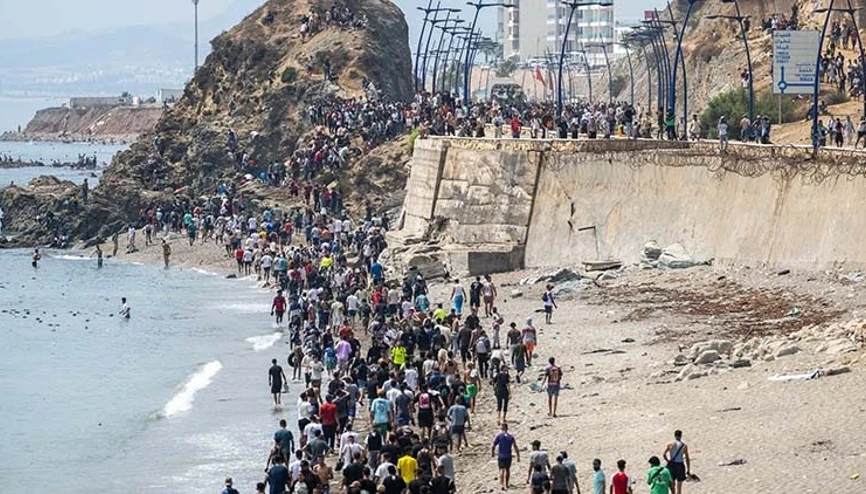
The situation has been serious enough to require no exaggeration. Thousands of people crossed from Morocco, many of them minors, in extremely dangerous circumstances. There were deaths, there was desperation, and there was a clear exploitation of migration flows within the framework of relations between Morocco and Spain, mediated also by the EU and the United States.
Although this entire episode deserved a serious explanation, a significant part of the public debate preferred, and still prefers, to resort to a much more convenient word: invasion. Talking about invasion allows one to stop thinking about anything else. If there are invaders and invaded, there's no longer any need to ask about the social conditions of those on either side of the border, the interests of the governments involved, or the economic and political relationships that bind both shores of the Strait. All that remains is to choose a side and put on the helmet.
Those who crossed into Ceuta were workers, young people, minors, and refugees driven by living conditions that allow their desperation to be used as a political tool. The Moroccan government bears a clear responsibility when it uses the control of migration flows as a means of exerting pressure in its relations with Spain. But to stop the analysis there would be too simplistic, because Morocco does not operate in a vacuum, nor are relations between the two countries limited to occasional diplomatic disputes. There are economic interests, investments, trade agreements, police and military cooperation, and a network of relationships that also includes the European Union and the continent's major powers.
This is where the issue starts to become somewhat less comfortable for those who want to explain everything through flags. The European Union is neither an innocent victim of these crises nor a neutral arbiter observing the excesses of its southern neighbors from Brussels. For years, it has been building a migration policy based on shifting control of its borders outwards, funding third countries to do the dirty work, and turning governments like Morocco's into gatekeepers of access to the European market. Then, when one of these governments discovers that the key to the border can be used as a bargaining chip, European institutions feign surprise at the consequences of a policy they themselves helped to create.
The reaction of some European governments to what happened in Ceuta was quite revealing. From Italy came expressions of support for the need to reinforce border controls and prevent new entries, something perfectly consistent with a policy that for years has turned every landing of migrants and refugees into a demonstration of state authority. Solidarity among European partners often takes a very particular form: each state must effectively prevent the poor from reaching its neighbor's doorstep. Then summits are held, declarations on human rights are drafted, and funding continues to be given to third countries so that the less palatable aspects of migration policy occur far enough away from the cameras.
This shouldn't surprise us. The EU doesn't need a fair migration policy; it needs a migration policy that serves the interests it represents. It needs to control migration flows, select its workforce when required, contain it when it ceases to be convenient, and keep the social consequences of profoundly unequal capitalist development under control. Therefore, the problem isn't that Europe isn't true to the values it proclaims, but rather that it acts in accordance with its very nature.
We in Spain know all too well about this. Every time the living conditions of the majority deteriorate, someone appears ready to explain that the problem lies with those who arrived later. If there's a housing shortage, the immigrant is blamed. If a health center is overcrowded, the immigrant is blamed. If a neighborhood falls into disrepair, the immigrant is blamed. By dint of repetition, one ends up attributing truly prodigious economic capabilities to foreign workers. They must be the ones who control the real estate market, decide on public investments, organize healthcare services, and draft public budgets. Large property owners, banks, corporations, and governments can breathe a sigh of relief: after so many years of searching for someone to blame, it turns out they were swimming across a border.
That is one of the great services racism provides to capitalist society. It makes those who have little see those who have even less as enemies. The worker who can't afford rent ends up suspecting the immigrant family who shares an apartment with two others. Someone who waits weeks for a doctor's appointment may end up convinced that the problem is the person sitting next to them, not the government's deliberate effort to degrade the public healthcare system. It is an enormously effective political operation because it allows class problems to be transformed into conflicts between workers.
And that is precisely the point that should not be overlooked. Spanish and Moroccan workers may be separated by a border, a language, and different living conditions, but neither owns banks, hotel chains, large agricultural operations, construction companies, investment funds, or export businesses. That difference is politically far more important than where each was born.
The Spanish bourgeoisie has its interests, and the Moroccan bourgeoisie has its own. Sometimes they coincide, and other times they clash. They may negotiate, compete, pressure each other, or use issues like migration in their disputes. But when these disputes spill onto the streets, those who bear the brunt of the conflict almost never belong to either of these ruling classes. It is the Moroccan workers who risk their lives trying to cross, the Spanish workers who endure the consequences of inadequate public services and neglected neighborhoods, and both groups who ultimately end up being called upon to confront each other.
That's why the discourse of invasion is so useful. It transforms disputes between states within the framework of profoundly unequal economic relations into a conflict between peoples. It erases social classes and replaces them with nationalities or origins. Suddenly, the Spanish worker shares interests with the Spanish business owner because they both have the same passport, while the Moroccan worker appears as a threat simply because they were born on the other side of the border. It's hard to imagine a more complete ideological victory for those who need workers to forget what class they belong to.
None of this means denying that migration creates concrete problems. Mass arrivals require resources, housing, education, healthcare, and planning. States must address these situations. But managing a problem is one thing, and blaming those who suffer from it is another. If there's a housing shortage, we need to talk about housing; if there's a shortage of doctors, we need to talk about healthcare; if certain neighborhoods deteriorate, we need to discuss why they're being abandoned. What doesn't work is constantly shifting the blame until the person responsible for everything is always the one with the least power to make decisions.
This is also why certain progressive responses that merely oppose xenophobic rhetoric with well-intentioned but ultimately ineffective ones are insufficient. It's not about asking for charity or turning immigrants into abstract figures who should elicit pity. It's about class politics. It's about understanding that migrant workers are part of the working class and that their organization, their participation in collective struggles, and the defense of shared rights are essential for all workers.
The Ceuta crisis has quite clearly revealed the full picture. Morocco can use migration as a tool for pressure. The European Union can reinforce its policy of externalizing borders. Governments like Italy's can seize the opportunity to demand a tougher stance. The most reactionary sectors in Spain can transform fear into votes and turn thousands of desperate people into a national threat. And, meanwhile, the root of the problem remains untouched: a system that produces inequality, economic dependencies, forced migration, and conflicts between states, only to then present the consequences as if they had fallen from the sky.
That's why it's wise to be suspicious whenever someone shouts that Spain is being invaded, because that kind of language serves to obscure who's in charge, who makes the decisions, and who pays the price. Spanish workers have nothing to gain by turning Moroccan workers into their enemies. They have far more to lose if they accept that their problems are always explained by the presence of someone poorer.
The decisive border isn't between Ceuta and Morocco, nor between those with a Spanish passport and those without. It's between those who live off their own work and those who live off the work of others. That border is far less visible on television, but it explains much more. And perhaps that's why there's so much interest in making us look elsewhere.