
The following article written by Adrián Franco and entitled "Preparing society for war: European rearmament, militarization and military service" was published in Nuevo Rumbo, organ of the Communist Party of the Workers of Spain.
PCTE on preparing society for war
The European Union has found an extraordinarily convenient explanation to prepare us for war: it all began on February 24, 2022. Before then, there was peace, rights, and democracy. A supposed oasis of privilege, an exception of civilization in the midst of a savage world full of predators seeking an opportunity to snatch it away. The war over Ukraine and the Russian threat (the embodiment of everything contrary to "our values") woke us from our naiveté. To defend this paradise, Europe must be prepared, especially if our main ally across the Atlantic is an unpredictable lunatic. We need "strategic autonomy," that is, our own military capacity that allows us to defend ourselves against all the beasts lurking beyond our borders. It is time to rearm, to retrieve the rifles that, apparently, we didn't know where we had left after so many decades of disuse.
This narrative does have one merit: it allows for the presentation of the largest increase in European military spending in decades as inevitable. The figures leave little room for irony.
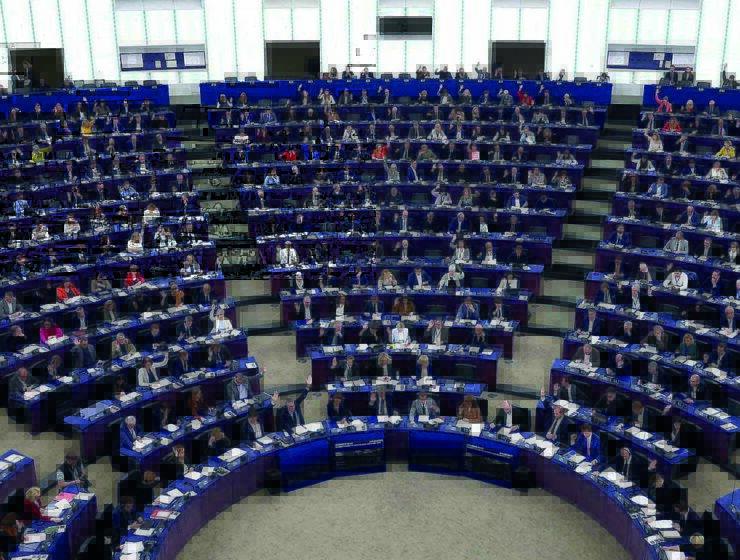
In 2025, the 27 European Union member states spent €418 billion on defense, 20% more than the previous year. The European Defence Agency estimates that by 2026, this figure will reach €454 billion, a 75% increase over 2021. At the same time, several member states have reinstated or expanded mandatory conscription mechanisms and are seeking to normalize military training among young people, including in schools and universities.
When they try to make us accept war as something imposed from the outside and inevitable, it is worth discussing the framework and drawing our own conclusions.
Capitalism needs a permanent military apparatus
Violence is inherent to capitalism. In monopoly capitalism, large corporations need the power of their states to guarantee social order within their borders and defend their interests abroad. Markets, raw materials, trade routes, and spheres of influence are secured by any means necessary.
The bourgeoisie can act as a relatively unified class in the face of the workers and, at the same time, compete fiercely for the division of the world. This contradiction intensifies when the uneven development of capitalism allows one power to challenge the positions acquired by others. Then, economic disputes can escalate into sanctions, trade wars, blockades, arms races, and, if necessary, open warfare.
Therefore, no major capitalist power can forgo having military force, whether its own or guaranteed by its alliances. Those who intend to maintain their position (or conquer others) need the capacity to politically back their interests. The army doesn't appear when war begins: it must exist before and after.
However, this does not mean that military spending increases linearly; it has accelerations and decelerations.
The war in Ukraine and militarization
After the fall of the USSR and the socialist bloc, capitalist countries enjoyed the "peace dividend." During the 1990s, budgets, troop levels, and conscription were reduced. This reduction was possible, among other factors, due to the disappearance of the main threat to capitalism and the vast spaces that opened up for capital expansion: new markets, privatized resources and industries, routes that had previously been off-limits to monopolies, and post-Soviet spheres of influence. This military slowdown did not lead to the disarmament of the imperialist powers, and wars continued.
In Europe, the development of independent military capabilities predates the war in Ukraine. In 1999, the EU agreed to develop a capacity for "autonomous action" backed by credible military forces. In 2004, it created the European Defence Agency. Since 2014, following Russia's annexation of Crimea, a sustained cycle of budget increases has begun. From 2017 onward, this trend has also acquired its own institutional framework: increased military spending, development of common capabilities, and new instruments to finance research, technology, and the military industry.
The war in Ukraine, therefore, does not initiate the rearmament of Europe—which has never been disarmed—but rather acts as a catalyst. It transforms a pre-existing trend into a political urgency, reveals shortcomings within the European bloc, and eliminates many of the remaining constraints that limited increased spending. The current situation explains the speed, but the intensification of imperialist competition sets the direction.
After 2022, a qualitative leap occurred. It was no longer simply a matter of the Ministry of Defense purchasing more weapons; the EU had to reorganize part of its economy to be able to produce them permanently and on a much larger scale. It adopted its first European Defence Industrial Strategy, promoted joint procurement and permanent increases in production, approved the European Defence Industry Programme (EDIP), and, with Readiness 2030, planned to mobilize up to €800 billion, including up to €150 billion in European loans.
To finance it, the rules governing the rest of the economy are also being modified. Fiscal limits are being relaxed to facilitate military spending, the European Investment Bank is expanding its financing of defense projects, private capital is being mobilized, and a continental arms industry less dependent on foreign suppliers is being promoted.
Preparing the population for war
However, a war cannot be sustained with factories, loans, and weapons alone. It needs soldiers, reserves, and a society capable of supporting the military effort.
Germany has reinstated mechanisms for identifying potential recruits through questionnaires and assessments, initially within a voluntary model that contemplates moving towards mandatory participation if the necessary numbers are not reached. France will launch a new national service; Croatia has reinstated mandatory conscription; Denmark has expanded it; and Poland aims to have forces of nearly half a million military personnel and reservists.
Preparation begins even before the age of conscription. In Poland, military personnel already participate in programs within schools; France speaks openly of a "human and moral rearmament of the nation." The European Union itself proposes preparing "the whole of society," combining civilian and military capabilities.
The rearmament thus takes on a dimension that transcends budgets and brings back to the forefront the question of who should be trained, mobilized, and, if necessary, sent into combat. And, consequently, how to make that possibility socially acceptable once again.
The utopia of strategic autonomy and European democracy
To make this transformation acceptable, conservative governments, social democrats, and sectors of the pro-European left converge on a single framework. Europe must be united to defend democracy. It must produce and buy its own weapons. It must reduce its dependence on foreign capital and technology. It must build a single military market. In short, it must be capable of acting autonomously. Everything else, they tell us, is utopian.
This new armed Kautskyism (the old illusion that competition between powers can be resolved peacefully) presents a fantasy as common sense: that united and armed European monopolies will cease to behave like monopolies; that inter-imperialist competition will disappear before a European army armed to the teeth to guarantee peace and "European values." The rest are utopian.
And social democracy in our country has had no problem accepting and embracing the bellicose climate, despite what they say: defending European strategic autonomy against other imperialist powers and blocs, defending Spanish territorial integrity, considering Morocco an "uncomfortable neighbor", signing record increases in military spending, etc.
Proletarian internationalism versus national unity
Spain is not on the sidelines. Although it has not yet announced a government plan to reinstate conscription, it is fully participating in European rearmament, and the debate on recruitment, reserves, and the military industry is being reopened. It is in the national interest, they say. And, once the nation is invoked, any other interest must disappear.
But the interests of the working class are not those of Spanish or European monopolies. The Russian, Chinese, American, French, or German worker is not our enemy simply because their bourgeoisies compete for markets, trade routes, or spheres of influence. If that competition leads to war tomorrow, it will be workers who produce the weapons, finance the military effort, and are sent to kill other workers.
In contrast to "national unity" and bloc discipline, the communist position demands class independence, opposition to recruitment in the service of imperialist interests, rejection of the militarization of youth, and defense of proletarian internationalism.
No flag can transform the aspirations of those who own monopolies into those who will end up paying the price in lives.