

The following article was published on Volume 25, Number 11 of Umsebenzi, the organ of the South African Communist Party (SACP) as an editorial. It is entitled "Towards whom does public power lean?"
Image
South African Communist Party reflects on importance of running independently in upcoming elections
South African CP on importance of running independently on elections
On 4 November, for the first time since 1994, the ballot paper will carry the name of the South African Communist Party.
That sentence should be read slowly.
For thirty-two years, working-class people have gone to the polls and found no party on the ballot that said openly what it was: a party of the working class, organised around a socialist programme, accountable to workers and the poor rather than to capital. As the Party’s manifesto puts it in this edition, electoral politics has repeatedly presented working-class people with choices without presenting the working-class programme. That absence was never neutral. It created political space for others to present their interests as the interests of society as a whole.
That space is now contested.
This edition of Umsebenzi Online carries the SACP’s election manifesto, launched alongside the Party’s 105th anniversary. It also carries the constitution of the Council of the Left in Boksburg on 21 August, Cde Pius Vilakati on what the Conference of the Left means for Africa, Cde Thabile Lenkwane on the blockade of Cuba, Cde Aviwe Mohapi on the collapse of imperialism’s “peace” with Iran and on youth, STEM and technological sovereignty, Cde Tsholofelo Maseko on menstrual leave, Cde Dineo Majavu on the crisis of public care work, Dr Sizwe Nyenyiso on the limits of clean audits, Cde Sphe Yalo against the unbundling of Eskom, and a report on the attempt to write the Bonteheuwel Military Wing out of the record of the liberation struggle. It is a full edition. But it has one centre of gravity, and readers should be told plainly what it is.
Every party contesting this election says municipalities must work. That is not a programme. It is a description of the problem.
The ANC launched in Diepsloot with a call to build together, promising stable, capable and accountable municipalities with zero tolerance for corruption. The DA launched in Newtown promising to get towns working, and framed its offer as the most implementable in its history — clean water, upgraded roads, reliable electricity, safer communities. The EFF launched in Thohoyandou promising to insource security, cleaning, waste and maintenance, to scrap tenders, to direct a minimum of 80% of municipal procurement locally, and to extend free basic services to grant recipients, the unemployed and the elderly. One commentator, reviewing the DA document, said there was nothing surprising in it. Another observed that voters were tiring of ideology and wanted to know only whether municipalities can be made to work.
We do not accept that framing, and this is the heart of the matter.
The question of whether municipalities work is not a technical question. It is a class question. A municipality that sells well-located public land to private developers while working-class families are pushed to the margins of the city is not a failing municipality — it is a municipality working precisely as capital requires. A municipality that outsources refuse removal to a politically connected contractor while its own workers lack equipment is not incapable. It is making a class choice. Every budget makes choices. Every land allocation makes choices. The manifesto puts the test in one line that should be on every SACP poster: towards whom does public power lean?
Read against that test, the manifestos separate quickly.
The ANC’s difficulty is not the quality of its promises. It is that it governs nationally in a coalition with the Democratic Alliance while asking working-class voters to believe that municipal collapse will be reversed by the same political arrangement that presides over it.
The DA’s difficulty is the opposite and more fundamental: it offers competent administration of the existing distribution of property and power. Clean water and repaired roads are necessary. They are not transformation. A city can be efficiently run and still be a machine for keeping the poor at its edges — and Cape Town’s disposal of public land makes that concrete rather than theoretical.
The EFF’s manifesto is the closest to ours in content, and we say so without hesitation: insourcing, scrapping tenders, free basic services and municipal land access are demands the SACP shares and has long fought for. The difference is not in the shopping list. It is that the SACP does not present these as gifts a party will deliver to the people from the council chamber. We present them as what organised working-class power can win and defend, in the chamber and outside it, between elections and not only at them.
That is what distinguishes this manifesto from all the others on the ballot.
Its six priorities — reliable public services rebuilt through public capacity rather than privatisation; the right to decent work; land, homes and food for social need rather than private profit; safe and caring communities; municipalities free of tender corruption; and councillors who seek mandates and report back — are not administrative undertakings. They are a socialist programme at municipal scale. The manifesto says so directly, and answers the obvious challenge in advance: some will ask, is this really socialism? Yes — because socialism means extending democratic power over the conditions of life.
And it names the thing most parties will not touch: The tender system must be scrapped, not managed. Public provision and in-sourcing must become the norm. When public money flows to tender networks while municipal workers lack tools and young people lack work, that is not development but class accumulation through public resources — a kind of legalised crime.
Dr Nyenyiso’s article in this edition sharpens the point from another direction: a municipality can achieve a clean audit while its residents live with sewage spills and failing water. Compliance is not governance. The Auditor-General’s approval is not the same thing as the people’s approval.
The manifesto’s sixth priority is the one we ask readers to weigh most carefully, because it is the one that cannot be borrowed by anybody else.
Democracy cannot mean voting once every five years and then disappearing from political life. That is not what the Freedom Charter meant when it declared that the people shall govern. The SACP is standing for ward assemblies, participatory budgeting, community oversight, and councillors who seek mandates, report back, disclose their interests and remain accountable. A council seat, the manifesto says, must be a post of struggle and service, not a career or a business opportunity.
A vote for the SACP is not a vote to become a spectator. It is a vote to organise.
We should also be honest about scale. The SACP will not win most municipalities on 4 November. That is not the measure. The measure is whether the working class enters this election with its own voice, its own programme and its own candidates — and whether what is built during this campaign survives it.
This is where the rest of the edition speaks to the manifesto. The Council of the Left, constituted in Boksburg on 21 August, has already committed to defeating the anti-poor amendments to the Prevention of Illegal Evictions Act and to defending the Expropriation Act against the DA, AfriForum and the Free Market Foundation in the courts and in the streets.
Cde Yalo’s argument against unbundling Eskom is the same fight at national scale: public assets held in public hands for public purpose. Cde Majavu’s account of the care crisis and Cde Maseko’s case for menstrual leave describe conditions no clean audit will ever capture. Cde Mohapi’s argument for technological sovereignty asks who will own the industries the next generation works in.
Internationally, the same principle holds. Cde Lenkwane exposes the oldest trick of the blockade: strangle an economy, then present its suffering as proof that socialism failed. Washington admitted the strategy in 1960 and has pursued it for sixty-six years. Cde Mohapi shows imperialism’s collapsed “peace” with Iran to be war conducted by other means. And the attempt to reclassify the Bonteheuwel Military Wing out of MK reminds us that even memory is contested terrain — that a state can write soldiers of the liberation struggle out of the record with a database.
One hundred and five years. Banned, driven underground, its members imprisoned, exiled and killed, the SACP organised workers when capitalism and apartheid worked to divide them. It did not survive that century in order to become a commentator on other people’s politics.
On 4 November, the working class can vote for itself.
Register. Organise. Campaign. Take the manifesto door to door, and when the election is over, keep the branch that built the campaign. This is our contract, our programme and our weapon.
Vote SACP on 4 November! Forward to organised people’s power! Forward to socialism!
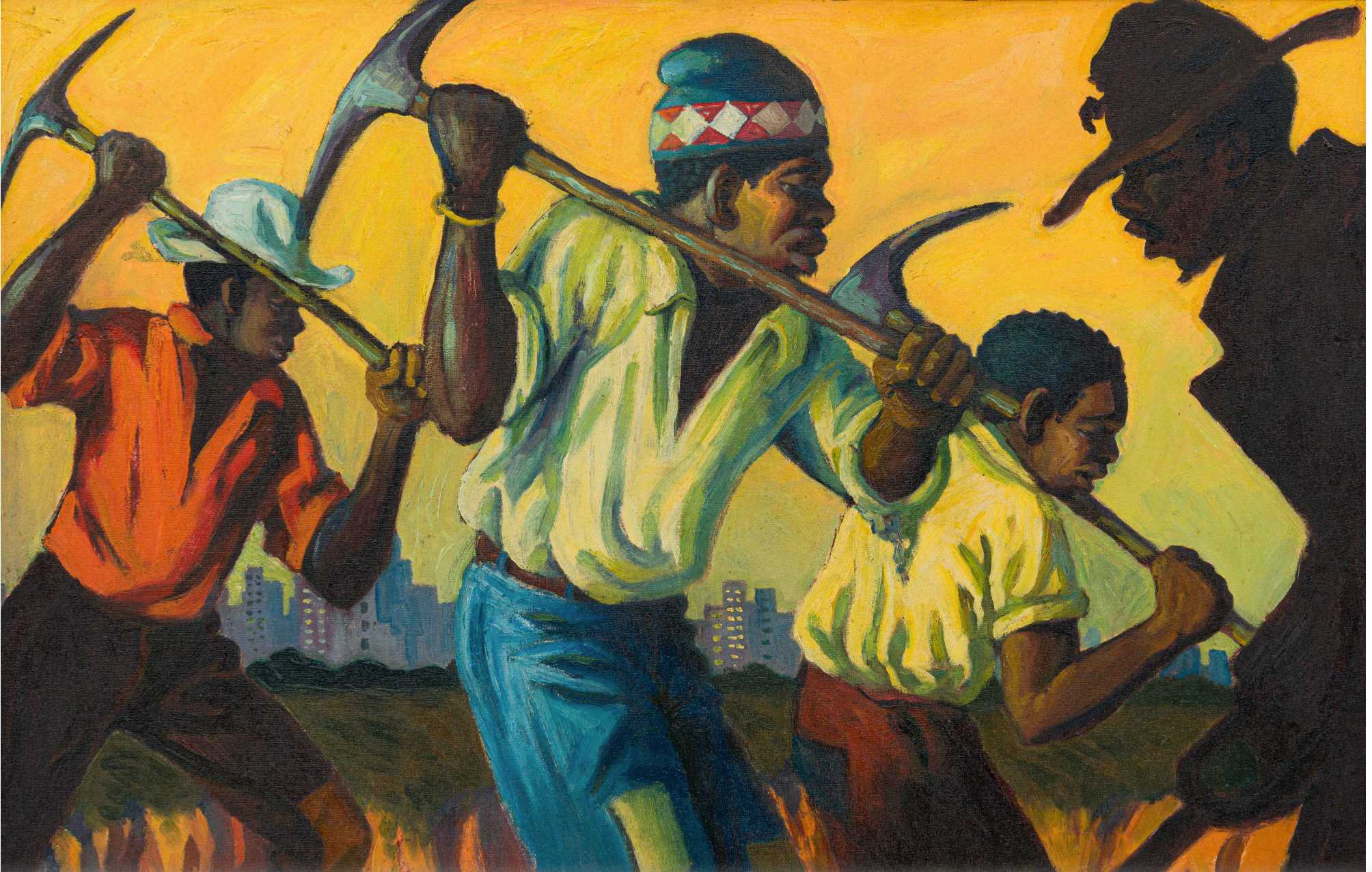
(Illustration: The Road Diggers by the South African artist George Pemba)