

The following article, entitled "The War Economy: Who Pays the Price?" was published in issue 4450 of Al-Midan, organ of the Sudanese Communist Party.
Sudanese Communist Party on war economy
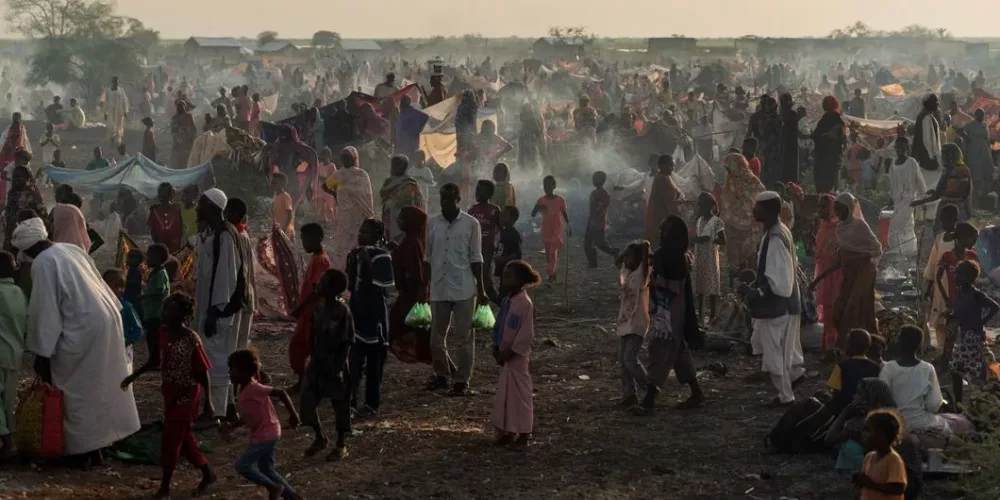
Day by day, the complex nature of the war in Sudan is becoming clearer. It is a conflict in which political, military and economic interests intersect, extending beyond the battlefields to reshape economic and social life itself. The war is no longer merely an armed confrontation draining the state and society; it has become an environment for redistributing wealth, resources and sources of income in favor of networks linked to the continuation of the conflict, while millions of Sudanese bear the cost through their food, wages, savings, services and the future of their children.
In this context, the war economy is taking shape as a parasitic economy that lives off the continuation of the crisis and feeds on the collapse of production, the expansion of the parallel economy, multiple centers of revenue collection, smuggling, speculation, and the trade in gold, currencies and commodities, as well as activities connected to weapons, supplies and services imposed by the conditions of war. This is an economy that does not accumulate wealth by expanding the base of social production, but by extracting rents, appropriating resources, and turning chaos and the collapse of institutions into opportunities for profit and influence.
Here lies the fundamental paradox: the wider the circle of destruction and collapse becomes, the wider the space in which parasitic activity operates. The war destroys the productive forces, disrupts supply chains, and paralyzes agriculture, industry, trade and services, while at the same time creating a new market for smuggling, speculation, hoarding, and revenue collection. Thus, economic devastation itself becomes a source of wealth accumulation for limited groups, while the cost of this accumulation is transferred to society as a whole.
The war has unleashed an interconnected wave of inflation and economic contraction. Production is declining, while the costs of transport, supplies and energy are increasing, and the currency is losing its purchasing power. At the same time, wages and incomes are eroding faster than they can increase. Workers, employees, farmers and small business owners are not merely facing rising prices; they are facing a continuous transfer of wealth from those with fixed incomes and from producers to rent-seeking and speculative interests and those who control commodities, resources and trade routes.
Thus, under a war economy, inflation becomes a mechanism for redistributing income and wealth. A salary that was sufficient to support a family at the beginning of the month loses a large part of its value before the month ends. Savings are eroded, the food basket shrinks, and basic necessities become increasingly inaccessible. As poverty, unemployment and displacement expand, the capacity for both consumption and production declines, pushing the country into a deep contractionary cycle: falling production raises prices; rising prices reduce demand; falling demand puts further pressure on production; while the collapse of services and infrastructure adds further costs to economic activity.
More dangerously, this collapse cannot be explained solely by the war as a destructive force, because the war economy itself becomes a factor prolonging the conflict. When public and private resources become sources of financing the conflict, when multiple fees and levies proliferate, and when large sectors of gold, trade, foreign currency and essential commodities are removed from productive economic circulation and public oversight, material interests tied to the continuation of the war emerge. At that point, the continuation of fighting is no longer an equal burden for everyone; for particular networks, it becomes a source of wealth and influence.
The parasitic nature of the war economy should therefore be viewed as part of the very structure of the political crisis. The two authorities operating within the reality of the war have neither presented a national democratic project for rebuilding the economy on the basis of production, development and social justice, nor possess a political horizon capable of unifying the country's resources and directing them toward rebuilding the state and society. As centers of influence compete for control over resources and sources of revenue, the economy becomes another arena of conflict. Revenue collection replaces the construction of the productive base, appropriation of resources replaces their development, and the parallel economy replaces state institutions.
This contradiction is particularly evident in the electricity sector. Citizens pay, directly and indirectly, the cost of rising fuel, transport and commodity prices, while at the same time facing deteriorating electricity services and prolonged outages that disrupt homes, hospitals, water stations, factories and markets. Every hour of interruption adds a new cost to production, services and daily life, forcing households and producers toward more expensive alternatives. Thus, the different elements of the crisis become intertwined: the war disrupts production; the collapse of production raises prices; rising prices expands poverty; poverty weakens productive capacity; deteriorating services increases the cost of economic activity; while the space expands for parasitic activity that profits from scarcity and chaos.
Sudan, with its agricultural land, gold, livestock, water resources, geographical position and enormous human potential, does not suffer from a shortage of resources so much as from the way those resources are controlled and directed. Wealth that should be transformed into production, employment opportunities, public revenues and social services is being significantly drained through networks of vested interests, smuggling, corruption and revenue extraction, outside a productive national economic cycle. At the same time, broad sections of society bear the burden of taxes, fees and rising prices, while the state's capacity to provide basic services is shrinking.
This is the essence of the class contradiction of the war economy: a minority benefits from rents, chaos, monopolies and revenue extraction, while the majority bears the cost of the war in the form of inflation, poverty, unemployment, displacement, collapsing services and the erosion of wages and savings. Wealth does not disappear; rather, it is redistributed from the bottom upward, from producers to those appropriating rents, and from society to war networks and centers of influence.
For this reason, ending the war is not merely a political and security requirement; it is also an economic and social necessity. However, a ceasefire alone will not be sufficient if the economic structure created by the war remains in place. What is required is to dismantle the war economy and its networks of vested interests, recover public resources, halt smuggling and multiple systems of revenue extraction, place economic activity under public oversight and institutions, and redirect resources toward production, reconstruction and services. This would open the way toward a democratic national economy based on work, production and social justice, rather than rents, speculation and plunder.
The struggle for the country, in one of its fundamental dimensions, is a struggle to reclaim the economy from the grip of war: to recover resources from networks of vested interests; redirect them from financing conflict to sustaining life; shift resources from weapons toward food, medicine, education and healthcare; move them from smuggling into the public treasury; replace revenue extraction with production; and replace the accumulation of parasitic wealth with the rebuilding of the productive economic base.
This task cannot be undertaken by the authorities of war and the centers of influence associated with them, because it requires a transformation in the structures of both power and the economy. It is a task for the national, democratic and social forces struggling to end the war, restore a democratic civilian state, and build an economy that serves producers, working people and the majority of the population, placing national resources at the service of development and social justice.
Hence the need to build a broad grassroots popular front as an instrument of popular struggle capable of uniting those harmed by the war and its parasitic economy, linking the struggle to end the war with the struggle to dismantle its economic and social foundations, and opening the way toward radical change and the construction of a civilian democratic Sudan based on peace, justice, production and popular sovereignty.