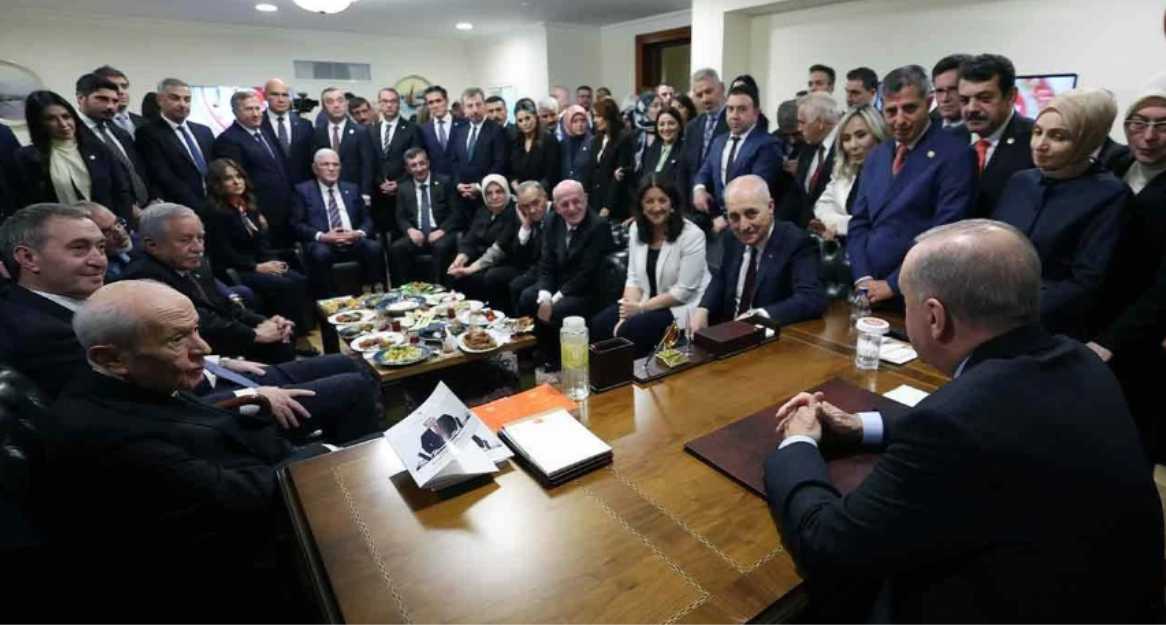
All sorts of transcripts started circulating, some long, some short. At first, nobody said, “No, these are fake.” After all, as a rule, journalists got documents like these from people at the negotiating table. The same people had also set up a number of messaging groups. One news site would publish the material first, then the rest would follow.
The transcripts included notes of meetings with a purpose to convince certain sections to the “new peace process”. They needed to circulate. People needed to hear about them so that they could work!
But once they spread, trouble followed! When people who read the transcripts with their heads rather than “under some spell” started to single out certain truths about the “new peace process”, the first pushback was, “you’re taking this out of context.” When that failed, they accused people of trying to discredit Öcalan. Finally came the official statement: “A complete fabrication!”
We do not know quite how far the phrase “a complete fabrication” extends. We do not produce these transcripts, we do not sit in on the meetings, and we have no wish to. Experience also tells us that in processes like this, people routinely circulate fake documents or make “miniscule” alterations to meeting notes.
So, we don’t know whether the transcripts we’ve read, the ones making the news, are genuine, including the ones nobody has denied so far. What’s more, some of the meetings that people claim took place may be pure invention.
Tomorrow someone may even pop up and say, “We never even met.” …
Because, as with every important matter the authorities hide from the public, those in power either manufacture the facts or bury them! The aim is for society to lose its bearings in the fog.
Those at the table said, “we never discussed any of this.” Yet what we read closely matched what they had actually done and what they had already said elsewhere. Yes, there were times even we couldn’t help and said “no way”, but we’d exclaimed “no way” before too, and every single time, it turned out to be a way after all.
Still, they said no. Well then, what can you do? We have to take the people at the table at their word. So, into the bin go the transcripts, or at least some of them…
Even so, we can still find our bearings, never mind whether the transcripts are lying to us or liars are manufacturing the transcripts!
But first, a quick bit of ground-clearing...
Accusations of the sort that say we “don’t want the conflict to end” simply don’t fit us, not in a million years. For years, long before these so-called peace processes, which some count as two and others as four, we stressed that the conflict was driving working people apart from one another. We said, “you can’t reduce this problem to terrorism,” but we also said, “this is terrorism,” without paying any attention to the sniping that came our way from a muddle-headed “left”.
Oddities like “how can you sit down with the terrorists” were never our style either. If a conflict is going to end, people talk, people sit at the table. “Why did you sit down” was always a question from empty rhetoric with no real content and it has always been too easy for them to deal with rhetorical objections. It’s a gift to those in power!
The state had already been talking to Öcalan for years. It is talking to him in this process too. Of course it should.
But what do they discuss, how do they discuss it, and to what end? Those are the real questions waiting for an answer.
Those in power have declared Öcalan a “founding element”, and that declaration proves PKK circles right when they say, “they had to acknowledge us.” Every one of Öcalan’s statements that nobody has denied so far (!) shows him acting with exactly that mission and that same confidence.
In short, the AKP presents its electoral victories to date as “the manifestation of the national will”, while the PKK declares Öcalan’s legitimacy “as the outcome of an era of armed struggle that has now come to an end”.
So, since both sides accept this, are we supposed to keep quiet?
No way!
Treating Öcalan as a legitimate counterpart, sorting out his legal status, none of that is the real problem. The real problem is that the authorities have decided to use a man they themselves have long called a “baby killer” to clear away the obstacles blocking the social and political changes they want, obstacles they haven’t managed to get past until now.
That is what we object to. And to anyone who responds with some version of “what’s it to you if both sides are happy?”, we can give exactly the same answer: What’s it to you?!
Everyone makes their choice, and the struggle goes on.
We have opposed this transformation outright from the very beginning. We have fought it, and we will continue to fight it.
We do not need their transcripts, minutes or records to describe what this transformation amounts to. In fact, there is very little left for us to wonder about. The transcripts were useful only because they might wake up those who still look at this process in all innocence and ask, “Could this perhaps solve some of Turkey’s problems?”. That is all!
Everything else is already out in the open. Point by point. In ways nobody can deny.
The heading over all of it is Neo-Ottomanism. It encompasses a reckoning with 1923, sectarianism, expansionism and pan-Islamism. Countless statements and articles support all four. Nobody can call that “a complete fabrication”. Nor do they particularly want to. They want people to reconcile with this.
Whether this is what the PKK’s base actually wanted is another question. But we have said it a hundred times, a thousand times. Ethnic, identity-driven politics can end up almost anywhere the dynamics of the existing system permit. A significant section of that base has spent years training itself to see “fascism” in the period from 1919 to 1923, so it can use that as a foothold for the agreement now reached with the AKP. The rest will not trouble them much either. So long as someone treats them as a legitimate interlocutor. Then... then reality asserts itself, and new paths emerge on a different terrain.
For the AKP and MHP(1), meanwhile, this amounts to an outright “success”. For now… A “success” because Neo-Ottomanism is replacing the exhausted Turkish-Islamic synthesis and becoming the official ideology of capitalism in Turkey, and for the first time it has achieved such genuine alignment at national, regional and international level.
Around ten years ago, Neo-Ottomanism ran headlong into a wall in Syria. Syria has also become the first testing ground for its new incarnation. Turkey joined the United States, Britain, Israel and Qatar in bringing about regime change in Syria. Yet if it wants to maintain a presence there while remaining aligned with a United States that has countless other problems, it needs the country’s Sunni communities to come together within a tribal order and an Arabo-Kurdish alliance to emerge from that arrangement.
The fact that Syria has become an arena of rivalry between Israel and Turkey represents only one side of the coin. On the other side lies a partnership between the two countries. Sometimes the Americans can broker that partnership, sometimes the British. And the region still contains plenty of issues that they need to “resolve” together. Let us not forget that those who won in Syria have yet to win in Lebanon, Iraq, Yemen and, of course, Iran.
The PKK’s change of format therefore offers the government a major opportunity. Some of those who have now embraced the peace process have swallowed the phrase they once repeated endlessly, “you do not negotiate with terrorists”, because they can smell the prospect of a “strong Turkey” stretching from Syria to Iraq. There is now a Grey Wolf at the den of wolves! (2)
The domestic political gain matters just as much to the AKP and MHP. With an economy like this, the “new peace process” may well offer their only route to another election victory. But the real objective is to paralyze the Republican resistance that they have failed to break for twenty-five years. That would allow them to move from being a “destructive” force to a “founding” one. A new constitution would provide the deed to seal it.
Unfortunately, the “Kurdish question” remains the weakest point of the Republican resistance. A few years ago, when we took the initiative to strengthen ties among Republicans, we said, among other things, that we would fight anti-Kurdish sentiment within Republican ranks. We came under fire for saying so. We were trying to explain that you cannot defend the values of the Republic by pretending the “Kurdish question” does not exist and parroting the language of the state in the 1980s.
The AKP spotted this weakness and exploited it all too well. What was the story? The Republic had supposedly shut Islamists and Kurds out, and now they would finally put that historical wrong right. The only way the Republican tradition could stand against that story was to reconsider the entire journey after 1919 through the lens of class. For those who could not do that, the road has now run out. A Republicanism that does not reinforce itself with egalitarianism has only two options left. It can take the “strong Turkey” part of the Neo-Ottoman project and stop worrying about the rest, or it can settle into the ranks of the “Turkist reserve forces” that the system will call on whenever it needs them.
And the “left”, of course, will keep quiet. They got a little confused, but never mind. They keep the game going on one side by endlessly chanting about the “Palace regime” (3), while on the other they refuse to budge an inch from the absolute obedience they have somehow extracted from the principle of “the right of nations to self-determination”. Once the Kurdish people had determined their own fate, they could turn their attention to other matters. And they knew perfectly well that the Kurdish people had handed that right over to the PKK, and the PKK had handed it over to Öcalan.
When Öcalan then opted for the AKP’s Neo-Ottoman strategy, the “left” felt a little pang inside, but what could they do? By then, the “left” had spent years becoming expert political operators. As the “forces of democracy”, they could follow Özel and İmamoğlu on one side, while as the “forces of freedom” they followed Öcalan on the other. By bringing these two lines of struggle closer together, they could still imagine themselves playing a perfectly “revolutionary” role.
Life has carried them from hostility towards the Republic of Turkey to a point where they cannot bring themselves to object to an imperial project. Such a shame…
Can they escape this trap? Over the past twenty-five years they have had plenty of chances to find a way out, and they failed to take them. If they manage it now, we shall see…
What matters now is what we do in a process that still remains far from complete. Our position is clear. Peace is good. Fraternity is good. So, we are not going to claim that this process offers no benefit whatsoever.
But we oppose it. We do not oppose it from the same standpoint as those who rage, “How can you sit down with terrorists?”, taking the easy way out. Nor do we oppose it like the foolish “leftists” who, nostalgic for the earlier aims of the “Kurdish freedom movement”, say “yes, but not enough”.
Something new has emerged. And this new situation requires us to prepare working people urgently for the major shocks that the reckless and ambitious Neo-Ottoman project will bring, by rallying them around a concrete programme of liberation and reconstruction.
When the Republic of Turkey set itself on the path of capitalist development in 1923, it held on to the anchor of “Soviet friendship”, which helped prevent major upheavals and threats. That friendship faded over time, but it helped shield the Republic of Turkey from imperialist partition.
The process we have now entered offers no such anchor, only international allies who cannot under any circumstance command our trust. They want to tie Turkey to something, and the leadership taking shape around this project consists of Erdoğan, Bahçeli and Öcalan. Anyone who wishes may compare them with the cadres who came to the fore during the revolutionary transformations of the 1920s.
This will not produce stability. Nor will it produce a new “Turkey”.
The issue moved beyond “who should our presidential candidate be?” long ago. The same goes for talk of Turkey moving a little closer to the “Global South” in international affairs... Getting stuck on questions like these reflects an inability to diagnose what is actually happening.
Neo-Ottomanism has now become the fate of Turkish capitalism. With or without this process. And this is a fact that all should bear in mind.
But capitalism is not Turkey’s fate. It is time this was understood.
1- The Nationalist Movement Party (MHP) is a fascist party and the junior partner in government through its alliance with the AKP under the name People’s Alliance. Its leader, Devlet Bahçeli, has played a leading role in the new “peace process” from the outset.
2- “Den of wolves”, is an expression for a political or social arena where powerful actors engage in a ruthless struggle for power and competing interests. The bozkurt, or Grey Wolf, is an established symbol of Turkish nationalism, particularly the fascist movement. Okuyan combines the two meanings here in a play on words, referring both to Turkey’s attempt to become a more assertive actor in regional struggles where imperialist powers dominate and to the nationalist and fascist element within that strategy.
3- Opposition circles in Turkey widely use the term “Palace regime” to criticise the AKP government and, in particular, the system of rule that increasingly centres power on President Recep Tayyip Erdoğan. “Palace” refers to the Presidential Complex in Ankara. At the same time, the term tends to reduce Turkey’s political and social problems largely to the current government and its leader, obscuring their structural connection to Turkish capitalism and the interests of the capitalist class.