
The following article appeared in the 107th issue of O Poder Popular, the journal of the Brazilian Communist Party (PCB). The author is Victor Hugo Arona, the National Secretary of Popular and Neighborhood Movements of the Communist Youth Union (UJC). The article discusses the issues with urban mobility under capitalism and the PCB's proposals for public transport, such as free fares (tarifa zero) and the nationalisation of transport services.
Image
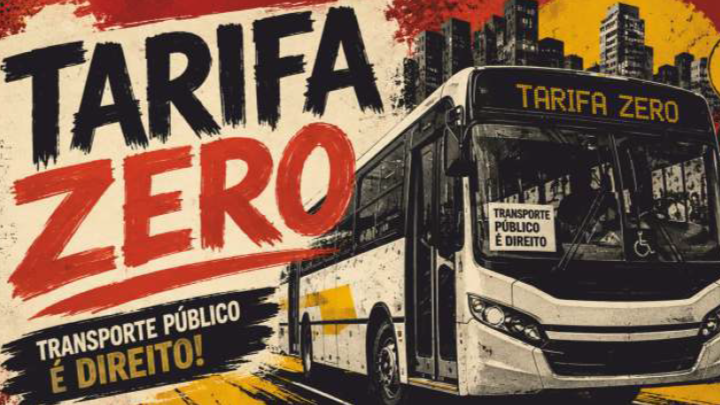
Article from O Poder Popular, the journal of the Brazilian CP (PCB), written by Victor Hugo Arona.
Urban mobility and class struggle
Displacement across territory, the capacity for territorial mobility, is one of the many human needs. Whether individually or collectively, we move using specific means of transport, according to various motivations. However, like many other aspects of the production and reproduction of our lives throughout our historical development, the private appropriation of mobility by the bourgeoisie, especially under imperialism, has turned into a commodity that has long been essential for us.
When we talk about Brazil, we see that we are predominantly present in cities: according to the latest census, almost 90% of the population is in urban areas. In the context of neoliberalism, urban mobility is dictated, whether in large, medium, or small cities, by privatisation or concessions granted in the transport sector. These companies use the existing road infrastructure and basically function to enrich the capitalists, who often do not seek to make improvements, while imposing increasing prices on the entire population that needs to use this service.
On this side, in addition to increasingly abusive fares, we experience numerous problems that expose the contradictions of capitalism. Among them, we can mention delays and restricted schedules throughout the week, delayed payment of wages and outsourcing of employees, imposition of double duty, extinction of rights such as free fare for students, the elderly and people with disabilities, reduction of itineraries and lack of territorial coverage, fleet reduction and overcrowding, discomfort, health issues and risk of life due to long journeys, lack of infrastructure or vehicle maintenance, and other examples.
At the same time, as a representative of the interests of the ruling class, the bourgeois state complies with any and all demands made by the owners of transport companies, usually conducted through federations or unions of companies. The most absurd reasons are presented, ranging from threats of service stoppage, through a supposed reduction in use in recent years, to isolated actions by individuals – such as theft and vandalism – to justify a "cost pass-through" that, in practice, is the guarantee of increasing profit for this small group.
Faced with what has been imposed, we communists understand the importance of presenting a political programme linked to territorial mobility, which brings together immediate demands, while at the same time defending a substantive transformation of the society we live in that can guarantee not only the continuity of our achievements, but also future victories. Organised and continuous popular mobilisation is fundamental, because, among other things, it increases our chance of success, by altering the correlation of forces that have presented themselves so far.
In defense of zero fare and the nationalisation of transport!
We have as a historical agenda the struggle for zero fare, where free fare is established for a group of users – such as students and people who do not have a job – or even for all people who use a certain transport. Furthermore, one can take advantage of the current conjuncture, in which some municipalities have stopped renewing concessions for private companies, when the federal government has been debating the institution of a National Zero Fare Policy and the very period of bourgeois elections, in which it is more favorable to debate national policy with the working class, in general, and with working-class youth, in particular.
As part of a more advanced program which should be our horizon, we defend the end of all concessions and the nationalisation of so-called public transport. This is capable of reshaping the interests involved up to now, placing territorial mobility in favor of the working class and their right to circulate across geographic space. This must be accompanied by a broad debate, collective elaboration of transport plans and by direct popular control over the operation of the service, such as through deliberative councils.
As a direct consequence of nationalisation, operating and service expansion costs fall and broader road restructuring projects become viable, as they are disconnected from the idea of profit. As policies that produce improvements in infrastructure are implemented, the use of these modes intensifies, making the use of automobiles less common and boosting the local and regional economy, while reducing environmental impacts. Furthermore, as they become public employees, the stability and consequently the quality of life of the workers involved in the sector can increase.
It is essential that our agendas are presented by us, in order to differentiate our political program, of a radical and revolutionary character, from any ideas disseminated by liberal or social-democratic sectors. In summary, ensuring a connection between our immediate demands and our strategic horizon, the following are proposals to be implemented in the short term:
• Guarantee of free transport for students, in the form of free passes;
• Implementation of free transport for unemployed people;
• Non-renewal of any transport concessions; and
• Prohibition of any increase in ticket prices.
Meanwhile, thinking about measures to be carried out in the medium term, not necessarily after the previous ones, we communists defend:
• Revocation of existing transport concessions;
• End of privatisations and nationalisation of transport services;
• Universal zero fare, for all people, every day;
• Guarantee of nighttime transport at regular times; and
• Creation of popular committees in places of study, work and housing.
Furthermore, as long-term actions that involve a profound restructuring in political-administrative and territorial terms, we have as proposals:
• Expansion of the railway, subway and waterway networks;
• Construction of bike lanes and their integration with other road networks;
• Direct control of transport by the working class;
• Formulation of Popular Territorial Plans involving transport; and
• Creation of Popular Transport Councils.
Radicalising the debate on territory, based on transport, is fighting for social justice, where the use and appropriation of space are universalised. This needs to be done, first and foremost, through the state, while promoting organisations that guarantee the continuity of these advances; in this sense, the radical control of public policies will take place through the construction of Popular Power, to promote the true revolution in territorial planning, removing the market character from services and guaranteeing their true democratisation.
The struggle for territorial mobility, whether urban or not, must accompany the struggle for socialist revolution, because it is from a new state that we will have real conditions to prioritise our demand: a healthy way to carry out our displacements based on our countless needs: not only for work, but also for study and leisure. Until then, the struggle is every day, understanding the urgency of building a new world.