

The following article was published as an editorial in Nuevo Rumbo, organ of the Communist Party of the Workers of Spain (PCTE).
PCTE on new political year
A new political year begins, one that will mark either a continuation or a new chapter in two terms of social-democratic coalition governments led by Pedro Sánchez's PSOE. Whenever the general elections are finally held, once again the old guard of social democracy and what remains of the –not so– new one will call upon us to "stop fascism," this time with more urgency and desperation than ever, knowing that retaining the central government will be a real struggle. It is worth asking, therefore, what has happened to the forces currently in government, on the one hand, and to the reactionary forces, on the other, in these almost eight years.
What happened in Ceuta, and what is still happening there more than a month later, pretty much sums up what has characterized the political practices of both sides in recent years. That is, provided one digs a little deeper and is willing to analyze the events thoroughly, with an independent perspective, going beyond the catastrophic pronouncements of some and the triumphalist boasts of others.
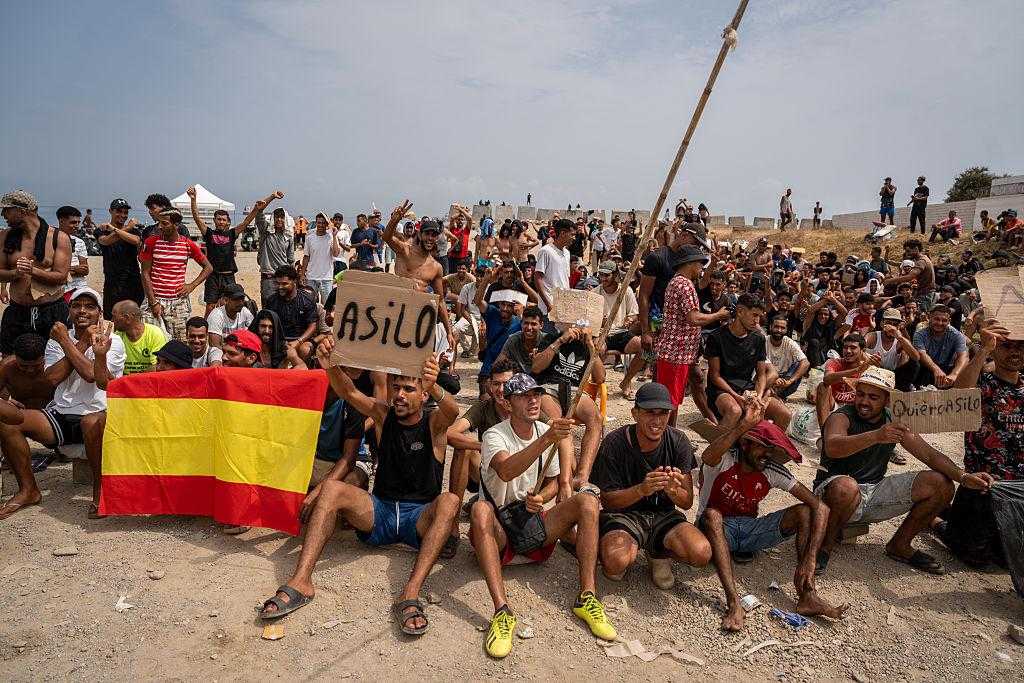
First, tens of thousands of people cross the border from Morocco, desperate, with nothing to lose, having no hope for a better future in their country, and enter Ceuta.
Second, the reaction is quick to speak of an "invasion" and to encourage "hunting them down one by one" – including minors – and "returning" them to their country.
Third, the central government denounces "the violation of Spain's territorial integrity," merely points the finger at "the mafias," and completely exonerates the Moroccan government, because preferred partners shouldn't be bothered too much. It reacts late and acts slowly, contributing to the chronic vulnerability and precariousness of the migrants, without providing the necessary resources to address the complex situation created by the fact that hundreds of migrants remain in Ceuta. Yet they staunchly defend their own handling of the situation and blame the reaction.
And the reactionary forces find themselves facing the perfect scenario: they blame and harshly attack the government, spreading hate speech, stoking the climate against the migrant population, and seeking to capitalize on that hatred for future votes. Before they can even resort to the language of "invasion" and "hunting them down," certain preliminary steps are necessary. We don't even need to go back to the 1930s in Germany; we have seen it and continue to see it today in Gaza, intensified since October 2023: the first step needed to normalize violence against a particular group of human beings because they have a different nationality or ethnicity is to dehumanize them, to treat them as if they were not equal to you, your family, your friends, your neighbors. These people are "something else" and come to disrupt order and peace, steal aid from those who lived here before, or simply to commit crimes. We saw it last summer in Torre Pacheco and we are seeing it today in Ceuta: pogroms, persecution, and attacks against migrants; the blocking of humanitarian aid; Burning of the precarious settlements where some migrants continue to survive weeks after arriving in Ceuta.
For its part, the government has sought to avoid angering Morocco and has absolved it of any responsibility, despite the unprecedented nature of such a massive influx of people. In fact, it has applauded Morocco's border "cooperation," thus reinforcing the role of EU enforcer that the alliance has been granting it through the outsourcing of migration policy, a role that the North African country has readily accepted over time. This is a policy that the European monopoly pursues to avoid the "inconvenience" of having its member states fulfill this function, which would make it difficult to maintain its image as a guarantor of human rights and civilizational values. Various Moroccan political leaders, for their part, have not missed the opportunity to put their demands on the two Spanish enclaves in the north of their territory on the table, knowing that they enjoy a strong negotiating position in diplomatic relations due to the control of migratory flows.
There is already a precedent: in April 2021, allowing the Polisario Front leader to enter a hospital in La Rioja cost the government, in "revenge," having to manage the entry of thousands of people into Ceuta and Melilla a month later due to the Moroccan police's lax border controls. The Spanish government's response to recover the strained diplomatic relations with its neighbor after that episode? To modify the official position Spain had historically maintained on Western Sahara, supporting the Moroccan proposal that it become an autonomous province of the Alawite kingdom—the "most serious, realistic, and credible basis," according to Pedro Sánchez—thus betraying the Sahrawi people and burying their hopes for a free future, with a referendum on self-determination to which Spain, as the former colonial power, was obligated under the 1975 Madrid Accords.
There isn't a single person responsible for the fact that, in 2026, some have gone so far as to burn down migrant settlements, just as some also do, periodically, with the substandard housing of seasonal workers in Huelva. The rise of xenophobic and racist attitudes internationally, an expression of imperialism's natural tendency toward reaction, is evident and cannot be combated from just one corner of the world. But those who have endlessly boasted about our country as a kind of European exception simply because the right and far right are no longer in power should face an uncomfortable question: if coalition governments are supposed to have expanded rights, boosted the economy, strengthened people's finances, and effectively confronted reactionary forces, how can we explain the surge in xenophobia and racism we've experienced since 2018? Wasn't fascism being held back with each—pyrrhic—victory at the polls? Wasn't that the most valuable thing a worker could do to slow down that advance?
Once again, we risk becoming entangled in that endless cycle where reaction advances, social democracy calls on us to vote en masse to defend "democracy" and "stop fascism," and if they lose, then yes, it will be time to mobilize in the streets… so that the "progressive forces" can return to power. To avoid this refrain, which is amplified during election periods, we must insist on the necessary path, even if it is less appealing and comfortable than casting a vote: organizing ourselves in our immediate surroundings, at work and in our neighborhoods, preventing the advance of reaction, which only seeks scapegoats, which tries to place the origin of the social contradictions generated by capitalism in national or ethnic differences, obscuring the truly determining division: those who live from their own work and those who live off the work of others, even if they share a nationality. Let's stop believing in messianic and sterile leaders called to "inspire people," because while some continue playing politics and clinging to living off it, and the vast majority of workers are barely getting by, things are getting very serious.