
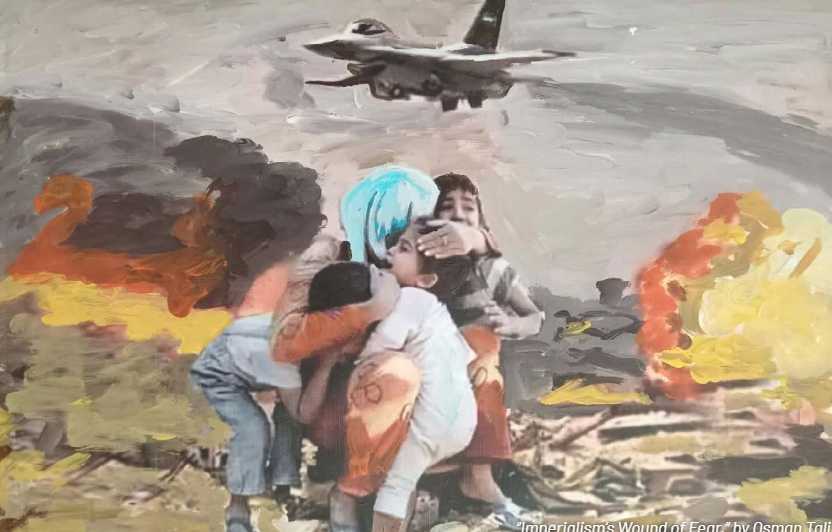

The following article, written by Murat Akad and entitled "Communists and the Struggle for Peace" was published in Voice of TKP, monthly international publication of the Communist Party of Turkey (TKP). The September issue can be reached here.
TKP on struggle for peace
The world is moving in a direction in which imperialism is escalating international tensions. This escalation is increasing the likelihood of war, perhaps even nuclear war. Humanity is facing a genuine and immediate threat.
In this conjuncture, one of the principal tasks of communists around the world is to wage a determined struggle for peace. The struggle for peace has been an important component of the international communist movement since its inception. At the same time, particularly following the demise of the actually existing socialism, certain currents within the peace movement moved towards a more liberal orientation and lost sight of their original focus.
Communists have remained committed to their principles and continued this tradition. Nevertheless, more needs to be done to strengthen the influence and weight of this principled struggle.
In order to make a sound assessment of the international situation and pave the way towards a just and sustainable peace, it is necessary to establish the fundamentals of imperialism. Imperialism is the highest and final stage of capitalism. It is not a temporary policy adopted by capitalism, nor a reversible mistake. Capitalism will not pass into another stage within the framework of capitalism itself.
The struggle against imperialism cannot be separated from the struggle against capitalism. These two phenomena cannot be assessed independently of one another. The anti-imperialist struggle must have an anti-capitalist character.
The global imperialist system is characterised by relations of hegemony and domination. Analysing the system and its functioning as a whole will help us understand the relations between countries occupying different positions within its hierarchy and how these countries are integrated into the system. This, in turn, would help peace movements in these countries formulate concrete objectives.
An imperialist country has the ability to influence the economic, political, military, ideological and cultural dynamics of other countries. The tendency to establish such relations, however, is not the same as the concrete ability to do so. The latter is the valid criterion for defining a country as imperialist. Therefore, determining whether a country is imperialist requires concrete analysis and a political perspective.
Imperialism has been experiencing a crisis of hegemony for a long time. Following the demise of socialist power in the Soviet Union and the other socialist countries, the United States and its allies expanded their hegemonic reach considerably, particularly during the 1990s and early 2000s. In subsequent years, however, the balance began to shift. On the one hand, the United States began experiencing economic difficulties; on the other, China emerged as a political and economic power, while Russia, despite greater economic turbulence, re-emerged as a significant political power, challenging US hegemony. The failures of imperialist policies, particularly in Syria and elsewhere, further contributed to this process. The United States responded by escalating tensions. What we are witnessing in the Middle East, Latin America and elsewhere is a consequence of this escalation.
The fact that the United States has led the imperialist system for a long period does not mean that this position is permanent. Competition and contradictions within the system have the potential to produce changes at every level of the hierarchy, including at the top. The functioning of the system does not automatically mean that such changes will favour peace. The dynamics undermining US hegemony do not necessarily set in motion developments conducive to peace.
The fact that certain countries challenge the existing hierarchy and produce disruptive effects does not necessarily generate positive outcomes for peace. The capitalist character of these countries must never be overlooked. In other words, the world may become multipolar, but unless capitalism itself is overthrown, this development will not bring humanity closer to peace.
Ultimately, achieving a lasting peace requires overcoming capitalism. But this certainly does not mean that the struggle for peace should be abandoned or postponed. A persistent struggle for peace can reduce the scale of destruction resulting from wars. It can also undermine the cohesion and stability of capitalism and imperialism.
First and foremost, it is necessary to clearly analyse the class character of current and future conflicts. As we have witnessed in numerous cases over the decades, nationalist sentiments are relentlessly imposed upon working people in order to prepare the ground for mass militarisation. A correct analysis of conflicts will enable the communist movement to bring their class character to the fore and reinforce this understanding with the ideas necessary to prevent nationalism from overwhelming class consciousness.
This will also enable communists to take clear and principled positions without taking sides between different capitalist classes.
We must explain to the peoples of the world that any general war would have devastating consequences for humanity on an unprecedented scale. Under current conditions, it is clear that nuclear weapons could be used in such a general war.
The foremost task of communists is to prevent a general war from taking place. War must be prevented at all costs. The destruction caused by war would fall particularly heavily on the working class and other impoverished sections of society. At the same time, the policy that should be pursued if war breaks out should also be indicated. If war nevertheless breaks out, intervention must be undertaken to bring it to an end as quickly as possible. And furthermore, the collapse of capitalism must be accelerated through persistent struggle.
The First World War gave rise to important debates during the early development of the peace movement. Lenin and the Bolsheviks opposed pacifism—that is, an abstract advocacy of peace—and stressed that it served no purpose other than deceiving the working class. At the Conference of the Russian Social Democratic Labour Party, held in Bern from 27 February to 4 March 1915, Lenin stated: “Today, peace propaganda that is not accompanied by a call for revolutionary mass action merely causes the proletariat to indulge in illusions and become demoralised, turning it into a plaything in the hands of the secret diplomacy pursued by the warring countries.” According to Lenin, it was also demonstrated that the ruling class's fear that a proletarian revolution might emerge as a result of a world war constituted a vital guarantee of peace.
The essence of calls for peace should be to make clear to the masses the distinction between socialism and capitalism, rather than attempting to reconcile two hostile classes or two antagonistic political lines.
The guarantee of peace is the organised and conscious movement of the working class.