
Isabel González Torrents, wo is responsible for the International Relations of the Central Council, from the Communist Youth Collectives (CJC) has given an interview regarding their recent summer camp and upcoming plans for the youth. CJC is the youth organisation of the Communist Party of the Workers of Spain (PCTE).
Image
"Exchanging these experiences helps strengthen the struggle of working-class youth."
Interview with Communist Youth Collectives of Spain
1. You are organising your 12th summer camp as the Communist Youth Collectives. What has been your main focus for this camp? Have you noticed any changes compared to previous camps?
The main theme of this year’s Youth Summer Camp is the 90th anniversary of the outbreak of the Spanish Civil War in July 1936. We want to commemorate the antifascist struggle of the Spanish people and working class, while also drawing lessons from that historical period, which our Party, the PCTE, has been studying and analysing in depth. This period is crucial for understanding the tactics adopted by communist parties today on issues such as popular fronts, as well as the role played by other imperialist powers in the Spanish Civil War. This allows us to understand the conflict not only from a national perspective, but also in its broader international dimension.
The main goal of our Summer Camp is to provide young people from the working class in Spain with a healthy and meaningful form of leisure, where they can learn more about the working-class movement, both nationally and internationally, while also gaining new tools for political struggle. At the same time, the programme includes sports, games, cultural activities and free time, so that there is a balance between political education and leisure.
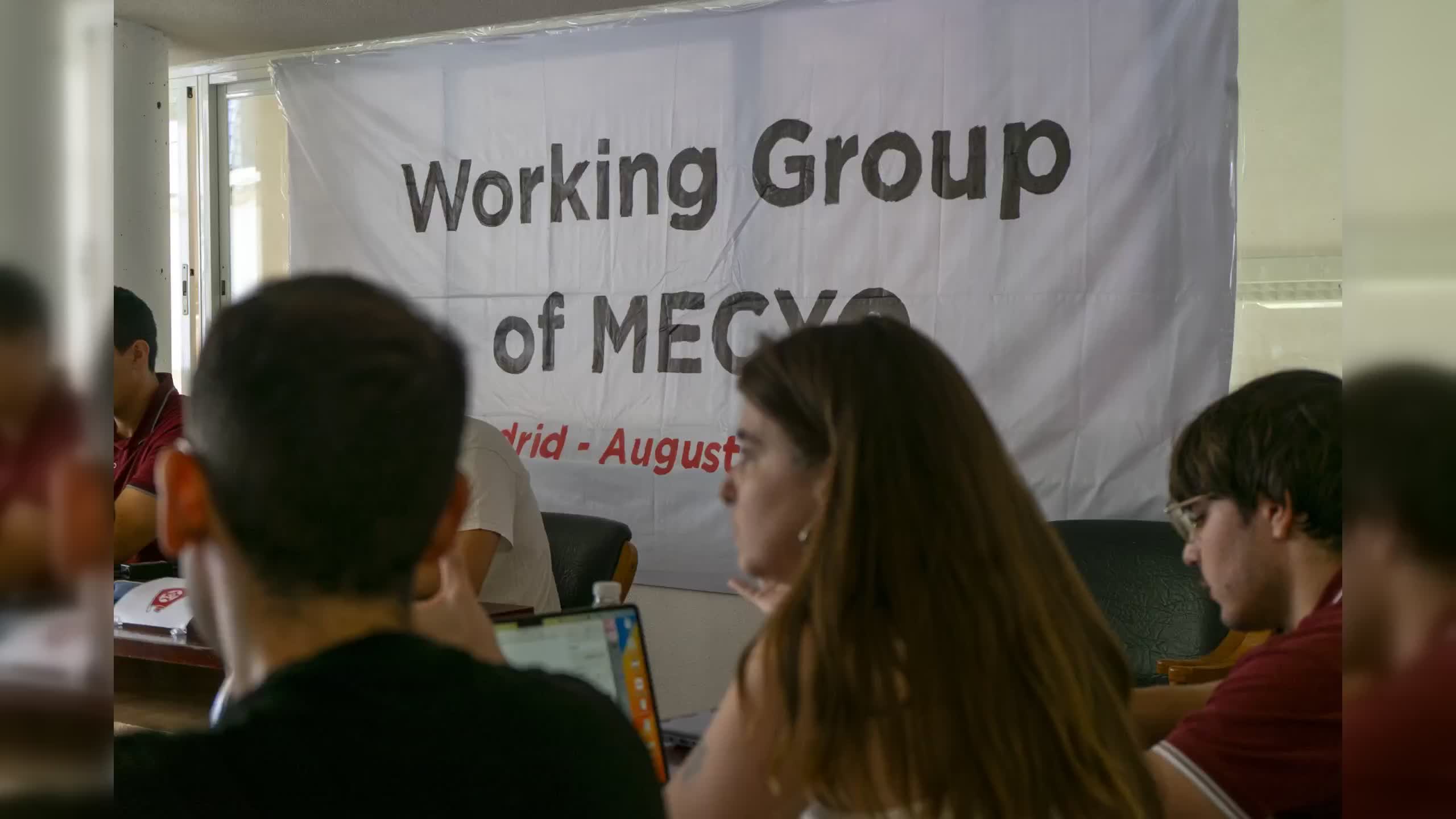
One of the main differences this year compared with previous editions is that we have welcomed the largest number of international delegations so far, partly because we have also hosted the MECYO Working Group. For us, this is particularly significant given the theme of this year’s camp and the role played by the International Brigades during the Spanish Civil War. More broadly, we believe that strengthening ties between communist youth organisations from different parts of the world are essential in the current context, marked by an acute intensification of inter-imperialist contradictions.
2. As the anniversary approaches, what is the CJC’s assessment of the civil war? How do you link this historical legacy to your current struggle?
Our Party has been working on an analysis of the role played by communists during the Spanish Civil War, and this work is still ongoing, as this is an extremely complex period to assess and one of the most significant episodes of struggle both for the Spanish working class and for the international communist movement in the twentieth century.
So far, we believe that two main conclusions can be drawn from this experience, both of which remain relevant to the struggle of communists today. The first concerns the tactic of the Popular Fronts adopted by Spanish communists, as well as by communists in other countries, in response to the rise of fascism. Our experience of the war showed us that alliances with social democracy, even when conceived as purely tactical, ultimately constitute a mistake from the perspective of the revolutionary objective we pursue. The struggle against reaction and fascism cannot be separated from the struggle for political power and socialist revolution.
The second conclusion is that the Spanish Civil War also became a battleground for different imperialist states and their respective bourgeoisies, particularly those ruled by fascist governments, such as Nazi Germany and Mussolini’s Italy. These forces confronted the Spanish working class and people, who in turn received support from the Soviet Union and from the international volunteers who joined the International Brigades. The Spanish Civil War, therefore, cannot be properly understood without taking into account the development of capitalism in its imperialist stage across Europe, as well as the international balance of forces within the workers’ movement at the time.
These lessons and analyses are still being studied and developed, and we hope to continue sharing our conclusions as this work progresses.
3. Could you please share the CJC’s plans for the coming period and the areas on which you will be focusing? What are you preparing for as the new academic year begins?
This September, the CJC will launch a general campaign closely linked to the general campaign of our Party, but with a specific focus on the living conditions of working-class youth in our country. On the one hand, the campaign will denounce imperialist war and the consequences it has for the working class in Spain. On the other, it will address the rising cost of living, the extremely precarious working conditions faced by young people, and the housing crisis. The latter cannot be properly understood without taking into account the labour precarity that affects young workers in particular.
At the same time, our Party is preparing for the 2027 general election, in which we will present our revolutionary programme to working-class youth, in close connection with the demands and objectives of our general campaign. From our perspective, elections, in their current bourgeois form, should serve communists as an opportunity to expand our political work among the working class. Through a programme centred on struggle and political mobilisation rather than on electoralism, we want to explain that voting is only a very limited part of what workers can do to improve their conditions.
Only the political independence of a revolutionary programme can bring about substantial improvements for the working class as a whole. Achieving this requires the organisation of workers and young people in workplaces, educational institutions and working-class neighbourhoods.
4. Could you share your assessment of the migration crisis in Ceuta and the government’s stance on it?
Migration crises in the Mediterranean are nothing new for many European countries, including Spain. On 31 July, thousands of migrants from Morocco crossed the Spanish border in Ceuta in search of better living conditions. As on many previous occasions, hundreds of people lost their lives along the way.
We believe that this latest episode must be understood as a means by which the Moroccan government seeks to exert pressure on the Spanish government, using the lives of the most vulnerable sections of its own population as leverage. At the same time, the Spanish government has limited itself to presenting these events as the result of human-trafficking networks, thereby removing from the discussion the political, economic and military responsibility that both the Spanish government and the European Union bear in their relations with Morocco.
It is also necessary to understand this migration crisis within a broader context of an acute intensification of inter-imperialist contradictions. Different states—in this case Spain and Morocco, which in fact share certain interests linked to their monopolies in strategic areas of North Africa, such as Western Sahara—seek to place themselves in increasingly advantageous political and economic positions, even within their own alliances. These alliances themselves are constantly being reshaped according to the interests of their respective monopolies.
5. The Spanish government is widely regarded as having considerable prestige due to its stance on issues such as Palestine. What is your general assessment of the government? Is there a genuine basis for this prestige?
The Spanish government, a social-democratic coalition between the Spanish Socialist Workers’ Party (PSOE) and Sumar, has tried to present itself to the Spanish working class and to the international community through an anti-war discourse. However, this rhetoric is difficult to reconcile with Spain’s actual position within its imperialist alliances and with the growing public investment in the arms industry.
In the current international context, marked by the war in Ukraine, the genocide in Palestine, growing confrontation between imperialist blocs and accelerated preparations for future conflicts, Pedro Sánchez’s government has significantly strengthened Spain’s military-industrial sector. In October 2025 alone, it channelled more than €14 billion in interest-free loans into the defence industry, mainly to finance military modernisation programmes and reinforce the position of major companies in the sector.
One of the main beneficiaries has been Indra, which has become a central actor in Spain’s military and technological industry. Its defence order book has grown rapidly, alongside major increases in recruitment and investment. This expansion is also increasingly international: Indra has strengthened cooperation with Germany’s Rheinmetall, while the Spanish government has committed further military assistance and industrial cooperation with Ukraine. In our view, these developments show that Spain is becoming increasingly integrated into the broader European rearmament strategy and remains firmly aligned with NATO and the Western bloc.
The hypocrisy of this pacifist discourse becomes even more evident when we look at the arms-related relations that the Spanish state continues to maintain with Israel. Despite the arms embargo approved by Congress in 2025 and the government’s repeated claims that no arms sales to Israel had taken place since 7 October 2023, various reports and analyses have shown that military trade and cooperation did not disappear, but rather continued through different channels. Available figures show that Spain has sold more than €84 million worth of defence equipment to Israel over the past two decades, with the current coalition government being among the periods with the highest average annual volume. This completely undermines the image of a government supposedly committed to peace and human rights. While solemn declarations are made in support of Palestine, the economic reality shows the persistence of commercial and technological ties with one of the world’s major military powers.
6. Would you like to share a brief message with our readers from the CJC?
We would like to thank you for giving us the opportunity to share our experiences of struggle in Spain over the past few months, as well as our analyses of both historical and current developments in our country. We believe that exchanging these experiences helps strengthen the struggle of working-class youth, both here and in other countries such as Turkey, just as we ourselves learn from your experiences and struggles.
For example, the anti-imperialist struggle carried out by communists in Turkey is an important example for us, as you demonstrated once again in the protests and demonstrations held in July this year against the NATO summit in your country. These experiences provide valuable lessons that can help guide our future struggles as we continue working towards our shared ultimate goal.
Isabel González Torrents