
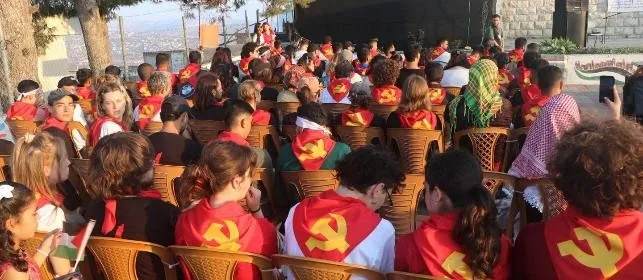
29th Youth Volunteer Festival was held in the Palestinian eco-village of Farha. For one week, young people from across the West Bank, Israel and other countries took part in agricultural work, construction and renovation, as well as political, educational and social activities. Zo Khadarek spoke with Ella Kedar Greenberg, secretary of the Tel Aviv branch of Banki (Young Communist League of Israel), about the festival, the communist and ecological character of the village, and the partnership that has developed between activists in Tel Aviv and the residents of Farha.
29th Youth Volunteer Festival held by Palestinian and Israeli young communists
What is the Farha Festival, and what makes it special?
The Farha Festival is an annual volunteer event for teenagers and young people. This year was the 29th festival. It was supposed to be the 31st, but it was not held during the previous two years because of the genocide in Gaza and the war. The festival was inspired by the volunteer work camp in Nazareth initiated and led by Tawfiq Ziad, and in the past the festival also bore his name.
The festival resembles a summer camp in format, but it is intended for teenagers and young adults rather than children. Every morning until the early afternoon, participants engage in intensive volunteer work in large groups. They work on construction, agriculture, cleaning and other tasks throughout the village. Later in the day there are team-building, educational and cultural activities, as well as tours.
Volunteers come to the festival from throughout the West Bank—from Hebron, Jenin, the Salfit area and many other villages. Many are activists in the youth movement of the Palestinian People's Party. Delegations from communist parties around the world also participate. This year, for the first time, volunteers from Israel participated throughout the entire week. At the weekend, a group from the Tel Aviv branch of Banki and Hadash Students joined them, volunteering in the mornings and participating in the other activities. This was a very significant development in our relationship with the village.
What is special about Farha?
Farha is an agricultural community in the Salfit Governorate, almost in the centre of the West Bank, and it is also an ecological village. For years it has been part of the global network of ecovillages, and it was the first village in Palestine to be recognised as such. This means that residents do not use chemical pesticides in their crops. They produce compost and return to the soil what they take from it. They do this not only as a matter of principle, but as part of a clear political strategy aimed at developing the village's food independence.
A significant portion of Farha's agricultural land is located in Area C, and large areas of land have been confiscated from the village. Against this background, local agriculture has profound political significance. The ability to grow food independently, preserve the land and cultivate it is part of the struggle against the occupation and the dependency it creates.
Farha is also one of the villages where the Palestinian People's Party is particularly strong. The party branch in the village was established in the 1950s and became much stronger during the 1980s. For many years, many members of the village council have been party members. Residents elect the village council, which then elects the village head.
Many Farha residents are members of the People's Party. Of course, not all residents of the village are communists, but it is the communists who develop initiatives, and the residents appreciate and like them for doing so. You can feel the strength of the local party branch on the ground. It is doing very impressive work based on the actual needs of the residents.
How did Farha become an ecological village?
One of the central figures in this process was Bakr Hamad, a veteran People's Party activist and former head of the village, who for many years was a leader and mentor to the village's youth and young people. Hamad studied ecological agriculture in Portugal, and when he returned he proposed that residents change their methods of work to sustainable agriculture.
In 2015, the village's ecological farm, Qamar al-Balad (“Moon of the Village”), was established. The farm grows food without chemical pesticides, returns organic matter to the soil, and combines different crops in the same area in order to avoid depleting the soil and to allow the plants to nourish one another.
Over the years, the farm has become the centre of the village's social and educational life. People come there to relearn knowledge that has eroded and been forgotten over decades of occupation: traditional methods of food preservation, local recipes and traditional agricultural techniques. Young people from the village also come there to learn agriculture.
About five years ago, young people in the village established the Al-Ard Lana (“Our Land”) Cooperative. It is a voluntary cooperative, and its activists do not receive wages for their work. In recent years, the cooperative has led a campaign under the slogan: “Sow the food, reap freedom.” The idea is that the more food the village produces itself, the less dependent it will be on international aid and on dictates from the Palestinian Authority, Israel and other actors.
The residents of the village have worked with international organisations for many years. They are frustrated that European organisations come and offer money or assistance but attach conditions and tell residents what they need. Village head Mustafa Hamad explained: “As communists, we cannot come and tell people what they need. We have to develop a theory, strategy and course of political and material action based on the concrete needs of the residents.” In my view, that is an ideal.
How did the relationship between the Tel Aviv branch of Banki and the village develop?
The relationship developed through joint activity by members of Banki and Hadash Students in Tel Aviv. Most of us first came to Farha in 2023 as part of a short visit by a group of refuseniks. We attended a ceremony held during the festival, but did not participate in the volunteer work.
In 2024, we decided to organise a volunteer day in the village, which also included a tour and an opportunity to get to know the residents. I organised it together with Mustafa Hamad, members of the village council, cooperative activists and young people from Farha. A relationship developed through this activity, which later also became a personal friendship.
For the past year and a half, we have made a point of visiting the village at least once a month. We also organise a workday every two months for volunteers from Israel—Palestinians and Jews. We are also developing projects in which we use our skills to assist the cooperative. For example, I help a young man from the village who manages the cooperative's social media.
This year, we not only joined the festival but also actively participated in organising it and preparing for it. It is now no longer simply a relationship between an outside group and a village where people come to volunteer. It is a genuine political partnership—something very rare in our reality.
What are you taking away from the week of volunteering?
I am taking away a great deal of hope. This year's festival was held in a different format from previous years, and many of the problems that arose were largely a result of the many changes that had been made. Nevertheless, I think we all came away with a great deal of hope for next year's festival and for the activities we will hold in the meantime.
This week once again made clear to me how important education is and how significant the festival's activities are. Half, and perhaps even more, of the volunteers were Palestinian teenagers from across the West Bank, aged 14 to 18. Theory, understanding, strategy and political thinking grow out of practical work, rather than the other way around. I think this is something we tend to forget in our day-to-day political activity, even though it is extremely important.
I am taking this insight back to the summer camps we organise in Banki as well. We must not view them merely as places where young people can have fun and parents can get a little rest. We need to take inspiration from the festival and turn the summer camps into spaces for political education—not through lectures, but through practical knowledge: how to take action, how to organise young people, how to organise a demonstration, how to volunteer and how to mobilise a large group of people. This is essential knowledge in general, and especially in the coming years of struggle, as the conditions in which we operate become increasingly difficult.