
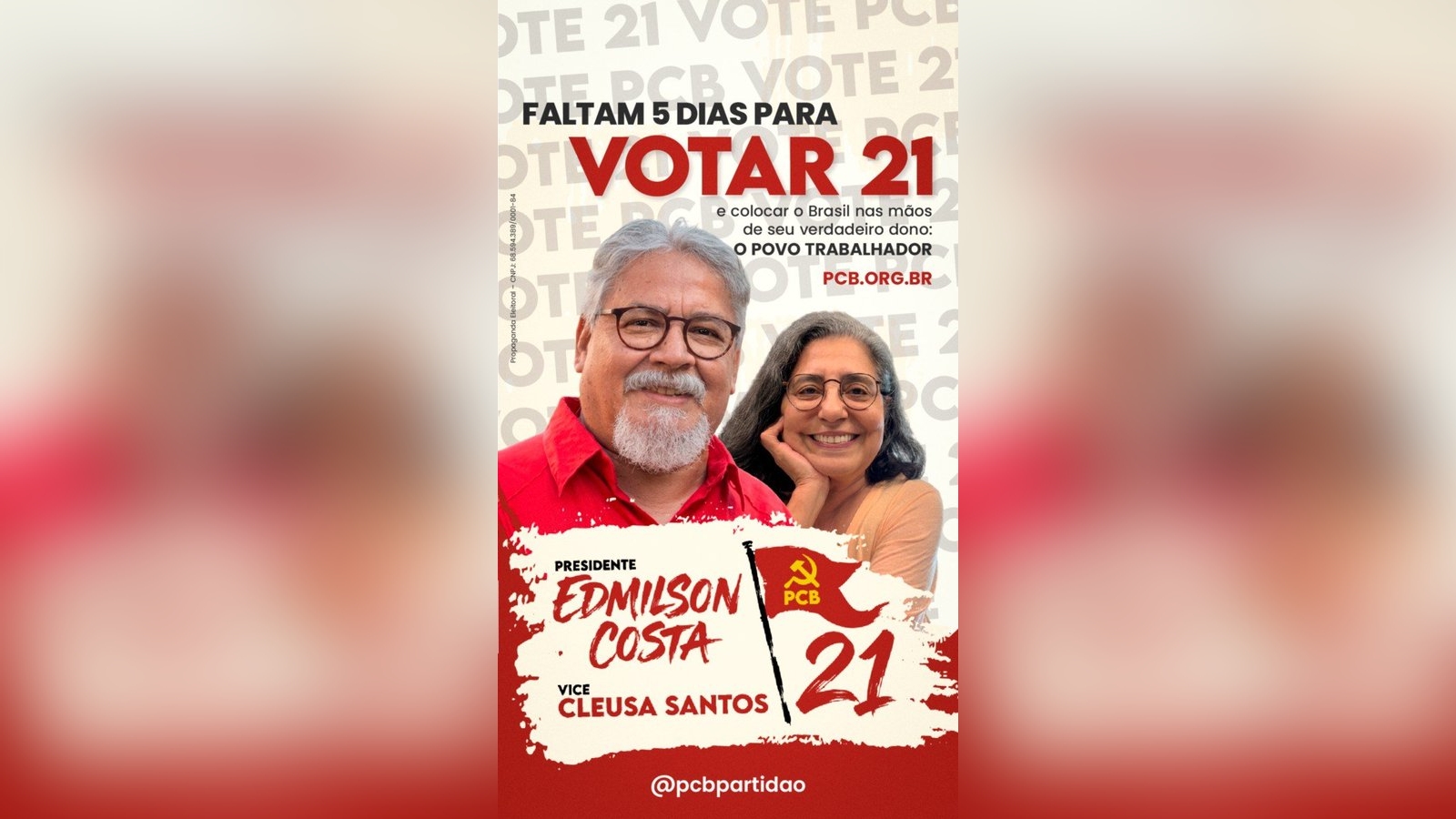
The Brazilian Communist Party (PCB) has entered the final stretch of the 2026 presidential campaign with Edmilson Costa as its presidential candidate and Cleusa Santos as his running mate. The first round is scheduled for 4 October, with Costa running under ballot number 21.
Brazilian Communist Party's election campaign in final days before first round
In the last few days, the campaign combined street-level activities, meetings with supporters and media appearances, while the party used the final days to reinforce its argument for an independent communist candidacy rather than concentrating the first-round vote around the larger left-wing candidacy.
On 29 September, Costa held a discussion meeting in Taguatinga, in the Federal District, as part of his campaign activity. The event was reported in the national election agenda compiled by Agência Brasil.
The following day, 30 September, Costa conducted leafleting in Guará, in the Federal District. This was one of the clearest examples during the period of the PCB combining the presidential campaign with direct contact with voters.
The campaign's political messaging was particularly explicit on 29 September, when Costa published “Em defesa de uma alternativa comunista nas eleições” (“In defence of a communist alternative in the elections”). The text responded to arguments that votes for left-wing candidates other than Lula could objectively benefit Flávio Bolsonaro. Costa argued that the first round should allow different political forces to present their programmes and rejected the idea that left-wing organisations should abandon their independent programmes before the first-round vote.
In the same statement, Costa reiterated the PCB's principal programme demands: revocation of neoliberal legislation affecting workers' rights; structural economic, political and social reforms; progressive increases in the minimum wage; a 30-hour working week without reduction in pay; an end to the 6×1 work schedule; public ownership of the financial system; re-nationalisation of privatised companies; public health and education; changes to public-debt policy; and agrarian reform.
The statement also clarified the PCB's position regarding a possible second round. Costa said that if the PCB were not in the second round, the party would participate in efforts to defeat the far right, while maintaining its political and programmatic independence.
On 2 October, the final Friday before voting, Costa had an interview with a radio station in Goiás and an appearance on a YouTube channel. He also gave an interview to Metrópoles, in which he presented the PCB's proposal to abolish the Federal Senate and establish a unicameral parliament. His proposal would have half of legislators elected through universal voting and half through votes involving trade-union, popular and youth movements, with the institutional changes to be pursued through a new Constituent Assembly.
The PCB's presidential campaign is also part of a broader slate of state-level candidacies. The party has highlighted candidates in states including Minas Gerais, São Paulo, Maranhão and Acre, with their campaigns presenting the same general themes of workers' rights, public services, popular participation and structural change.