
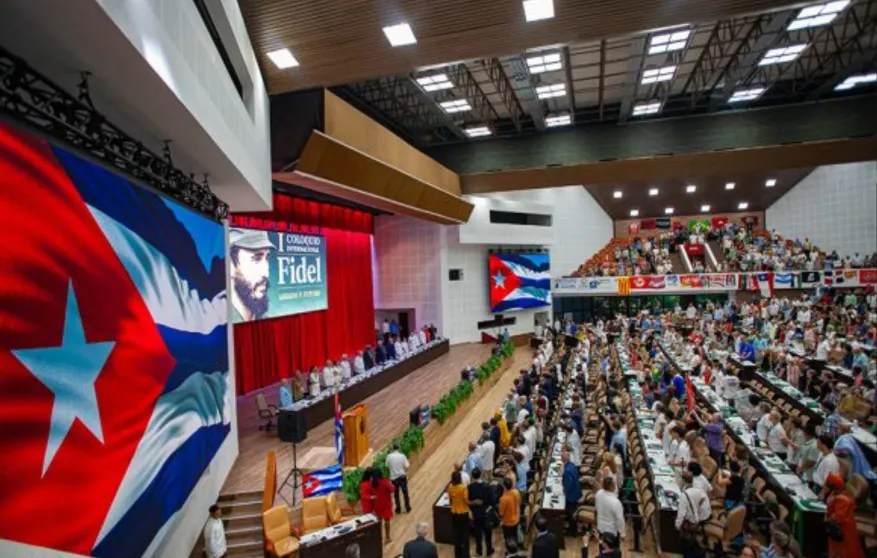
The First International Colloquium “Fidel: Legacy and Future” begins this Monday at Havana’s Convention Center, as part of the program of activities marking the centenary of the birth of the historic leader of the Revolution.
Colloquium for Fidel begins in Havana
Cuban President and First Secretary of the Central Committee of the Communist Party of Cuba Miguel Díaz-Canel spoke at the international colloquium “Fidel: Legacy and Future,” held in Havana as part of the activities marking the 100th anniversary of the birth of Fidel Castro, the historic leader of the Cuban Revolution.
In his speech, Díaz-Canel said that Fidel’s political legacy should not be regarded as a body of ideas belonging to the past, but rather as a method for developing responses to the problems Cuba faces today.
“Fidel left us not a dogma, but a method of work and an example to follow,” Díaz-Canel said, emphasizing that, under Cuba’s current circumstances, resistance should not be understood as a passive stance:
Our resistance is not passive; it is creative.
‘Shortages and power outages are the result of a silent genocide’
The Cuban leader devoted a substantial part of his speech to the economic blockade imposed by the United States on Cuba.
Referring to shortages of goods, power outages, inflation and queues in the country, Díaz-Canel argued that these conditions could not be considered separately from the political context and the policies pursued by the Cuban government.
Díaz-Canel said that these conditions were the result of a “silent genocide” being waged by the United States against the Cuban people.
He stated that Washington’s objective was to economically and politically suffocate Cuba, but said that Cuba would nevertheless not abandon its existing social order or its policy of solidarity in international affairs.
Díaz-Canel said that, despite the difficulties facing the country, “the homeland will resist aggression,” and stated that no amount of pressure would bring an end to Cuba’s policy of solidarity or cause the country to abandon its goal of “building a more just country.”
Call for solidarity from foreign participants
Díaz-Canel also addressed a call to the foreign delegates attending the colloquium.
Urging them to communicate the realities of Cuba in response to international media campaigns concerning the country, Díaz-Canel called in particular for stronger solidarity and coordinated action on social media.
He called on participants to develop critical thinking and continue their solidarity with the Cuban Revolution, presenting this as part of the struggle against the imperialist pressure facing the country.
The international colloquium “Fidel: Legacy and Future,” organized to mark the 100th anniversary of Fidel Castro’s birth, will continue in Havana until August 13.