
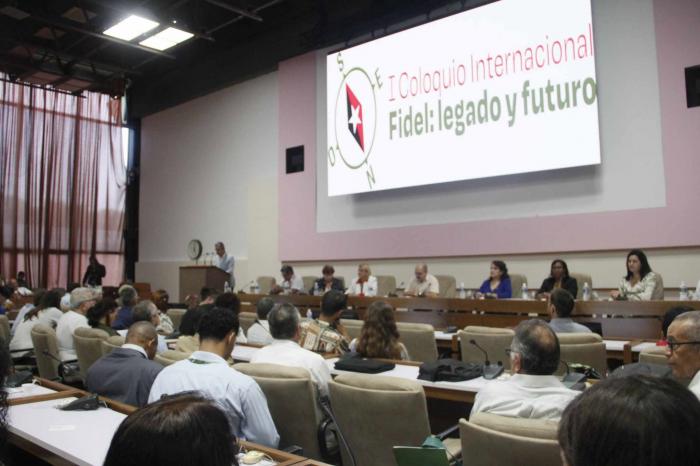
The First International Colloquium “Fidel: Legacy and Future,” being held in Havana as part of the centenary commemorations of Fidel Castro is an event, which is primarily an international political and ideological gathering focused not only on Fidel’s historical legacy but on the continued relevance of his ideas to contemporary struggles over sovereignty, imperialism, socialism, international solidarity and social development.
Colloquium for Fidel continues
The colloquium opened at Havana’s Palace of Conventions on August 10 with a keynote address by Miguel Díaz-Canel, First Secretary of the Central Committee of the Communist Party of Cuba and President of the Republic. Díaz-Canel welcomed participants from across the world, portraying their presence as an act of solidarity with Cuba at a time of intensified US pressure and what he described as imperialist hostility. He emphasized that Fidel’s legacy should not be reduced to historical remembrance but should continue to inform Cuba’s political and social practice.
Díaz-Canel argued that Cuba’s response to its current difficulties was based on what he described as “firm and creative resistance,” unity, defence of the Revolution’s achievements and continued transformation of the economic and social model without abandoning socialism. He presented the Communist Party of Cuba as the central force responsible for directing and coordinating this process and for defending social justice and the achievements of the Revolution.
International participation and solidarity
Foreign political leaders and representatives of left-wing and communist organizations were present during the first two days and made important contributions. During August 10, Díaz-Canel held a series of meetings with participants in the colloquium.
The discussions repeatedly emphasized international solidarity with Cuba. Liu Haixing conveyed the support of the Chinese Communist Party and Xi Jinping, while Díaz-Canel highlighted Chinese assistance to Cuba's transition toward renewable energy. The Cuban president also thanked Namibia for its consistent support for Cuba in international forums. The Prime Minister of Namibia, Ngurare, declared that Namibia would remain alongside Cuba, recalling Cuba's role in African liberation struggles.
Youth forum and the contemporary relevance of Fidel
On August 11, Díaz-Canel and Roberto Morales Ojeda attended the youth forum “Creo en Ustedes” (“I Believe in You”), organized by the Union of Young Communists. The forum brought together Cuban youth and representatives of communist and progressive youth organizations from other countries.
UJC General Secretary Meyvis Estévez Echeverría focused on the effects of the US blockade on Cuban society, particularly on children and healthcare. She cited shortages of medical supplies affecting surgical procedures, vaccination and prenatal care, while reaffirming that Cuban youth would defend the country and the socialist system.
Gonzalo López, president of the World Federation of Democratic Youth, expressed solidarity with Cuba and linked the country's situation to what he described as a wider imperialist strategy involving sanctions, militarism and war. He also denounced the situation in Palestine and US policies toward Venezuela, while reaffirming the federation's commitment to supporting the Cuban Revolution.
Díaz-Canel's intervention connected the present generation of Cuban youth with the generation that followed Fidel in the struggle culminating in the 1959 Revolution. He argued that today's young people face an imperialist offensive against the Global South, accompanied by the growth of conservative and fascist tendencies, ideological and cultural warfare, and extensive disinformation campaigns. He concluded by identifying three principles drawn from Fidel's thinking: humanism over the logic of algorithms, cultural identity over cultural colonization, and solidarity over selfishness.
Fidel's foreign-policy legacy
One of the principal discussions on August 11 examined Fidel's approach to foreign policy. Deputy Foreign Minister Carlos Fernández de Cossío identified three central principles.
First, he said Fidel's approach emphasized the uncompromising defence of Cuban sovereignty, even under extraordinary circumstances, citing the October Crisis as an example. Second, Cuba should not trade away its internationalist and solidarity commitments in negotiations with other governments. Fernández de Cossío referred particularly to US efforts to pressure Cuba over its support for Puerto Rican independence and its internationalist role in Africa. Third, Fidel's foreign-policy thinking involved a critique of the international economic order and a search for greater global justice and a more equitable distribution of resources.
Fernández de Cossío linked these principles to Cuba's activity in the United Nations, the Non-Aligned Movement, the Group of 77 and China, and Latin American and Caribbean organizations. He also highlighted Cuba's medical internationalism, including the Henry Reeve International Contingent, Cuban educational assistance abroad and the country's military involvement in African liberation struggles.
Science, technology and national sovereignty
Another session examined Fidel's emphasis on scientific and technological development. According to Granma, physician and researcher José Luis Fernández Yerro identified technological and scientific sovereignty and perseverance as two central lessons of Fidel's approach. The discussion presented scientific development not simply as an economic objective but as a means of strengthening Cuba's independence and capacity to resist external pressure.
This theme fits closely with Díaz-Canel's broader presentation of Fidel's legacy: economic and scientific development are portrayed as instruments of national sovereignty rather than merely mechanisms for growth.
Cultural presentation: 100 Posters of the Cuban Revolution with Fidel
The colloquium also included cultural activities. On August 11, the book 100 Posters of the Cuban Revolution with Fidel was presented. The volume brings together examples of Cuban revolutionary graphic design depicting Fidel in connection with the struggles and achievements of the Cuban people.
The presentation was attended by Díaz-Canel, Roberto Morales Ojeda, intellectuals, artists and international participants. Prominent Cuban intellectual Abel Prieto highlighted the importance of the publication. The book also highlights historical connections between Cuban and US social activists and presents Fidel's ideas as relevant to current political challenges.
The colloquium has been an effort to translate Fidel Castro's historical legacy into a contemporary political framework. Rather than treating Fidel primarily as a historical figure, the interventions repeatedly stress the practical relevance of his ideas to current questions of Cuban sovereignty, socialism, internationalism, anti-imperialism, scientific development and resistance to US pressure.
The international dimension is particularly prominent. The participation of communist parties, progressive organizations and representatives of governments from China, Vietnam, Namibia and Russia is an evidence of Cuba's continuing international relationships and of solidarity with the island under pressure. At the same time, European and Latin American left-wing figures used the event to connect the Cuban experience with broader opposition to imperialism, militarism, sanctions and the growth of right-wing and fascist forces.
The second day therefore broadened the meaning of Fidel's legacy beyond the history of the Cuban Revolution: sovereignty, internationalist solidarity, anti-imperialism, social justice, scientific independence and the defence of socialism are presented as continuing political tasks for Cuba and for the younger generation internationally. The colloquium's programme is scheduled to continue with further discussions on Fidel's foreign policy, public health, biotechnology and pharmaceuticals, with the stated aim of examining his legacy as a guide for interpreting and transforming contemporary reality.
(Photo: Granma)