
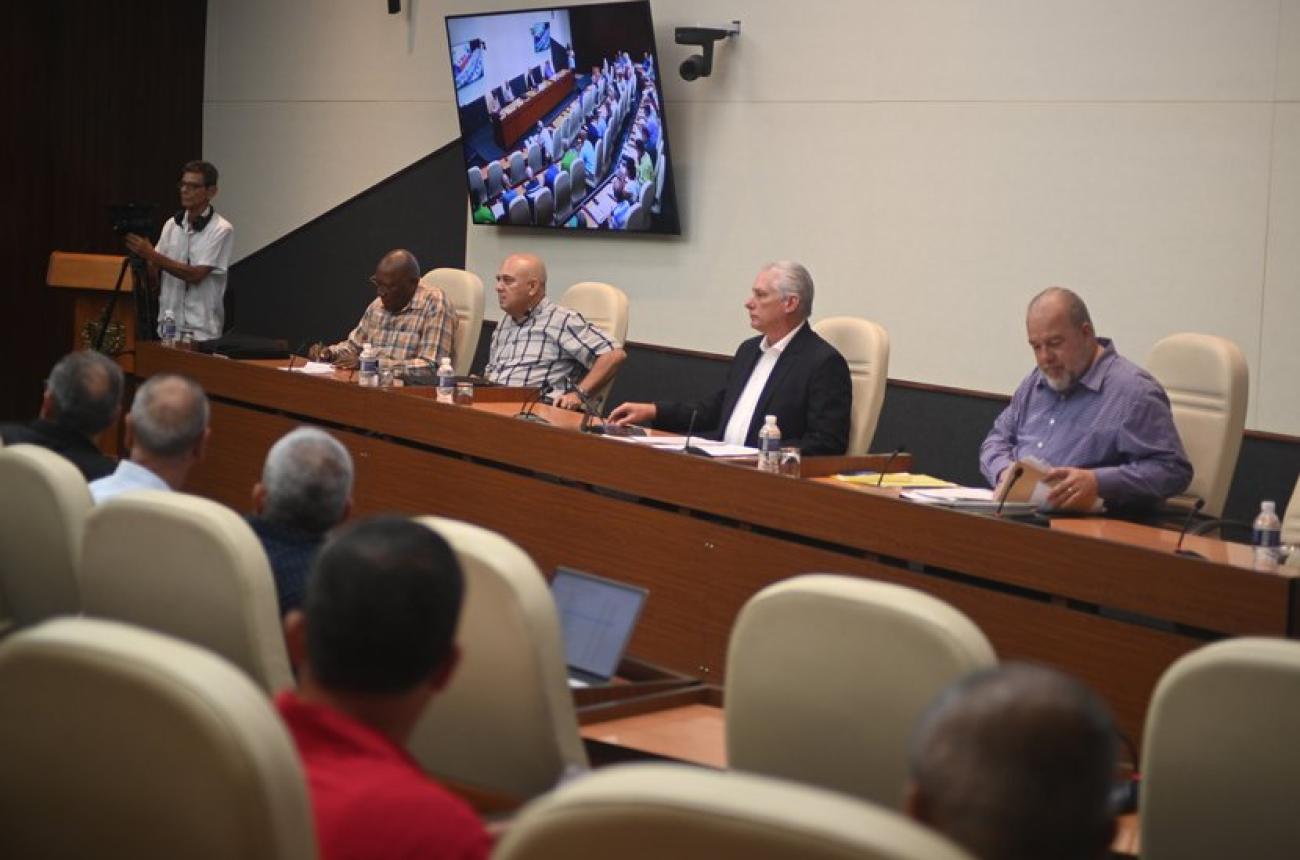
First Secretary of the Central Committee of the Party and President of the Republic, Miguel Díaz-Canel Bermúdez, held a meeting with representatives of state economic entities that stand out for their results and are at the forefront of the implementation of the 176 Economic and Social Transformations.
Díaz-Canel held a meeting with representatives of state economic entities
The leadership of the Party, the Government and the State reaffirms its “full confidence in the capacity of the Cuban socialist state business system to provide the country with what it needs, and you are the ones who will be at the forefront of that process, so we are going to transform ourselves and we are going to move forward.”
This was stated by the First Secretary of the Central Committee of the Party and President of the Republic, Miguel Díaz-Canel Bermúdez, in a meeting with more than thirty business leaders from this sector, whose entities stand out for their results in the application of the economic measures that the country has adopted in recent years and now lead the implementation of the 176 economic and social transformations.
The exchange, held at the Palace of the Revolution, was also led by members of the Political Bureau, Manuel Marrero Cruz, Prime Minister; Roberto Morales Ojeda, Secretary of Organization of the Central Committee of the Party; and Salvador Valdés Mesa, Vice President of the Republic; Deputy Prime Minister Inés María Chapman Waugh also attended, among other leaders.
Moderated by Roberto Ricardo Marrero, president of the National Institute of State Business Assets, the meeting served to delve deeper into the results being obtained by entities of the socialist state business system and to address the strengths, threats and challenges they face.
ON THE RIGHT TRACK
The National Beekeeping Company, which reached the current process after the successful implementation of a large part of the powers previously granted, testified to the practices that many entrepreneurs in the state sector in the country have been able to establish.
Its CEO, Alberto Vicente Águila Abreus, outlined the extensive debate surrounding the 176 transformations at all levels of the group. He explained that they have been analyzed within work collectives, and employees have contributed to them based on the characteristics and experience of their respective sectors.
The beekeeping group is a business that has taken the previous flexibility measures seriously, as shown by the financing scheme it has been applying for a year now, with results that have allowed it to advance in its management, including timely payment to producers.
These transformations, explained one of the grassroots directors of the National Beekeeping Company, have been embraced not only as a structural change, but as a tool that will yield better results, promote more efficient production, and generate higher incomes, both for the companies and the workers, as well as fulfill our social responsibility in the communities where we are, social centers and other areas.
Wilson Ramírez Peña, president of the Agricultural Logistics business group (GELMA), detailed the implementation of the transformations in an activity present in most of the country's municipalities.
Rodríguez Peña observed that the transformations, which are a radical change, have generated doubts at the grassroots level, hence the importance of carrying out an active process of exchanging opinions and experiences that allow for greater comprehension and understanding by the working groups.
Oscar Carvajal Serrano, general director of the Automotive Group at the Ministry of Transportation (Mitrans), described the work carried out by this entity based on the flexibilities granted, which are now reaching new heights with the recent transformations. He exemplified this by stating that none of its companies will end the year with losses and that they will all see growth in contributions and profits.
Today we can say, he noted, that our companies face no obstacles to progress and are in a position to resolve the problems. And these transformations, he emphasized, are the leap forward; although, he clarified, the difficulties won't be resolved overnight, so we have to work hard.
The meeting between Díaz-Canel and representatives of the Cuban socialist state business system included directors of higher business management organizations, companies, state MSMEs and basic business units.
Representatives from diverse sectors, including LABIOFAM, hydraulics, and the electronics industry, among others, spoke about the best practices and results of their work and the implementation of the transformations.
It was an exchange that can be summarized in the words of Edel Gómez Gómez, general director of the Comandante Camilo Cienfuegos electronic industrial company, for whom the 176 economic and social transformations “allow us to put ourselves on equal footing with the rest of the economic actors.”
“This,” he said, “is what the socialist state enterprise has always asked for, and although we have been making transformations, these remove obstacles, remove impediments and allow us to move forward more quickly in the creation of the wealth that we need at this time.”
WITH THE PARTICIPATION OF THE WORKERS
At the conclusion of the exchange, the First Secretary of the Central Committee of the Party and President of the Republic recalled that a few days earlier he had held a meeting with representatives of the non-state business sector to learn how they were assimilating the transformations and their opinions and doubts about them.
He commented that these meetings will be held systematically, although the next ones will be with the Cuban business sector: state, non-state and cooperative, "so that we can integrate ourselves as that unique business system conceived in our economic and social model," he stated.
Regarding the 176 Economic and Social Transformations, grouped into 23 thematic areas, he explained that a significant portion of them already have the legal certainty provided by the regulations and laws, which are being published in the Gazette; but –he noted– no one has to wait for the regulations to design the implementation of the transformations in their companies.
He commented that a group of companies, the most entrepreneurial ones, already have these designs, and now, with the new regulations, they are in a better position to move forward. They “took risks and therefore now have a clearer path,” he stated.
He also asked that information, guidelines and other references be transmitted to the grassroots structures, especially to the branches of national entities in the territories, so that they can prepare to carry out the transformations.
Along the same lines of thought, Díaz-Canel stressed the urgency of changing the styles of leadership and management of business activity, because – he reminded – we have to realize that everything must be done with the participation of the workers.
He indicated that special attention should be paid to two important moments that will occur in the remainder of the year in labor collectives: the discussion of the 176 Economic and Social Transformations and the preparation of the 2027 Plan.
Regarding the debates on economic and social transformations, he indicated that this must be a time to give the most important participation to the workers, because –he reiterated– “if the workers do not take ownership of the transformations, there will be no transformation.”
The transformations, he emphasized, are a continuous process. He gave an example: a worker might propose something better than what's currently planned, and that will be taken into account, processed, and implemented. At the same time, "the very process of implementation will reveal things we need to correct along the way, and who better than the workers to notice these things?"
Regarding the conception of the 2027 Plan, Díaz-Canel spoke of the need for this year's plan to definitively emerge from the grassroots, with the participation of the workers, because – he reflected – “if we have given them all the autonomy, then let the workers say how, by exercising that autonomy and applying the transformations, we can enhance the activity of our socialist state enterprise.”
The First Secretary of the Party's Central Committee also critically observed that in some places the leaders are emphasizing, above all, the salary increases that the transformations should bring, forgetting that what is at stake is the payment of salaries with a productive response and with wealth creation.
OUR MAIN ECONOMIC PLAYER
In his address to representatives of the socialist state business system, the First Secretary of the Central Committee of the Party and President of the Republic analyzed the strengths, opportunities, threats and challenges of this sector to face and move forward in the current times.
He pointed out that if there is one sector that needs to embrace transformations and for these transformations to lead them to transform themselves and impact the economic and social life of the country, it is this one, the socialist state business system, our main economic actor.
Referring to how the socialist state business system must function amidst the economic war imposed upon us, Díaz-Canel explained that “we must achieve productive sovereignty, we must promote the interconnection of all economic actors, and we must take advantage of the political will that exists in the country, in the Party, in the Government, in all institutions, so that the socialist state business system can move forward and contribute to the country what it has to contribute.”