
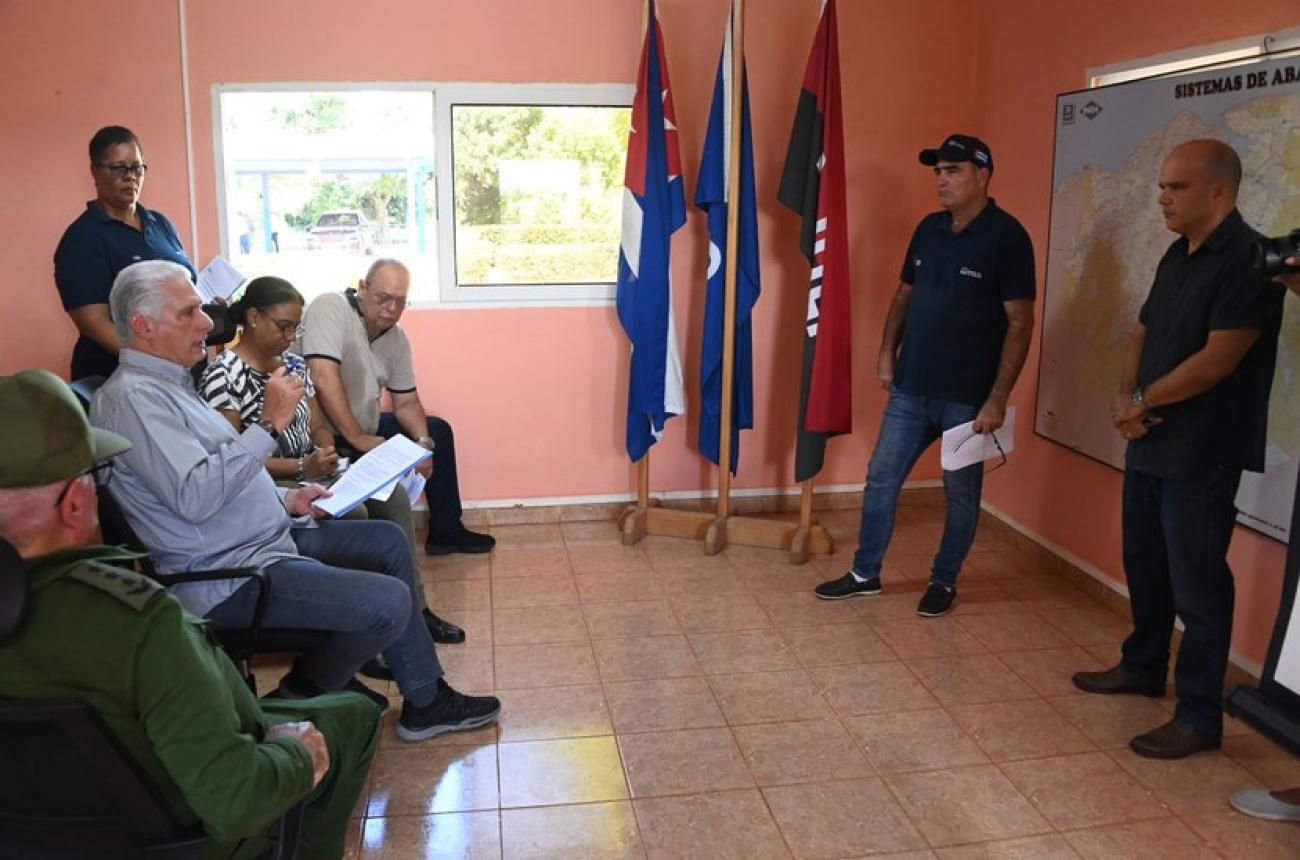
Cuban President and First Secretary of the Central Committee of the Communist Party of Cuba, Miguel Díaz-Canel Bermúdez, inspected the implementation of a recently adopted comprehensive programme to address Havana’s deteriorating water supply. The visit formed part of a weekly monitoring process established by the Cuban leadership to oversee the implementation of the strategy.
Díaz-Canel reviews plan to address Havana’s water supply problem
Díaz-Canel visited the Southern Basin System, a major water source shared by the provinces of Artemisa and Mayabeque that supplies more than 30 percent of Havana’s population, or approximately 336,000 residents. He was accompanied by Revolutionary Armed Forces Minister Álvaro López Miera, Deputy Prime Minister Inés María Chapman Waugh and Energy and Mines Minister Vicente de la O Levy.
Díaz-Canel attributed the deterioration of Havana’s water supply primarily to the intensification of the US blockade, particularly restrictions affecting Cuba’s energy supply. He explained that water systems require prolonged periods of stable electricity to fill pipelines and operate interconnected pumping and booster systems. According to the President, approximately 10–12 hours of stable electricity are required for these systems to operate reliably, a condition that Cuba currently struggles to maintain amid prolonged blackouts.
The government therefore intends to reorganise the management of the water supply system so that it is less dependent on the stability of the National Electric System. The strategy envisages combining electricity supplied through the national grid with distributed generation in the first stage and renewable-energy generation in a second stage.
Díaz-Canel stressed that these measures would require investment and could not produce immediate results. Nevertheless, the objective is to gradually improve water supplies even while prolonged power outages continue, thereby reducing the combined impact of electricity shortages and water scarcity on households and economic activity.
Implementation timetable
The President said that the first improvements in Havana were expected by the end of September, particularly in two or three of the capital's principal water-supply systems. Other sources would be consolidated during October, while the government expects to begin moving towards more sustainable systems based on renewable energy by the end of 2026.
He cautioned, however, that the timetable could change because of the continuing effects of US sanctions and of the blockade. The government therefore considers the programme subject to changing economic, energy and political circumstances.
Extension beyond Havana
Díaz-Canel said that the strategy developed for Havana would be shared with Cuba's other provinces and municipalities. Local authorities would be encouraged to adapt the approach to their own circumstances, although the national government would continue to address problems requiring resources or decisions at the national level.
The strategy extends beyond energy supply. It incorporates diagnosis and prioritisation of problems, infrastructure investment and maintenance, optimisation of water distribution, improved governance and management, local and community participation, popular oversight, institutional communication and financing.
The President described the programme as an attempt to develop a clearer and more creative approach to managing the country's interconnected energy and water problems. He also indicated that the government would not disclose all operational details because of external efforts to obstruct or persecute Cuba's proposed solutions.
Southern Basin investment programme
The Southern Basin System supplies the Havana municipalities of Plaza, Diez de Octubre, Cerro, Centro Habana, Habana Vieja and part of Boyeros. Its infrastructure currently faces problems affecting wells, pipelines, pumping equipment and other facilities.
The recovery programme includes repairing pumping equipment, eliminating leaks, rehabilitating pipelines and pumping stations, and carrying out comprehensive civil-infrastructure maintenance. It also includes restoring access roads, extending a new pipeline, repairing automatic control and pressure systems, and improving electrical reliability.
Energy-related measures will involve improvements to the electricity network as well as distributed and renewable generation, with the aim of making the water system more resilient to power interruptions.