
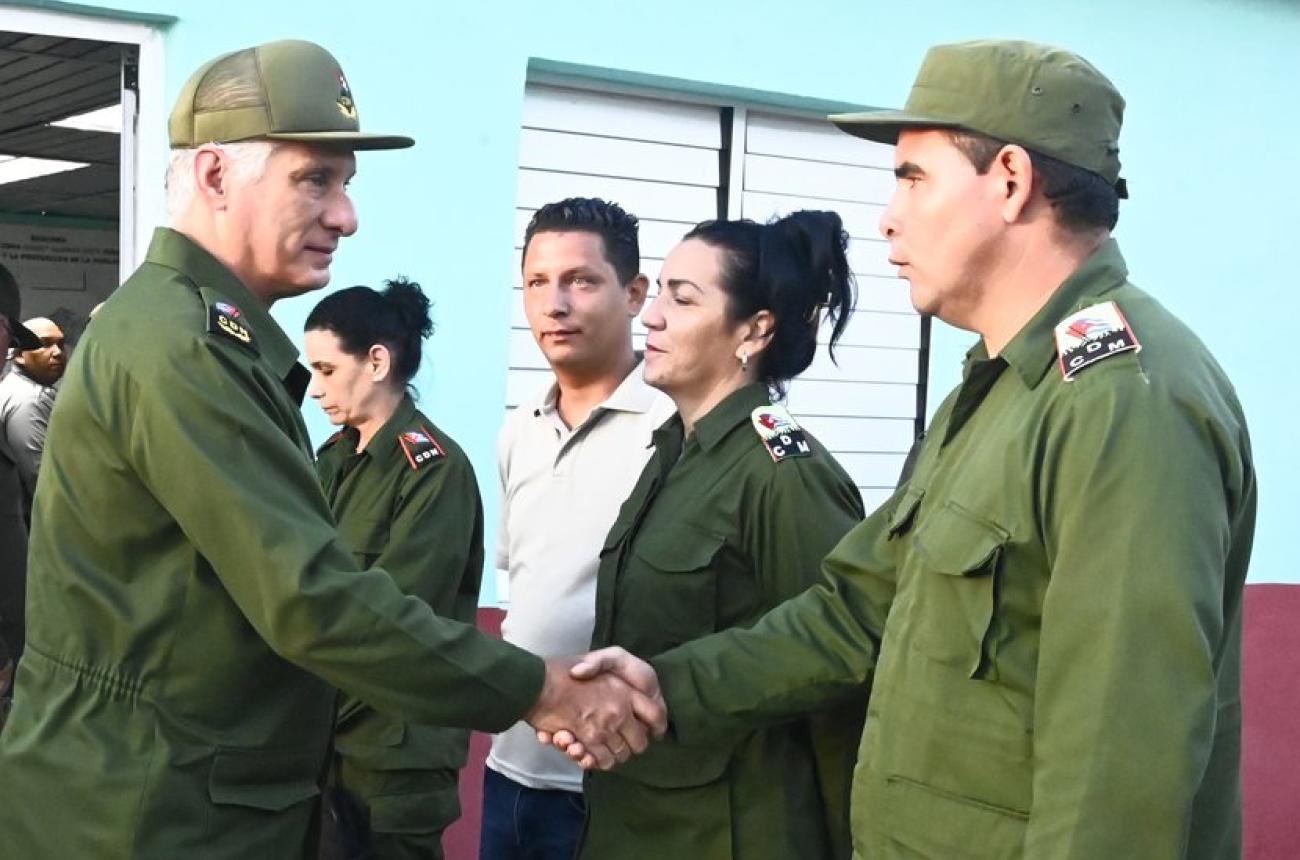
Cuban President and First Secretary of the Central Committee of the Communist Party of Cuba, Miguel Díaz-Canel Bermúdez, visited the Alamar Este Defence Zone in Havana during the National Defence Day activities, where he reviewed preparations for confronting an external enemy threat and discussed the community’s economic and social affairs.
Díaz-Canel says defence is first priority
Díaz-Canel, who is also President of the National Defence Council, praised the quality and depth of the work carried out by the local Defence Council in organising and preparing the population. He stressed the importance of practical exercises to ensure that residents know where to seek protection and how to respond in the event of an attack.
Defence preparations and community organisation
The Alamar Este Defence Zone covers more than nine square kilometres and has a population of approximately 36,000. It includes more than 40 Production and Defence Brigades, organised through neighbourhood constituencies and economic and social institutions.
Local Defence Council President Ernesto Cruz Rivero reported on preparations for warning and protecting the population, staffing levels and other defence-related tasks. The authorities emphasised the role of the population as the central participant in the defence of the country.
The visit was attended by senior Cuban political and military officials, including National Assembly President Esteban Lazo Hernández, Communist Party Organisation Secretary Roberto Morales Ojeda, Minister of the Revolutionary Armed Forces Álvaro López Miera and Minister of the Interior Lázaro Alberto Álvarez Casas.
Economic and social priorities
Alongside defence preparations, the meeting examined measures to address local economic and social needs. Alamar Este has 85 hectares of land available for food production, including agricultural cooperative activities and contributions from household gardens and small plots.
The local authorities also reported on initiatives to improve services, including:
- Expanding the availability of cash-payment services for pensioners and retirees through state institutions and private businesses.
- Improving the collection and disposal of urban waste, with greater community participation in neighbourhood cleanliness.
- Addressing water shortages, identified as one of the locality’s main problems. Residents have undertaken local measures, including repairing some leaks, while broader improvements depend on the national programme for Havana’s water supply.
- Supporting youth activities through the Community Youth Network, sports and recreation programmes, and the “My Neighbourhood for the Homeland” movement led by local elected representatives.
Implementation of economic and social transformations
In his concluding remarks, Díaz-Canel underlined the importance of implementing the 176 approved economic and social transformations. He stressed that these measures require active and leading participation by the population in their communities.
The visit therefore combined Cuba’s defence preparations with efforts to organise local production, improve public services and mobilise community participation. The report presents Alamar Este as an example of the country’s approach to maintaining structures and capacities for wartime conditions during peacetime, while also addressing everyday social and economic challenges.