
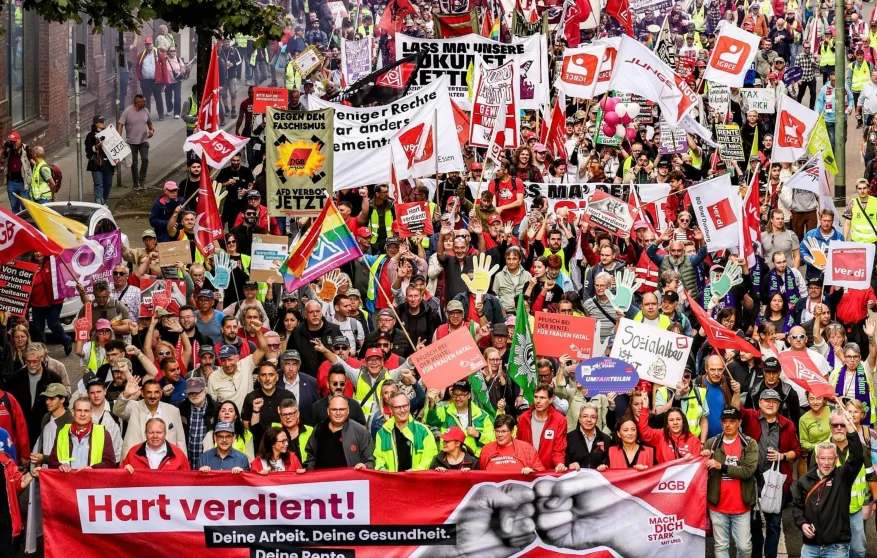

The German Communist Party (DKP) took part in the nationwide demonstrations organised by the German Trade Union Confederation (DGB) on 26 September 2026.
German Communist Party participates in DGB demonstrations
The DGB organised simultaneous demonstrations and rallies in 15 major German cities under the slogan “Hart verdient! Deine Arbeit. Deine Gesundheit. Deine Rente!” (“Hard-earned! Your work. Your health. Your pension!”). The demonstrations focused on defending the welfare state, jobs, working conditions and workers’ rights.
The DKP publicly called on its members and supporters to participate in the DGB actions. The party's Stuttgart organisation, for example, announced that the DKP would participate in the demonstration at Schlossplatz in Stuttgart at 11:55 on 26 September, explicitly presenting its participation as solidarity with workers taking part in the DGB action.
Other DKP branches also mobilised for the demonstrations. The DKP group in Gießen listed participation in the Frankfurt DGB demonstration among its activities for 26 September, while DKP Münster called on supporters to join the DGB protest in Essen.
The DKP's involvement also connected the social issues highlighted by the trade-union demonstrations with its broader campaign against increased military expenditure and the planned reintroduction of military conscription. In its mobilisation material, DKP Münster linked the defence of the welfare state to opposition to rising military spending, arguing that increased expenditure on armaments should not be financed through cuts to social provision. It also called on people to support the school strikes against conscription on 25 September and the DGB demonstrations on 26 September, followed by the nationwide peace demonstrations scheduled for 3 October in Berlin and Stuttgart.
This connection was also made by the DKP's national leadership. In a 2 September statement, DKP chairman Patrik Köbele described the planned trade-union actions on 26 September as part of a broader sequence of popular mobilisation that included the school strikes against conscription on 25 September and the peace demonstrations planned for 3 October. The statement argued that the government's military policies and increasing military expenditure were affecting social conditions inside Germany.