
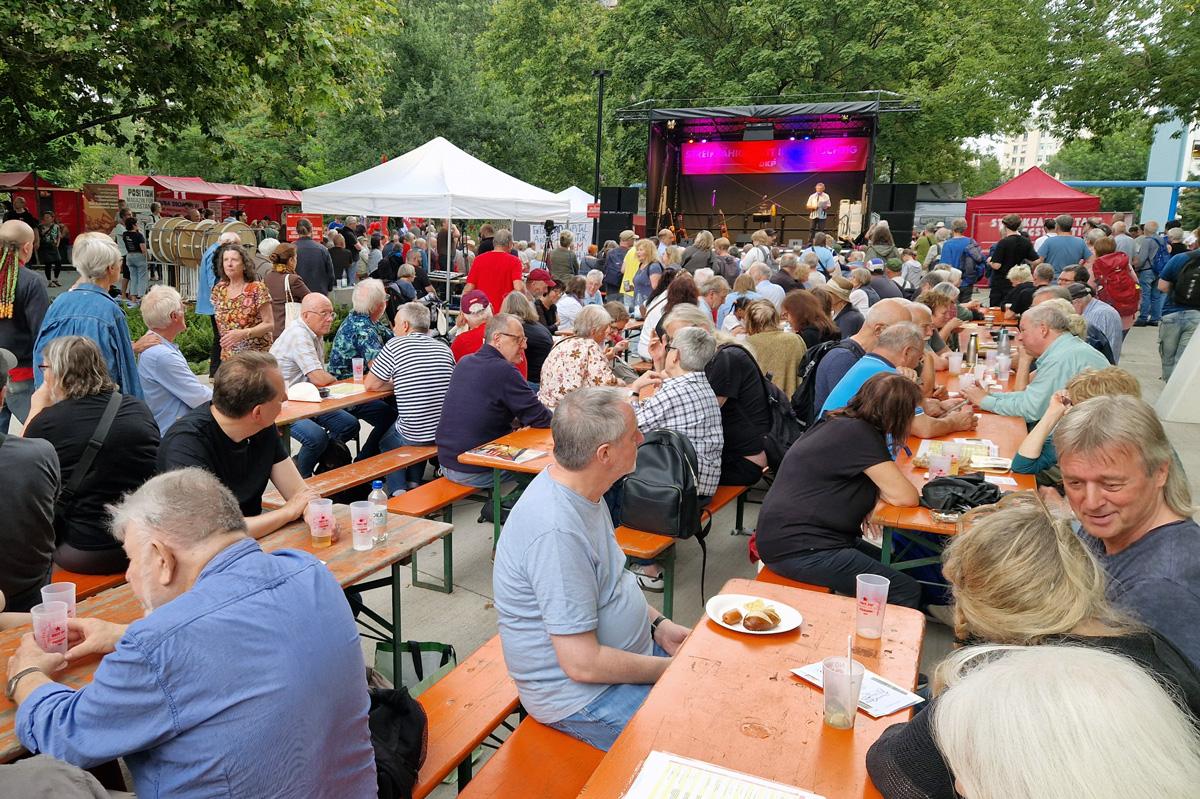
The UZ-Friedenstage 2026 (UZ Peace Days) were held in Berlin from 28 to 30 August 2026. The three-day event was organised around Unsere Zeit (UZ), the socialist weekly newspaper of the German Communist Party (DKP), and took place at and around the FMP1 building (Franz-Mehring-Platz 1).
German Communist Party's UZ Peace Days concluded
The event combined political discussions, international solidarity, peace activism, youth activities and an extensive cultural programme.
A meeting point for the peace movement
The central purpose of the UZ Peace Days was to bring together different sections of the German peace movement and link opposition to war and militarisation with struggles against social cuts and attacks on workers' rights.
According to UZ, the event was intended as a meeting point for peace activists, trade unionists, young people opposing conscription, and solidarity movements supporting Cuba and Palestine. The organisers emphasised the connection between Germany's military build-up and preparations for war on the one hand, and the dismantling of the welfare state and worsening living and working conditions on the other.
The event therefore presented opposition to war not as an isolated issue, but as part of a broader struggle against militarisation, social austerity and capitalist policies.
Preventing a Third World War
One of the major opening discussions was entitled “Preventing the Third World War”. The discussion focused on what participants described as the rapidly growing danger of a wider military confrontation.
Lühr Henken of the Federal Committee Peace Council (Bundesausschuss Friedensratschlag) pointed to the accelerating military build-up by the EU and the United States, the war in Ukraine and tensions surrounding China and Taiwan. The speakers argued that the forces opposing militarisation remained too weak and stressed the need for broader public mobilisation.
The discussion also focused on the relationship between the peace movement and the labour movement. Speakers argued that trade unionists and workers must become more actively involved in the struggle against war.
An important theme was the fight against war propaganda and militarisation within German society. Participants discussed the need to explain the consequences of preparations for war in concrete terms and to connect the peace movement with upcoming protests against social cuts and compulsory military service.
International solidarity: Cuba, Palestine and BRICS
International solidarity was another major feature of the Peace Days.
The programme included a major solidarity event for Cuba, while Cuba and Palestine were repeatedly highlighted in political discussions. The opening day included performances by Cuban musicians Pablo Miró and Tony Ávila, followed by the Cuba solidarity event.
A particularly well-attended discussion addressed “Anti-imperialism and the struggle against neocolonialism today.” Speakers included Miguel Torres Tesoro, Deputy Ambassador of Cuba in Germany, and Palestinian activist Naser El-Mokdad. According to UZ, the large Münzenberg Hall was nearly full, with all standing places occupied.
This was followed by a discussion on BRICS and the “multipolar world order”, examining the issue from Chinese and Brazilian perspectives. Participants included Ana Prestes, International Secretary of the Communist Party of Brazil, and Sun Shouliang, Minister-Counsellor of the People's Republic of China.
These discussions reflected the strongly anti-imperialist orientation of the event and its interest in changes in the international balance of power.
Palestine and West Asia
The programme also devoted considerable attention to Palestine and developments in West Asia.
Sessions addressed the background to the conflicts in West Asia and the question of Palestine solidarity in Germany, including repression against activists and workers involved in Palestine solidarity activities.
The inclusion of these subjects demonstrated the organisers' attempt to link the German peace movement with international struggles against imperialism, war and colonialism.
Youth and opposition to conscription
Young people played a prominent role in the event, particularly through the participation of the Socialist German Workers' Youth (SDAJ).
The SDAJ organised its own programme, including discussions and workshops on opposition to the possible reintroduction of compulsory military service, attacks on student protests, the militarisation of schools and the situation of young workers.
The youth programme also included discussions about the role of the German armed forces in schools and hospitals and about resistance among working and studying young people. International solidarity with Cuba and Palestine was also part of the SDAJ programme.
Berlin: “City of Armaments or City of Peace?”
The Peace Days also addressed the militarisation of Germany itself.
One discussion was entitled “Berlin, City of Armaments? – City of Peace!” and examined Berlin's role as a centre of military production and the possibility of building resistance to the arms industry and militarisation. Participants included representatives of peace and anti-conscription initiatives.
Another discussion examined the relationship between the environmental and peace movements, asking how the two movements could develop a common struggle.
Culture and political celebration
The UZ Peace Days were not limited to political meetings. Culture was presented as an integral part of the event.
The programme included concerts, literary events, a Brecht programme, readings and performances. Artists from different political and cultural traditions participated, while the programme also included an anti-imperialist solidarity concert featuring Banda Bassotti.
There was also a children's programme, a literature tent and cultural activities outside the main political discussions. The organisers described the event as combining “communist culture” with political debate and social gatherings.