
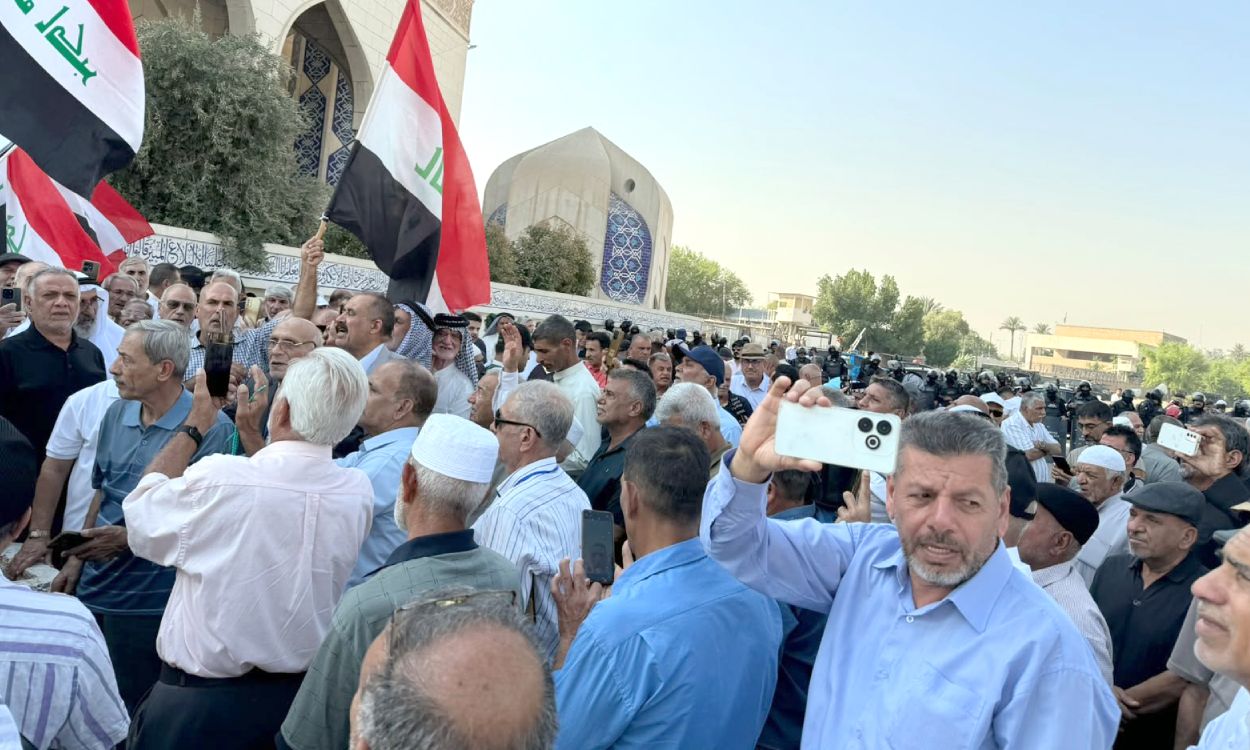

Iraqi Communist Party took part in the protests that have been going on for several days across Iraq.
Iraqi Communist Party supports protesters
Graduates, workers, farmers, and drivers took to the streets and widespread protests were made against unemployment, delayed salaries, and rising fuel prices.
The daily protests that take place in various cities express the depth of the gap between the majority of citizens who are demanding the most basic rights, versus a privileged minority that continues to plunder public funds at the expense of the citizens.
According to Tareek Al-Shaab, observers emphasize that these protests may, at a certain moment, turn from the current demands into popular anger, and raise slogans demanding change, as people become more aware of their difficult circumstances, which, in their opinion, cannot be overcome without taking to the streets and putting pressure on this failing system.
Retirees: Increase our pensions
The Retirees Association organized a massive demonstration in the Alawi area of Baghdad, heading to the Council of Representatives and the Council of Ministers, to demand an amendment to the retirement law and an improvement in their living conditions.
The demonstrators demanded that the retirement age be lowered to 63 years, and that Articles 13 and 28 of the Retirement Law be amended, calling for their demands to be met and for the problems affecting their rights and retirement benefits to be addressed.
The retirees also demanded that their salaries be improved and increased in proportion to their years of service, and that the minimum pension be one million dinars, stressing that the current salaries are not enough to meet the requirements of normal living, especially with the high costs of housing, treatment and education.
Communists in Muthanna support the graduates
In Al-Muthanna Governorate, a number of petroleum engineering graduates renewed their demonstrations in front of the Samawah oil refinery, demanding job opportunities.
The correspondent for Tareek al-Shaab said that “the demonstrators blocked the oil tanker route because their demands were ignored,” stressing that “this action forced the refinery’s management to pledge to hold a meeting to discuss their demands.”
Members of the Muthanna branch of the Iraqi Communist Party participated in this protest, while the demonstrators stressed that "their demands are to obtain job opportunities in the oil sites," noting that they had obtained university degrees in important specializations, but they did not obtain their right to be appointed.
Four large demonstrations in Basra
Basra Governorate witnessed four major protest events, in which participants focused on demands for job placement, payment of salaries, and rejection of converting government facilities into investment.
A new demonstration of engineering graduates from various disciplines and scientists took place in front of the Basra Governorate building, demanding employment.
The protesters stated that they have been demonstrating for a year and a half, demanding their most basic right: contract-based employment. They noted that their number is approximately 1,500 graduates. They added that they have yet to find any Basra official, or even a minister, willing to listen to their demands.
The protesters affirmed that they would continue to protest until their demands were met.
Employees of the General Company for Fertilizers also demonstrated, rejecting moves aimed at converting one of the state-owned plant's production lines into an investment, warning of the repercussions of this step on the workers and the revenues that the state achieves from the project.
Protester Farqad Ahmed said, "This demonstration is to stand against turning the government line into an investment line," explaining that "investment allows the state only 20 percent of the production, while most of the revenues go to the investor."
Ahmed stressed that "the factory generates more than one trillion Iraqi dinars for the state and employs about 5,000 workers," noting that "the government at this time is seeking to create job opportunities, while referring this factory to investment may lead to the dismissal of thousands of workers."
In a related context, a number of participants in the demonstration organized in front of the governorate's education directorate suffered fainting spells due to the high temperatures, which led to some of them being taken to a nearby hospital.
The protesters, in ongoing demonstrations, are demanding the acceleration of the release of salaries for the ten thousand contract workers, the resolution of the file of 19,000 volunteer lecturers in external departments, in addition to reviewing the lists of names, stressing that they possess official documents related to the addition of names from outside the governorate.
Protester Abu al-Hassan al-Shawi confirmed the existence of documents proving the addition of more than 250 names from outside the governorate to the lists of those appointed, demanding that the regulatory authorities open an investigation into this matter.
He added that "the file of the Sadiq district witnessed a significant decline due to the influential forces and some deputies and officials in charge of it, which led to raising the number of names in it to 37,000 names, after it contained only 2,100 names," calling on the concerned authorities to give this file the necessary attention.
Al-Shawi explained that "the demonstrators strongly condemn and categorically reject what happened in the Education Department of the city district, which resulted in the loss of the rights of the deserving sons of the governorate, by including names from outside Basra, including names from Karbala and Al-Chibayish, in a clear violation that requires justice and fairness in the distribution of opportunities."
He stressed that “what happened was not just a passing administrative error, but is confirmed by official orders, letters and administrative documents that reveal the details of what happened during the period when the former Minister of Education, Ahmed Al-Asadi, was in charge of the ministry in a caretaker capacity, which witnessed the addition and passing of more than 250 names from outside the governorate.”
In another demonstration, contractors in the 38,000 file, including those with 10,000 job positions, organized a protest in front of the Basra Education Directorate, to demand their financial dues that have been delayed for three months.
The participants in the sit-in confirmed that they were “surprised by the cutting of salaries for three months, under the pretext of data verification, or that the disk was broken, for example, or the lack of a full name, in addition to a shortage in the unified card,” while asking at the same time: “How was the Ministry of Finance disbursing these salaries to contractors and funds during the previous period?”
They explained that they were previously volunteer lecturers, and today they are demanding to know the reasons that led to the deduction of their salaries, and to resolve their case quickly.
Maysan and Muthanna
In Maysan Governorate, dozens of contract workers with the Turkish company “Sham Group”, the administrative operator of Al-Hakim Hospital in Amarah, demonstrated in protest against the decision to lay off 350 workers, due to the company’s failure to renew its contract with the Ministry of Health.
A number of protesters said that they "represent 700 contractors with the Turkish company, working in various jobs at Al-Hakim Hospital. The company has laid off 350 of them, while the rest will be laid off at the end of this month, due to the expiration of the company's contract with the ministry about three months ago."
The protesters demanded that pressure be put on the relevant authorities to reinstate them to work, either through contracting with the company or through direct contracting with the Maysan Health Department.
In Al-Muthanna, a number of cement truck drivers in the city of Samawah demanded an increase in transport fees, in light of the recent rise in cement prices.
In another demonstration, a number of residents of the Al-Bayader Investment Complex in the city of Samawah organized a protest to demand the completion of basic services in the complex and the implementation of promises related to that.
The participants in the sit-in said that "the complex needs the completion of sewage, electricity and road services," while holding the official authorities responsible for the delay in completing what was agreed upon, demanding that the local government intervene and follow up on the implementation of the commitments that were previously made to them.
No to raising fuel prices
In Diwaniyah, dozens of factory and plant owners organized a protest after all factories stopped operating as a result of fuel prices increasing fivefold, so that the price of a tanker became 15 million dinars instead of 3 million, which led to the factories in the governorate ceasing to operate.
In Wasit Governorate, truck drivers from various districts and sub-districts of the governorate demonstrated near the Kut-Maysan checkpoint, demanding the cancellation or reduction of fees imposed on them while traveling between governorates, and the restoration of their allocated fuel quota to 300 liters instead of 250 liters of gas.
Farmers and peasants
In Diwaniyah Governorate, dozens of farmers and agricultural workers from Al-Shafi’iyah district, west of the governorate, organized a demonstration to demand support for the agricultural sector and to expedite the release of financial compensations.
The protesters demanded a reduction in the prices of petroleum products, in support of the agricultural sector, and to alleviate the financial burdens on farmers and peasants.
In Diyala province, a large demonstration of farmers took place, in which they used their agricultural machinery and tractors, to protest against the high fuel prices and the resulting additional financial burdens on farmers.
In Baghdad, farmers in the Zanbaraniya area organized a protest to demand a halt to the conversion of their agricultural lands into residential areas, and to seek justice for those affected and protection of their rights.