
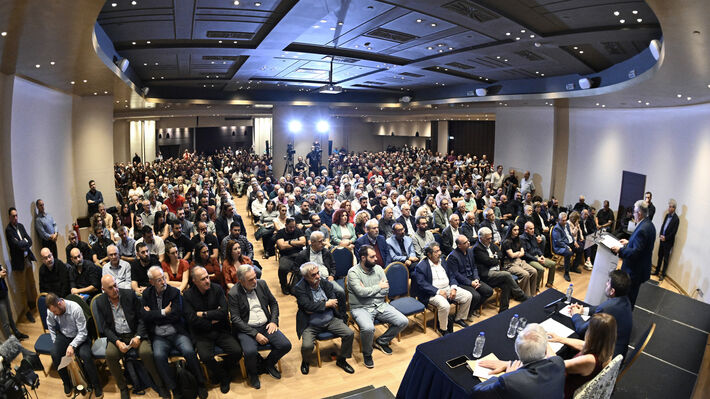
The Communist Party of Greece (KKE) held a public event in Athens on 12 October under the title “Greece and Turkey in the Maelstrom of Imperialist Rivalries: The Way Out for the Peoples.”
KKE holds event on Greek-Turkish relations amid imperialist rivalries
Dimitris Koutsoumbas, General Secretary of the KKE Central Committee, delivered the main speech, arguing that tensions between Greece and Turkey must be understood in the context of wider international competition and the interests of the two countries’ ruling classes.
According to 902.gr, the event, organised by the KKE Central Committee at a central Athens hotel, brought together a range of speakers with military, academic, technical and political backgrounds. Among them were retired naval officer Panagiotis Chatziperos, who participated in the 1973 Velos destroyer mutiny against the military dictatorship; retired air force officers; representatives of military personnel and their families; and an engineer from the defence company Intracom Defence.
Koutsoumbas criticises Greece’s military and energy strategy
Koutsoumbas argued that Greece’s growing role as an energy and transport hub serves the interests of Greek capital rather than the population. He criticised the country’s strategic partnerships with the United States, France and Israel, the expansion of US military bases, and Greek military deployments abroad.
He also criticised Greece’s major arms procurement programme, known as “Agenda 2030,” and the proposed “Achilles Shield” air-defence system. He added that military spending and energy projects were placing additional burdens on the population through taxation and cuts to social expenditure, while drawing Greece more deeply into international military competition.
The KKE leader linked these developments to the broader US-China rivalry and tensions between the Euro-Atlantic and Eurasian blocs. He argued that temporary agreements or reductions in hostilities would not eliminate the underlying competition over markets, energy resources and geopolitical influence.
Greek-Turkish tensions and competing interests
Addressing bilateral relations, Koutsoumbas rejected explanations that attribute tensions primarily to the personal ambitions of individual leaders. He argued instead that competition between the Greek and Turkish ruling classes, both operating within NATO, was driving disputes over maritime zones, energy resources and regional influence.
He referred to Turkey’s “Blue Homeland” doctrine and its claims concerning maritime areas in the Aegean and eastern Mediterranean, alongside long-standing disagreements over continental-shelf and exclusive economic zone delimitation, territorial waters, airspace and the status of eastern Aegean islands.
Koutsoumbas also warned against assuming that periods of improved diplomatic relations necessarily resolve these disputes. Tourism, trade and economic cooperation can expand, he said, while strategic competition continues beneath the surface. He argued that successive Greek governments had encouraged unjustified complacency during periods described as “calm waters.”
The speech further criticised the role of foreign powers in the region, arguing that Greece’s alliances and military cooperation could expose the country to the consequences of wider conflicts rather than guarantee its security.
Call for cooperation among popular forces
Concluding his intervention, Koutsoumbas called for the alignment of new popular forces with the KKE and for stronger organisation of popular resistance, both inside and outside parliament. He framed this appeal around the interests of workers, small farmers, self-employed people, young people and women, arguing that their interests differ from those of the economic groups driving the competition.
The event presented the KKE’s position that opposition to war and military escalation must be linked to resistance against the economic and political interests underpinning international rivalries. Its proposed alternative, as expressed in the event’s title, was cooperation among peoples against the competing interests of ruling classes.
(Photo: 902.gr)