
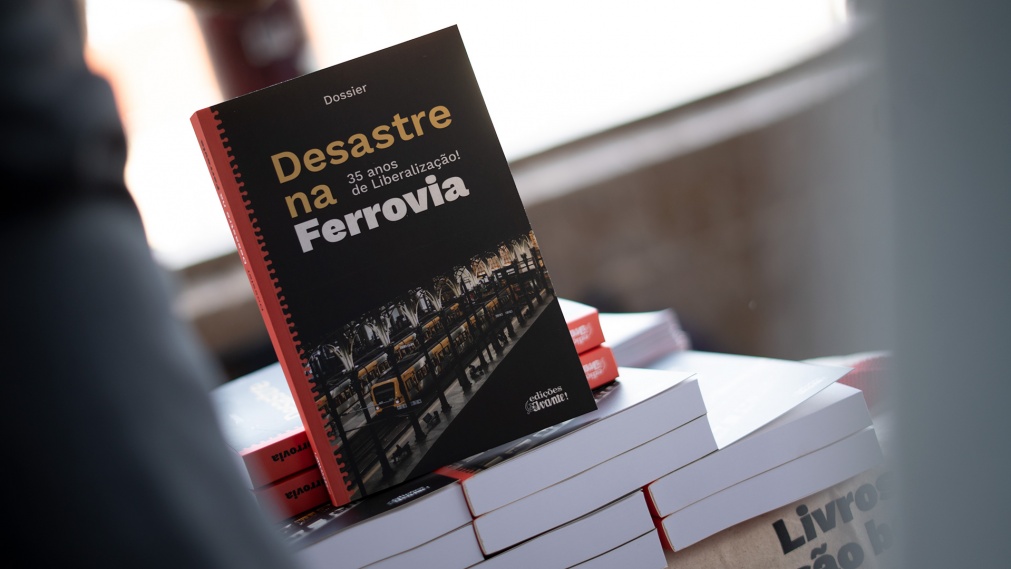

Paulo Raimundo, Secretary-General of the Portuguese Communist Party (PCP), used the presentation of the book Disaster on the Railway: 35 Years of Liberalization to launch a broader political criticism of railway liberalization and privatization in Portugal. At the event organised for the launch, he stated that the railway is a strategic public sector, essential not only for passenger and freight transport but also for national production, territorial cohesion, environmental protection, sovereignty and national development.
Portuguese CP launches book on liberalisation of railways
Thirty-five years of liberalization
Raimundo placed the current problems of Portugal's railway system within a 35-year process of liberalization, which he attributed principally to successive governments led by the Socialist Party (PS) and Social Democratic Party (PSD).
He particularly criticized the PSD/CDS government of Pedro Passos Coelho, accusing it of closing the largest number of railway lines, dismantling REFER, cancelling investment in rolling stock and infrastructure, privatizing CP Carga and attacking railway workers. According to Raimundo, these decisions created many of the problems facing the railway today. He also criticized the PS for its own record in government and for supporting PSD/CDS budgets that enabled these policies.
His central argument is that the same political forces now presenting liberalization as the solution to the railway's problems are responsible for creating many of those problems in the first place. He asks rhetorically who closed the lines, emptied stations of workers, dismantled CP, reduced staffing and imposed policies of wage restraint and worsening working conditions.
Shortage of trains and destruction of national production
Raimundo identified two particularly visible consequences of current railway policy: the shortage of trains and the destruction of Portugal's domestic rolling-stock industry.
He pointed to the destruction of Sorefame, which produced railway rolling stock in Portugal until 2003. Although successive governments have promised since 2018 to purchase new trains, he noted that eight years later only one train was undergoing testing. Against an estimated requirement of approximately 200 trains, he questioned why CP had been prevented from purchasing sufficient rolling stock over the previous two decades.
He also criticized the absence of a national rolling-stock plan and what he described as a bureaucratic system that benefits multinational corporations while producing lengthy delays between the decision to purchase trains and their actual delivery.
Criticism of privatization and concessions
A major part of the speech was devoted to demonstrating what Raimundo considers the failure of the liberal model through concrete examples.
He cited the PPP for the Poceirão–Madrid high-speed rail project, arguing that no railway line was constructed despite the Portuguese state already having spent €232 million. He also pointed to the privatization of CP Carga, claiming that a public asset worth more than €200 million was transferred to a multinational for €2 million, while less freight is transported today than before privatization.
The Fertagus concession is presented as another example. Raimundo argues that, contrary to the promise that competition would improve services, users face shortages of trains while CP is prevented from operating urban services on the line because of exclusive rights granted to the private operator. He maintains that Fertagus costs the state more per passenger, charges users more and provides an inferior service compared with CP.
“Liberal mythology” versus reality
Raimundo's broader critique is that the supposed benefits of privatization—private investment, modernization and competition leading to lower prices—do not materialize in practice.
He summarizes what he sees as the actual model in stark terms: the state pays for the trains, infrastructure and subsidies, while private companies receive the profits. Less profitable services, meanwhile, remain dependent on additional public subsidies or face closure.
He warns that during future capitalist crises, the consequences would include reduced services, further line closures, higher prices and the depopulation of parts of the country, while concession contracts and legal mechanisms would protect private profits.
The Cascais railway as a warning
Raimundo used the Cascais Line as an important case study. He argued that the line had previously been privately owned, was bankrupt when nationalized, and was subsequently modernized after the April Revolution.
According to his account, however, the state subsequently failed to authorize CP to purchase new trains, allowing the line to deteriorate despite the efforts of railway workers. Now that new trains are finally becoming available and the line has been modernized through public investment, the government intends to privatize it again.
For Raimundo, this illustrates the fundamental contradiction of the privatization model: public investment is used to rehabilitate an asset and then the resulting profitable operation is transferred to private capital.
He also invoked the experience of the United Kingdom, describing railway privatization there as a major failure that disrupted the railway system and imposed substantial costs on public finances. He noted that both Labour and Conservative governments participated in the process before rail services were subsequently renationalized.
The PCP's alternative: a unified public railway
Raimundo presented the PCP's alternative as a “patriotic and left-wing” railway policy, explicitly linked to the party's broader socialist perspective.
The PCP rejects further liberalization and proposes reunifying the railway system into one national public company, CP, rather than further fragmenting operations among competing companies. It advocates cooperation and intermodality rather than market competition, and national planning rather than allowing market interests to determine the structure of the railway system.
The policy would also prioritize:
- investment in railway workers, including wages, qualifications and working conditions;
- reducing dependence on multinational corporations;
- resisting subordination to the European Commission;
- strengthening national production and international cooperation;
- integrating railway policy into a wider national development strategy;
- bringing railway operations, infrastructure and maintenance together under CP.
Public transport and national industrial capacity
The PCP also proposes a long-term transition toward free public transport, beginning with lower prices and requiring substantially increased services and better intermodality.
Raimundo criticized the government's recently announced “green rail pass”, arguing that such measures cannot solve the fundamental problem while CP and Fertagus lack sufficient urban trains to accommodate additional passengers. He argued that Portugal has the capacity to re-establish domestic production of trains and rolling stock, while also expanding the railway workforce and restoring freight transport to the public sector.
Mobilization against privatization
Raimundo stressed that political proposals alone are insufficient. The PCP believes it must build the social and political force capable of implementing them, through the organization of railway workers, users and others around a common programme.
He portrayed the struggle against privatization as a continuing battle stretching back 35 years. Previous attempts to privatize profitable railway services in the 1990s and under the Sócrates and Passos Coelho governments were, in his account, defeated through popular and workers' resistance. The PCP intends to oppose the current attempt in the same way.