
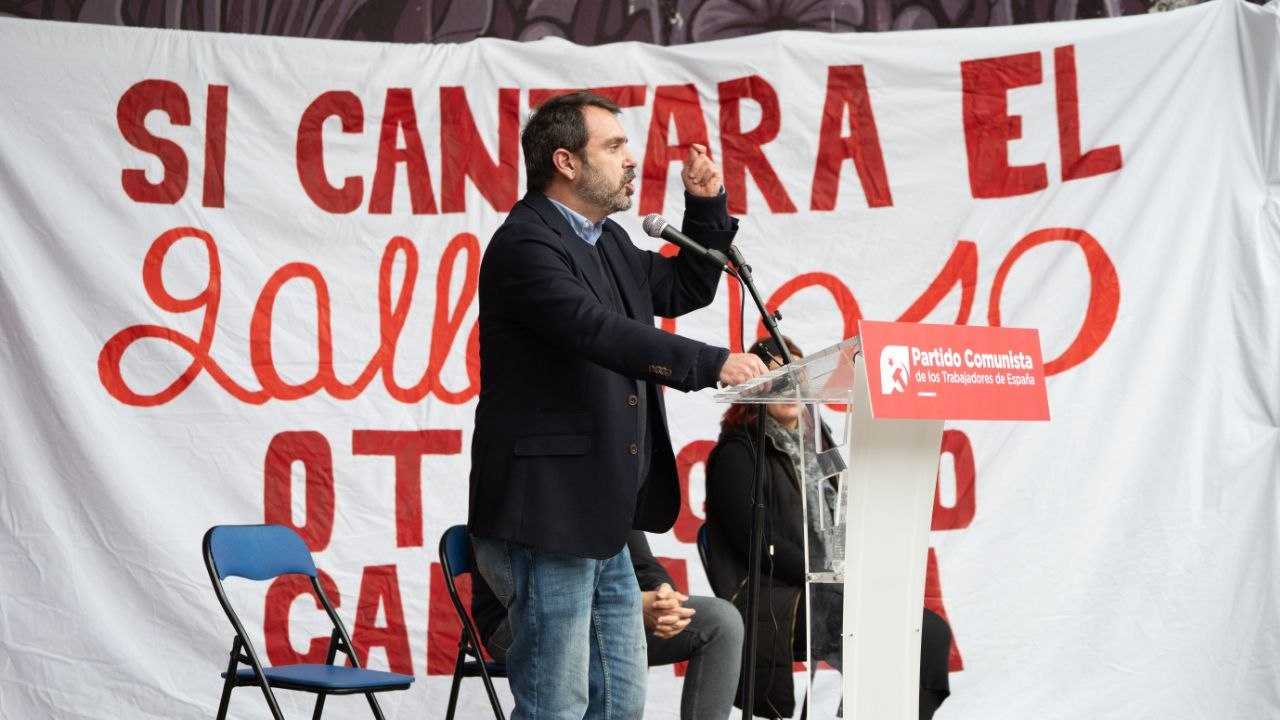

General Secretary of the Communist Party of the Workers of Spain (PCTE) Ástor García answered the questions of the International Communist Press, before the elections on 29 November.
EXCLUSIVE INTERVIEW with PCTE's General Secretary Ástor García
Elections will be held on 29 November, and PCTE announced its position on the elections to the public recently. How does the Party intend to conduct its campaign during the remaining days?
The campaign work being carried out by members of both the Party and the Youth organisation is varied and intense. Throughout the country, posters are being put up, materials distributed, information stalls set up, rallies held, and candidates interviewed — all with the aim of bringing the Party's politics to an ever-growing number of workers. We are presenting our class with a programme of struggle: a series of demands which, when taken into workplaces and neighbourhoods, will enable us to strengthen the struggle and organisation of the working class. These are not electoral promises, but demands that place the needs of the working majority at the centre, based on what is needed at this particular moment, rather than being constrained by what we are told is possible or by the limits imposed by capital.
Two major rallies have been held: the first in Granada on Saturday 14 November, and the second in Mieres (Asturias) last Saturday, 21 November. The latter was particularly significant for two reasons. Firstly, because it took place in the mining regions, which have witnessed historic struggles by one of the most advanced and militant sectors of our working class. Secondly, because we had the opportunity to welcome Lefteris Nikolaou-Alavanos, a Member of the European Parliament from the Communist Party of Greece (KKE), who participated in the rally.
The essential task in the remaining days is to continue challenging the lesser-evil narrative and breaking with the constant political blackmail that intensifies during election campaigns. The social-democratic political forces that have governed over the past eight years, or supported the Government, without solving a single one of the problems faced by the working majority, are now calling on us to vote for them once again. Why should we trust them this time? We need a political force that is independent of capitalist governments, that does not place all its hopes for social transformation in the parliamentary road, and that defends the interests of the working class regardless of who is in government.
What do you expect from these elections? Beyond the electoral results in numerical terms, what do you hope the Party will gain from its election campaign?
First and foremost, we expect to increase our number of votes, especially considering that we are standing in 13 more constituencies than in 2023, covering a large part of the country: 46 out of a total of 52 constituencies. However, as you rightly suggest, we attach even greater importance to strengthening the Party organisationally than to electoral growth. If, by the end of this campaign, we have more Party members, prospective members and supporters — in other words, more people involved in the Party's activities in one way or another — we will have made considerable progress.
In fact, halfway through the campaign, we publicly announced the introduction of a new category of Party supporters, a decision adopted at our Third Congress. This stems from our recognition that there were quite a few comrades close to the Party who, although unwilling or unable to become full members, were nevertheless eager to contribute to its development in other ways. Without changing in the slightest the importance of Party membership or the criteria for becoming a member, we considered it necessary to provide them with their own form of organisational participation, allowing them to establish a formal organisational link with the Party and thereby helping our politics reach an ever-growing number of sectors of society. This initiative was launched in the middle of the election campaign and, thanks to the work carried out over these weeks of housing protests, the general strike and the electoral campaign, it has already proved successful: in the first few days alone, we received dozens of applications from people interested in collaborating with the Party.
This was precisely what we wanted the electoral campaign to achieve above all: to bring an increasing number of workers into the struggle alongside the Party, in whatever way their individual circumstances allow.
A major general strike took place in Spain on 11 November, and PCTE made considerable efforts to help organise it. What did this strike mean for the Spanish working class, and what significance did it have for the Party itself?
The most remarkable aspect of this strike is that it was the first general strike in 14 years. That alone illustrates how the working class had lost both strength and confidence in one of its main weapons of struggle: the general strike. Explaining why this has happened would take considerable time, but it can be summarised in the dominance, within the major trade union confederations, of positions favouring social partnership rather than rank-and-file organisation and militant struggle, regardless of who is in government. Over the past eight years in particular, trade union leaderships have sought to link improvements in the conditions of the working majority ever more closely to the policies of progressive governments. Yet the material living and working conditions of our class have not improved at all as a result of these government policies, and tying the fate of the working class to that of social democracy in government has contributed to discrediting these trade union practices.
For us communists, therefore, this strike represented an important opportunity to challenge these conceptions and raise working-class consciousness, emphasising the need to struggle against every capitalist government, regardless of its political colour. Precisely because of the current weakness of trade union organisation in our country and the stagnation affecting parts of the labour and trade union movement, the strike was not as widespread as it could have been. Nevertheless, it marked an important turning point in enabling the working class to recognise itself as such once again: there were significant work stoppages in several large factories and in sectors traditionally characterised by higher levels of unionisation and militancy. Moreover, the harsh police repression of picket lines and demonstrations reminded the working class of how the bourgeois state responds to the demands of the working majority.
Members of the PCTE and the CJC devoted themselves fully to preparing the strike. Our aim was to overcome the efforts of certain actors to minimise its impact or divert attention from those against whom it was directed. On the one hand, the coalition Government, which has spent several years demonstrating its inability to resolve the serious problems affecting our class, attempted to jump on the bandwagon by encouraging people to join the strike and mobilise, seeking to create the impression that the strike was not directed against the Government or that it was even directed against the opposition. The major trade union confederations, which had largely been pushed into calling the strike by other organisations against the backdrop of mass mobilisations over housing, had their own interests: they sought to avoid excessively damaging the electoral prospects of the parties in government, just two days before the start of the election campaign. Meanwhile, reactionary forces did not even respect the right to strike, attacking the strike itself, those who called it and the trade union movement as a whole.
The Party's intervention focused on organising efforts to overcome these limitations, while keeping in mind a fundamental principle that, surprisingly enough, needed to be reiterated: a general strike must be organised from the workplaces. The lack of sustained, militant day-to-day trade union activity in workplaces was evident in the approach of the major trade union confederations, which preferred to measure the success of the strike by the size of the demonstrations held in the afternoon rather than by the extent to which production was brought to a halt. As communists, we sought to ensure that this latter, correct understanding of a general strike prevailed, while also promoting the greatest possible unity among workers. In all trade union activity, but especially during a general strike, the unity of the working class must take precedence, with a view to overcoming fragmentation, division and rivalry between trade union organisations — problems that are particularly acute in Spain.
The eviction of Maricarmen Abascal from her home sparked a wave of social mobilisation in Spain that has since grown considerably. How might this movement shape Spain’s future? Is there a risk that this social momentum could become confined within the framework of electoral politics?
There is no doubt that these mobilisations have benefited certain political forces seeking to improve their electoral prospects after initially unfavourable opinion polls, at a time when the question of when the next general election would be held was already in the air at the beginning of the political year. Congress's rejection of the decrees that the Government had approved at the last minute further exposed the parliamentary fragility that has characterised Sánchez's latest government. Using the question of who was responsible for defeating the measures contained in those decrees as a pretext, the social-democratic forces are attempting to present themselves in these elections as the saviours standing against the advance of reactionary forces and the prospect of a PP-Vox government. They are seeking to ride the wave of these mass mobilisations while attempting to neutralise the growing cracks opened up by the many voices criticising the Government's inability or unwillingness to substantially improve the lives of the working majority. Their aim is to curtail the momentum demonstrated by a significant section of the working class and reduce it to a choice between two blocs competing to manage capitalism, as though no other alternatives existed.
This is precisely the risk we have repeatedly warned about in recent weeks. There can be no doubt that it was the mass mobilisations following Maricarmen's eviction that forced the Government to adopt measures that had not been on its agenda and triggered the political crisis that ultimately brought the parliamentary term to an end and led to the calling of early elections. It is a positive development that the discontent accumulated over years of deteriorating living conditions has finally given rise to mass mobilisations. However, we have insisted that, beyond demonstrations and protest encampments, this energy must be channelled into the struggle for better working conditions, linking wages and working hours to housing, since these issues are interconnected. This struggle must be sustained in workplaces and neighbourhoods, where we experience exploitation on a daily basis and where the contradiction between our needs as workers and the profits of the major monopolies becomes apparent.
Whether these mobilisations extend beyond the coming weeks and bring about improvements for the working majority, or whether they remain isolated protests with few lasting consequences, remains to be seen. To a large extent, this will depend on whether we succeed in strengthening workers' organisation and their understanding of the need to reinforce the independent political organisation of our class. In other words, it will depend on whether we manage to steer these mobilisations in an increasingly revolutionary direction.
Waves of social mobilisation are spreading across many European countries and beyond, including countries like India. Young people, in particular, are increasingly articulating their opposition to capitalism. What kind of future do you see unfolding for Europe? In what directions might these dynamics develop?
Once again, we believe that the course of events will depend on the direction these mobilisations take: whether we, as revolutionary organisations, succeed in advancing the independence of the working class, or whether these mobilisations are co-opted by reactionary forces to deepen divisions within our class and further benefit the major monopolies, or by social democracy to soften the increasingly visible clashes between antagonistic classes.
The fact that young people are driving many of these mobilisations is no coincidence: capitalism has increasingly less to offer the working class. Despite differences arising from the particular circumstances of each country, many young people in Europe and across the world have known little other than economic crises and wars, which for them have translated into unemployment, precarious working conditions, increasingly expensive or inaccessible education, and enormous difficulties in achieving independence. In short, they face instability in their lives and an inability to make plans for the future. Faced with these material conditions, protesting and organising come more naturally, as does developing an awareness of the existence of social classes and recognising which class one belongs to. It also becomes more natural to direct criticism towards all governments, since, regardless of their political orientation, none of them are offering any solutions to the precarious conditions in which these young people live.
Time will tell. We communists in Spain will strive to rise to the occasion.
Ástor García