
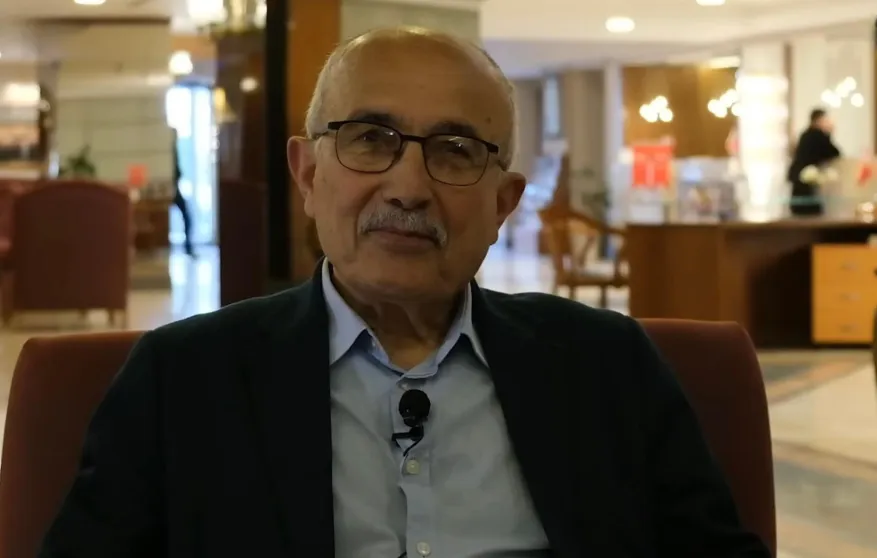
During the 24th IMCWP Working Group meeting held in İstanbul, soL TV -the Youtube channel of the soL News Portal- spoke with Navid Shomali, International Secretary of the TUDEH Party of Iran. We are sharing with ICP readers his responses, in which he assesses the latest developments concerning the recent imperialist aggression against Iran.
Shomali: Iranian people stood firm
I think that it is very important to consider that the current situation is one of the most dangerous and unprecedented periods in the contemporary history of Iran; because we have had now within the space of nine months two wars involving two militarily very powerful countries. United States, that is in fact the strongest military force internationally and also Israel have attacked Iran knowing that Iran would not militarily be able to match their military power.
As a result, the impact on Iranian infrastructure, people’s lives, and, more generally, the country’s economic and social situation has been catastrophic, to say the least.
As you know, these two wars [I am referring to] were attempts at regime change in Iran. These were not just small incursions; all the evidence suggests that Israel, in June 2025, intended to create conditions that would allow a regime change within days—bringing to power a more reactionary government, subservient to the interests of the United States, to power. That attempt failed.
A second attempt, more or less under similar conditions, took place on 28 February 2026, almost two months ago. What must be emphasized is that these developments were extremely alarming. In both instances, the United States was already engaged in formal [diplomatic] negotiations with Iran and had reached what appeared to be potentially acceptable agreements. In June 2025, less than 48 hours before the sixth round of ongoing negotiations—following five weeks of talks that were expected to culminate in a final round—there was a widespread belief that a peace agreement or ceasefire was within reach. However, that did not happen. Israel unilaterally attacked Iran.
In fact, the United States had agreed with Israel in advance. At first, it was claimed that Israel had acted on its own alone. However, after the first two days—when it appeared that the Israeli war efforts might succeed in bringing down the Iranian regime—the United States acknowledged that it had also agreed with the operation in advance. This proved that it had been a pre-planned military attack.
In response, the Iranian people raised their voices, making it clear that they would not accept a regime change directly imposed from outside. At the same time, they did not necessarily express any support for the continuation of the existing order either. As a result, the regime change planned by Israel failed.
Donald Trump quickly decided, on the twelfth day of the war, that the situation should not escalate further. Instead, the United States carried out un-announced bombardments of three Iranian nuclear facilities and then called for a ceasefire. From this attempt, two things became clear. First, this action of the US was not a sign of a genuine desire for peace. Rather, it reflected Israel’s distress. For the first time, it became evident that the “Iron Dome” and the widely promoted defensive shield over Israel—long described as impenetrable—had been breached by Iranian missiles. Israel could see that real damage was reaching Tel Aviv, Haifa, and other areas. As a result, Israel was pressing the United States to take decisive action.
A very similar scenario unfolded eight months later, in late February 2026, in Geneva. The Iranian and American official high-level delegations met and discussed a peace plan and a possible agreement was agreed. Two independent witnesses— Oman’s Foreign Minister Badr Albusaidi, who was mediating between US and Iran, and Jonathan Powell, an advisor to the current government in the United Kingdom—both stated that Iran and the United States had reached an understanding late into Thursday evening- 26th February.
The expectation was that these discussions would continue. The parties had agreed to meet again on Monday, 2 March, to address the technical details of how to implement the agreement. However, on 27 February, Benjamin Netanyahu contacted Trump and informed him that Israeli intelligence had identified the location of a meeting where many key Iranian leaders were present. That they knew where and when the meeting would take place. The implication was that this presented an opportunity to strike and effectively decapitate the Iranian regime, and eliminate both military and political leaderships of the country.
Donald Trump went on the media late evening on 27 February and announced that the United States would begin a war with Iran. Within hours, preparations were under way, and the attack began early in the morning of the 28th. Trump stated that as he had agreed with Israel, at around 7:00 a.m., Israeli jets had begun moving toward Iran, and by 9:00 a.m., the bombardment had started.
The consequences were devastating. Not only was the regime’s supreme religious leader assassinated, but members of his family were also killed, along with a significant number of military advisors and key political figures who played important roles within the Islamic regime. It was believed that the leadership of the regime had been completely decapitated. However, this did not turn out to be the case.
Once again, the Iranian people made it clear that they would not allow a foreign power to impose regime change in the country. This does not mean that the Iranian people—or the opposition—accepted the nature of the current regime or would tolerate its continuation indefinitely. However, as has been stated many times, the people once again clearly said that the future of Iran must be decided by the Iranian people alone, without external interference.
Iran has experienced such external interventions before. In fact, the first regime change of the modern era after World War II occurred in Iran in August 1953. When the democratically elected government—one that was acting in the interests of the Iranian people—was overthrown in a coup d’état, planed and supervised by the CIA and Britain MI6, and a dictatorship lasting 25 years was imposed on Iran.
A similar pattern of events can be seen in the present situation. This time, all available means of power were deployed over a period of 40 days. There is no doubt that the US and Israeli governments intended to do what they set out to do: they wanted to bring the regime down, to carry a regime change. This was a calculated and planned operation; it was not just Israel acting alone.
We now know that on 11 February, the United States hosted Benjamin Netanyahu and a high-level Israeli delegation in Washington. The delegation included the head of Mossad, head of Israel military intelligence, and the leadership of the IDF, among others. They had requested a meeting with Trump and his key milisters, which ultimately lasted nine hours. In fact, the meeting took place in the White House Situation Room—a venue typically reserved for high-level strategic discussions involving the U.S. administration. During this meeting, Netanyahu reportedly outlined a four-stage plan to achieve regime change in Iran.
From that point on—11 February—it appears that Donald Trump was largely convinced that such a plan could succeed. However, the head of the CIA and Marco Rubio were said to have dismissed the proposal, describing it afterwards as unrealistic and exaggerated.
The final stage of the plan involved decapitating the Iranian regime leadership, replacing the existing regime, and installing a new government—reportedly with the intention of installing Reza Pahlavi, the son of deposed Shah, to power.
One could say that on the morning of 28 February they killed at least 50 senior military and government officials and attempted to ensure that no one remained able to govern Iran. The Israeli regime tried to eliminate, one after another, all those who could have been part of any negotiation process. However, this effort ultimately failed.
We would like to emphasize two points. The main issue is that the Iranian people stood firm on their stated belief that the future of Iran must be decided by the Iranian people alone, and by no one else. Secondly, despite the claims made by the Americans and Israelis regarding their overwhelming military capability, they were unable to stop missiles from being launched toward Israel. Israel did suffer casualties and experienced destruction in a number of key towns and cities. There was also growing concern that the situation could significantly paralyse Israel—not only militarily, but also socially and in the public perception.
Israel was not safe for more than a month. All Israeli people, without exception, had to stay in their homes and could not go out. The economy effectively came to a halt, along with most normal activity.
However, it must also be said that the situation in Iran was dreadful, as Iran was heavily bombarded. According to statements from Israel and the United States, tens of thousands of bombing missions took place to the extent that they eventually the US and Israeli air forces ran out of ammunitions and had to replenish their supplies. They then requested a ceasefire.
We understand that the United States wishes to present this outcome as a victory. We know the reasons for that. First, the Iranian people remained firmly committed to the position that they would not accept this type of intervention or installation of government through foreign military intervention. Second, international public opinion has overwhelmingly turned to be supportive of Iran.
It is a shame on the EU countries—except for Spain, I should say—that remained silent about this war that had been condemned by the UN. It is noted that many other countries of the world accepted this as a war which was illegal, outside the framework of the United Nations and international law. It was unlawful, and for that, the United States and Israel must be held accountable for their actions.
If we speak about so-called rogue states that should be bound by international law, there are two countries that have shown they are not acting in accordance with it: the United States and Israel.
The Iranian people want peace. They want sovereignty, human and democratic rights, and social justice—and they will achieve these. We want to ensure that international solidarity with the people of Iran remains strong. In this conversation, we also should emphasise that we are deeply concerned about the future of the Middle East.
We want to ensure that, through multilateral discussions and decisions involving all parties, a solution can be reached—a way forward that would prevent the United States and Israel from acting in this manner in violation of international law and the UN Charter. We also believe they should be held responsible for the damage they have inflicted on Iran.
In Iran, many industries have been destroyed, including major industrial infrastructure. Universities have also been affected, with 31 universities reportedly damaged. Cultural heritage sites have been harmed, and several important industries have been severely impacted. As a result, millions of workers may now face unemployment.
We need solidarity. We need international support from comrades and peace advocates to stand with us, to ensure that Iran can be rebuilt—not as a backward or undemocratic state, but as a government elected and controlled by its people, working toward a peaceful future in Iran and the Middle East.
Navid Shomali