
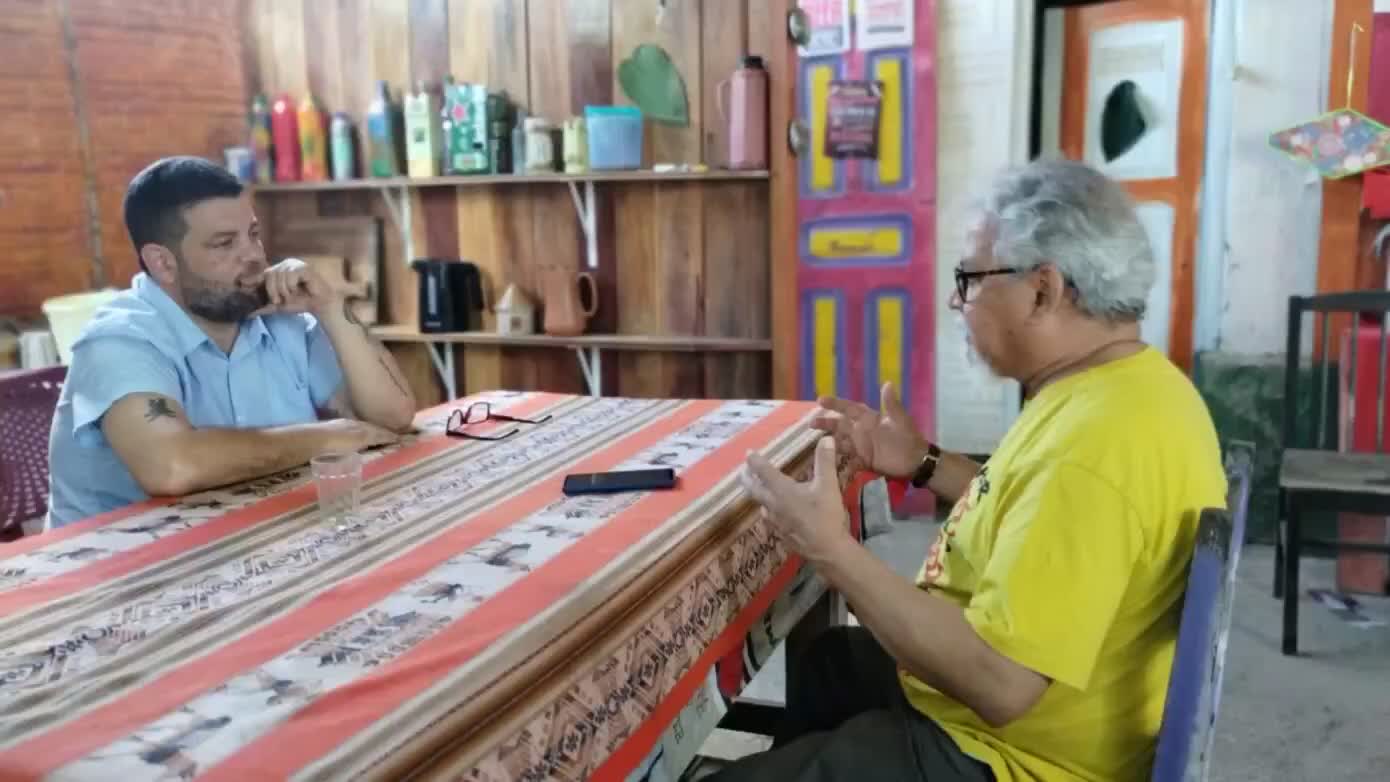
The candidate for President of the Republic for the Brazilian Communist Party (PCB), Edmilson Costa, gave an interview to the news portal AC em Pauta during a visit to Rio Branco.
Brazilian Communist Party candidate for presidency gives interview
During the conversation, the presidential candidate addressed national issues and presented proposals that he intends to defend if elected. Among the subjects, he spoke about the intention to nationalize all universities in the country.
When asked about the difference between the PCdoB (Communist Party of Brazil) and the PCB (Brazilian Communist Party), Edmilson Costa pointed out that PCdoB is proposing something that they had in the 1950s, which was alliances with sectors of the bourgeoisie, with a national development project. Costa explains that they believe that Brazil is already a mature capitalist country and that there is a main contradiction between capital and labour.
"When there is a main contradiction between capital and labour, the transformation strategy is socialist. So, we have this major strategic divergence. And there are also tactical divergences. Just look at who they support and who we support."
Costa announced that PCB generally supports some PSOL candidates; however, they have very little support outside that political spectrum.
When asked about how is the pre-candidacy for president going, Costa responds that their candidacy aims to raise a set of issues that other candidates don't want to raise or can't raise because of their political alliances. He points out that the struggle of PCB is against imperialism and in solidarity with Cuba, Iran, the Palestinians, and all peoples who fight against the imperial system.
"Brazilian workers continue to live with low wages, public services are dilapidated, our youth continue without prospects, and millionaires, bankers, and agribusiness owners make rivers of money at the expense of the workers. We have to put an end to this situation."
Costa explains that their plan starts with transformations in the institutional and political areas; in the economy; in health and education; in the social and labour areas; and in the international area. These are five major transformations that PCB campaign summarized to present during the election period.
When asked about, how would a communist president maintain governability, and what would the relationship with Congress be like; Costa answers that he doesn't see any problem in maintaining governability because, if they win the election, it will be maintained through popular mobilization.
"Just winning the elections already changes the balance of power. If a communist manages to win the elections, it's because the balance of power has changed in people's understanding. With this change in the balance of power, you would govern with the people. Congress, whether it likes it or not, will have to be very sensitive to what the people are thinking."
Edmilson Costa adds that their campaign is complex and challenging. They face a very unequal situation because the established candidates have economic and political power,
"Congress, governors, mayors, and city councillors. We only have our program and our activists, which are not large. But we believe it is fundamental, in an electoral process, to have an alternative so that people see that it's not just more of the same. Our candidacy presents itself as an alternative to everything that is there. We want to change the political system; we want to abolish Congress and the Senate. In place of the Senate, we want a unicameral Parliament. We believe that the Federal Senate is an outdated and conservative institution. We will implement a unicameral Parliament."
Costa explains the would-be parliamentary elections as fifty percent through universal suffrage and the other 50% through labour, youth, and popular movements.
"In the current elections, with the rules of the game we have today, social majorities are transformed into political minorities after the elections."
Edmilson Costa shares that PCB'S campaign proposes the nationalization and state control of the financial system.
"Because the Brazilian financial system is typically speculative, it lives off high-interest rates and bank spreads and doesn't even have a connection with the industrial system, as is the case in developed countries. Therefore, we will transform this financial system into a public system, that is, to effectively serve the interests of the population. With interest rates similar to those paid in the rest of the world, and not this aberration that exists here in Brazil."
The party's proposal for agrarian reform on all unproductive large estates, on lands where there is slave labour, and on properties that do not fulfil their social function is shared. In these places, PCB plans to establish workers' cooperatives.
Costa states that they are going to end the commodification of healthcare. They will nationalize the entire Brazilian healthcare system.
On the subject of education, Costa promises quality education at all levels.
"We will nationalize all private universities, which today function more as diploma mills than as providers of high-quality education."
When asked about PCB's positions if it turns to a run-off election between President Lula and Flávio Bolsonaro; Costa responds that this has not been discussed yet; and they will only do that after the first round.
"I can say in advance that we will always be against the return of the far right to our country."